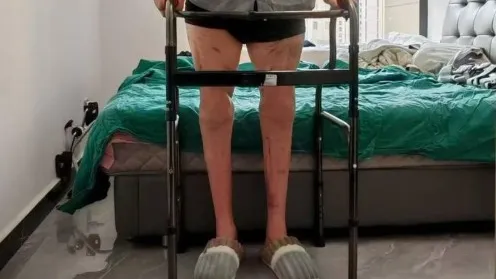
A 51-year-old man in China can walk indoors with a frame nearly 20 months after both of his thighs were completely severed in an industrial accident – following what doctors describe as the world’s first successful double-thigh replantation.
The rare procedure was performed at Suzhou Ruihua Orthopaedic Hospital in Jiangsu province after the man, identified by local reports only by his surname, Jiang, suffered the devastating injury on December 2, 2024. A multidisciplinary team of more than 20 medical professionals worked for nearly eight hours to reconnect the severed limbs.
The case is significant not simply because the legs were reattached. The patient has since regained enough movement and sensation to stand and walk with assistance, while managing most daily activities independently. His recovery, however, is still ongoing, and doctors have not predicted when — or whether — he will be able to walk without support.
What is double-thigh replantation?
Double-thigh replantation refers to surgically reattaching both thighs after complete amputation at the thigh level.
Limb replantation is already among the most technically demanding areas of trauma surgery. Surgeons must restore the physical structure of a severed limb while also re-establishing its blood supply and, where possible, its nerve and muscle function.
In this case, the challenge was multiplied because both thighs had been completely severed.
Doctors had to reconstruct and reconnect multiple types of tissue, including:
- Bones and major bone fragments
- Arteries and veins
- Major nerves
- Muscles and other soft tissues
- Skin and surrounding tissue
The procedure relied heavily on microsurgical techniques, which allow surgeons to work with small blood vessels and nerves under magnification.
China has a long history in this field. A 2026 review of the development of microsurgery in China traces the country’s modern limb-replantation work to the landmark 1963 replantation of a completely severed forearm performed by Chen Zhongwei and colleagues in Shanghai.
How was the double-thigh replantation performed?
The operation began after the patient arrived at Suzhou Ruihua Orthopaedic Hospital following the factory accident.
More than 20 medical professionals from different specialities were involved in the emergency operation. The surgical team worked for almost eight hours to restore continuity between the patient’s body and the two completely severed thighs.
The operation was only the beginning.
For a replanted limb to remain viable, surgeons must restore adequate circulation. Reconnecting the arteries allows oxygenated blood to reach the tissue, while reconnecting veins provides a route for blood to leave the limb.
But blood flow alone does not restore normal function.
The surgeons also had to stabilize the bones and repair damaged nerves and muscles. Even when the limb survives, those structures can take months or years to recover — and some damage may be permanent.
That makes this case particularly notable: the patient did not merely retain viable legs after surgery. He eventually recovered enough motor function to move them, stand and walk with assistance.
Why is this case considered unusual?
Single-limb replantation, including replantation of a severed thigh, has been reported before. What makes this case different is the simultaneous complete amputation of both thighs, followed by successful reattachment and meaningful recovery of walking ability.
According to the treating hospital, the case was evaluated as the world’s first reported successful replantation involving complete bilateral thigh amputation. A local report citing the Jiangsu Provincial Institute of Medical Information described it as the “world’s first” case of complete bilateral thigh replantation.
That distinction matters.
A medical “first” does not necessarily mean that a particular surgical technique has never been attempted anywhere. It can refer to a specific combination of circumstances — in this instance, complete bilateral thigh amputation, successful replantation of both limbs and subsequent restoration of ambulation.
The hospital has emphasized that its surgeons already had experience with single-limb replantation, fracture fixation, vascular anastomosis and nerve repair. Those skills became critical when treating the far more complex bilateral injury.
What happened during the patient’s long recovery?
The patient’s recovery was far more complicated than simply waiting for the reattached limbs to heal.
Three months after surgery, he was reportedly able to lift and move his legs while lying in bed. Sensation had returned into the lower limbs as far as the middle of the calves, and his external fixation devices had been removed. He was discharged on March 5, 2025, to continue rehabilitation.
The recovery also involved serious complications.
Skin damage required additional surgery
The patient developed localized skin necrosis after the initial operation. Doctors subsequently performed flap reconstruction to repair the affected tissue.
Skin and soft-tissue complications are an important concern after severe crush injuries because tissue that initially appears viable can deteriorate as the injury evolves.
Flap surgery can provide healthy, well-vascularized tissue to cover exposed or damaged areas. Surgeons at Suzhou Ruihua have published research on complex lower-limb wound reconstruction using anterolateral thigh perforator flaps, demonstrating the hospital’s established experience with microsurgical tissue reconstruction.
The patient also developed femoral nonunion
The recovery later faced another major obstacle: severe open comminuted fractures resulted in femoral nonunion, meaning the broken bone failed to heal properly.
Doctors performed bone grafting and reinforced the internal fixation of both femurs.
This illustrates why successful limb replantation is measured over months and years rather than by whether a limb survives the first operation.
A reattached limb must ultimately become structurally stable enough to bear weight and functionally capable of controlled movement.
When did he start walking again?
Nearly 20 months after the accident, the patient has reached a significant rehabilitation milestone.
He can now stand and walk indoors with the assistance of a walker. He can also perform most routine daily activities independently. Sensation has reportedly returned to the area above his ankles, and the two legs are approximately equal in length.
That does not mean his recovery is complete.
Doctors have said they cannot yet determine when he will be able to abandon the walker completely. His future progress depends on factors including muscle strength, nerve recovery and the continued healing of the femoral fractures.
The distinction is important: the patient can walk with assistance, not independently without a walking aid.
That is still a remarkable functional outcome after an injury that initially resulted in complete bilateral thigh amputation.
Why does this surgery matter beyond one patient?
The case highlights how modern trauma surgery increasingly combines multiple specialties rather than relying on a single operation or surgical discipline.
A successful replantation of this complexity requires coordination across areas such as:
- Orthopedic trauma surgery for bone reconstruction and fixation
- Microsurgery for blood-vessel repair
- Peripheral nerve repair
- Soft-tissue and flap reconstruction
- Intensive postoperative monitoring
- Long-term physical rehabilitation
It also demonstrates that the definition of surgical success can change over time.
Immediately after the operation, success meant keeping the replanted limbs alive. Months later, the goal became restoring movement and sensation. Eventually, rehabilitation shifted toward weight-bearing, standing and walking.
The patient’s current progress therefore represents not one medical breakthrough, but the cumulative result of emergency surgery, reconstruction, complication management and prolonged rehabilitation.
What happens next for the patient?
For now, rehabilitation continues.
Doctors are cautiously optimistic that his walking ability may improve further, but they have not offered a specific timeline for independent walking. His recovery will depend on how much strength returns, how nerve function develops and whether the repaired femurs continue to heal properly.
That caution is appropriate. Nerve regeneration is slow, and complex crush injuries can affect tissues at multiple levels. Even when a replanted limb survives, functional recovery can remain uncertain.
The patient’s progress nevertheless represents a striking outcome: after losing both thighs in a factory accident, he has progressed from being unable to move his lower limbs to walking indoors with a frame and managing much of his daily life independently.
For microsurgical trauma care, the case offers another demonstration of what may be possible when advanced reconstruction is paired with sustained rehabilitation.
TL;DR
A 51-year-old Chinese factory worker whose both thighs were completely severed in an industrial accident has regained the ability to walk with assistance after a rare bilateral thigh replantation.
A team of more than 20 specialists at Suzhou Ruihua Orthopaedic Hospital spent nearly eight hours reconnecting the bones, blood vessels, nerves, muscles and other tissues. The patient later faced skin necrosis and femoral nonunion, requiring additional reconstructive procedures.
Nearly 20 months after the accident, he can walk indoors with a walker and handle most daily activities independently. Doctors say it is too early to know whether he will eventually walk without assistance.