
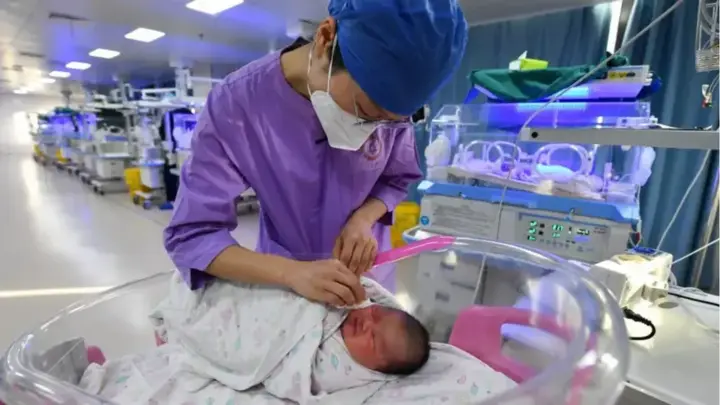
China is preparing one of its most sweeping pro-natalist policy shifts in decades. Beginning next year, the government will cover all out-of-pocket medical expenses related to childbirth, as Beijing intensifies efforts to slow, and eventually reverse, the country’s sharp population decline.
The announcement, made by China’s National Healthcare Security Administration, comes as the world’s second-largest economy confronts falling birth rates, a shrinking workforce, and a rapidly aging population. The question now is whether making childbirth effectively free will be enough to persuade young couples to start families.
What exactly is China promising?
Under the new plan, China aims to eliminate direct medical costs associated with childbirth in stages.
Full reimbursement by 2026
According to the healthcare administration, by 2026, China will work toward nationwide full reimbursement for all policy-covered childbirth-related medical expenses. These include:
- Prenatal checkups
- Delivery costs
- Other medically necessary services tied to childbirth
The goal, the administration said, is to achieve “no out-of-pocket expenses” for childbirth, significantly reducing the financial burden on families at the earliest stage of parenthood.
Starting next year, expanded coverage will roll out more broadly, building on pilot programs already underway in several provinces.
Why is Beijing making childbirth free now?
China’s demographic problem is no longer theoretical; it’s already reshaping the economy.
A population in decline
China’s population fell for the first time in decades in 2022 and continued to decline through 2024. Demographers widely expect the trend to persist for years, driven by:
- Persistently low birth rates
- Fewer marriages among young adults
- Delayed family formation
This marks a dramatic reversal for a country long associated with population growth.
Economic pressure is mounting
A shrinking working-age population means fewer taxpayers supporting:
- A rapidly growing elderly population
- Pension systems are already under strain
- Local governments burdened by debt
In short, fewer babies today translate into fewer workers tomorrow and higher fiscal stress down the line.
How did China get here?
China’s falling birth rate is the result of long-term structural changes, not a single policy failure.
The legacy of the one-child policy
From 1980 to 2015, China enforced the one-child policy to curb population growth. While it succeeded in reducing births, it also reshaped social norms around family size, effects that have proven difficult to reverse.
Even after the policy ended, birth rates continued to slide.
Modern pressures on young families
Today’s young Chinese adults face challenges that go well beyond hospital bills:
- High housing costs in major cities
- Expensive childcare and education
- Job insecurity amid a slowing economy
- Longer working hours and limited work-life balance
For many couples, the cost of raising a child, not just giving birth, remains the biggest deterrent.
Have similar policies worked before?
China is not starting from scratch.
Provincial experiments are already underway
Several provinces, including Jilin, Jiangsu, and Shandong, have already introduced policies making childbirth nearly free of charge. These local initiatives appear to have informed the national rollout.
However, early data suggest that while such measures reduce financial stress, they do not automatically lead to baby booms.
Lessons from abroad
Other countries facing demographic decline, such as Japan, South Korea, and parts of Europe, have tried similar strategies, including:
- Cash incentives for newborns
- Free or subsidized medical care
- Extended parental leave
The results have been mixed. Financial incentives help, but they rarely overcome broader lifestyle and economic concerns on their own.
Is free childbirth enough to raise birth rates?
This is the central question policymakers now face.
What the policy does well
Covering childbirth costs addresses a clear and immediate barrier:
- It reduces upfront expenses for families
- It signals strong state support for parenthood
- It may particularly help lower-income households
What it doesn’t solve
Critics note that childbirth is only the beginning. Families still worry about:
- Years of childcare costs
- Education expenses
- Career penalties, especially for women
- Housing affordability
Without parallel reforms in these areas, demographers warn that free childbirth alone may have a limited impact.
What other steps is China taking?
Beijing appears to recognize that childbirth reimbursement is just one piece of a larger puzzle.
Broader family-support policies
In March, Chinese authorities said they would “actively” respond to demographic challenges by introducing measures such as:
- Childcare subsidies
- Expanded childcare services
- Making preschool education free
Previous efforts have also included:
- Longer maternity leave
- Tax benefits for families
- Housing subsidies for parents
Together, these policies reflect a shift from population control to population encouragement, a major ideological turn for the Chinese state.
Why this matters globally
China’s demographic shift has implications far beyond its borders.
- A smaller workforce could slow global supply chains
- Aging demographics may reduce China’s long-term growth
- Fiscal strain could reshape government spending priorities
For countries watching their own birth rates fall, China’s experiment with free childbirth will be closely studied, not just for whether it works, but for what it reveals about the limits of state intervention in family life.
TL;DR
- China will cover all out-of-pocket medical expenses related to childbirth starting next year.
- By 2026, the government aims for full nationwide reimbursement of policy-covered childbirth costs.
- The move targets China’s falling birth rate and aging population.
- While it reduces financial barriers, experts say broader economic and social reforms are still needed to significantly boost births.