
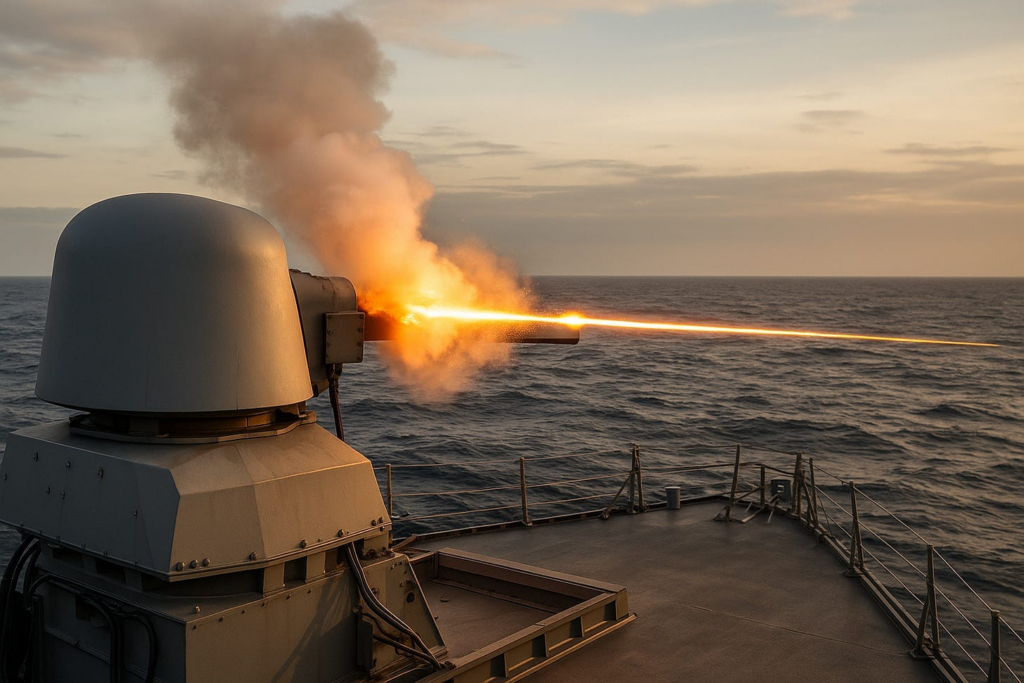
China is reportedly developing a new type of weapon that sounds almost paradoxical: A hypersonic missile small enough to be fired from an ordinary anti-aircraft gun. If confirmed in real-world deployment, the system could compress advanced missile technology into something closer to artillery ammunition, dramatically changing air defense economics and battlefield survivability.
The idea is simple but disruptive. Instead of launching a large, expensive interceptor from a specialized battery, a standard gun could fire a compact glide missile traveling at hypersonic speed.
What are China’s mini hypersonic missiles?
The reported weapon is an ultra-small hypersonic glide missile designed to be launched from an 80 mm anti-aircraft gun. After launch, it accelerates to about Mach 6, roughly six times the speed of sound.
Key reported characteristics
- launch platform: conventional anti-aircraft gun
- speed: up to Mach 6
- engagement range: over 20 km
- altitude capability: about 32,800 feet
- targets: fighter aircraft and drones
Unlike traditional shells that follow a ballistic arc, the projectile transitions into a guided glide phase. In effect, each round becomes a miniature smart missile.
Why speed makes them dangerous
Hypersonic weapons compress time. In air combat, time equals survival. At long range, pilots rely on early warning sensors and defensive maneuvers. But at extreme speed, detection happens too late to matter.
The response-time problem
Reports suggest an aircraft might only detect the incoming projectile about 3 km away.
At that distance:
- the missile is still traveling above Mach 3
- the pilot has only seconds to react
- countermeasures struggle to deploy effectively
This shifts air defense from a duel into an ambush. Traditional intercept logic assumes a reaction window. Hypersonic micro-interceptors shrink that window to almost zero.
How can such a small missile still hit accurately?
Speed alone is not enough. The lethality comes from maneuverability at high velocity.
Claimed targeting capability
Computer simulations indicate the projectile can adjust course even if the target performs a near-90-degree turn. That suggests advanced guidance and control surfaces capable of operating in extreme heat and pressure. The reported outcome is a 99% kill probability in modeled engagements. This is notable because high-speed projectiles usually sacrifice agility. A mini glide missile attempts to keep both.
Why launching from a gun changes warfare economics
Modern air defense is expensive. A surface-to-air missile can cost hundreds of thousands or even millions of dollars per shot.
Drones, meanwhile, are getting cheaper every year.
The cost imbalance problem
Today’s battlefield faces a mismatch:
| Weapon | Approx cost | Purpose |
|---|---|---|
| interceptor missile | very high | shoot down aircraft |
| drone | low | overwhelm defenses |
If a gun can fire guided hypersonic rounds once per second, it flips the equation. Air defense becomes ammunition-based instead of missile-based.
Potential advantages
- lower cost per interception
- higher firing rate
- simpler logistics
- larger ammunition reserves
This matters most against drone swarms, where traditional missile systems run out of interceptors quickly.
Why are drones and fighter jets both affected
The system sits between short-range guns and medium-range missiles.
Against drones
Small drones rely on numbers and maneuverability. A near-instant interception weapon reduces the swarm advantage.
Against fighter aircraft
Pilots depend on detection distance and maneuvering margin. Hypersonic engagement compresses both, making evasive action less reliable.
In practical terms, the weapon blurs categories. It acts like artillery at the cost level, but like a missile at the performance level.
Could this really change air combat doctrine?
Possibly, because doctrine depends heavily on survivability zones.
Today’s model
Aircraft avoid entering defended airspace because missiles can reach them.
Emerging model
Aircraft may avoid even approaching defended airspace because reaction time disappears.
This pushes air warfare toward stand-off weapons and autonomous systems even faster than current trends.
What technological hurdles remain?
Miniaturizing hypersonic systems is extremely difficult.
Key engineering challenges include:
- heat resistance at Mach 6
- guidance electronics surviving shock loads
- precision control surfaces at extreme velocity
- stable communication and targeting updates
A projectile small enough to fire from a gun must endure forces far greater than a conventional missile launch. That means the concept is significant even if early versions have limitations.
TL;DR
China is reportedly developing mini hypersonic glide missiles that can be fired from an anti-aircraft gun. Traveling up to Mach 6 and maneuvering in flight, they drastically reduce pilot reaction time and could offer low-cost, high-volume air defense. If operational, they may reshape aerial warfare by replacing expensive interceptor missiles with rapid-fire guided ammunition.