
What’s behind the viral SIM card gold videos?
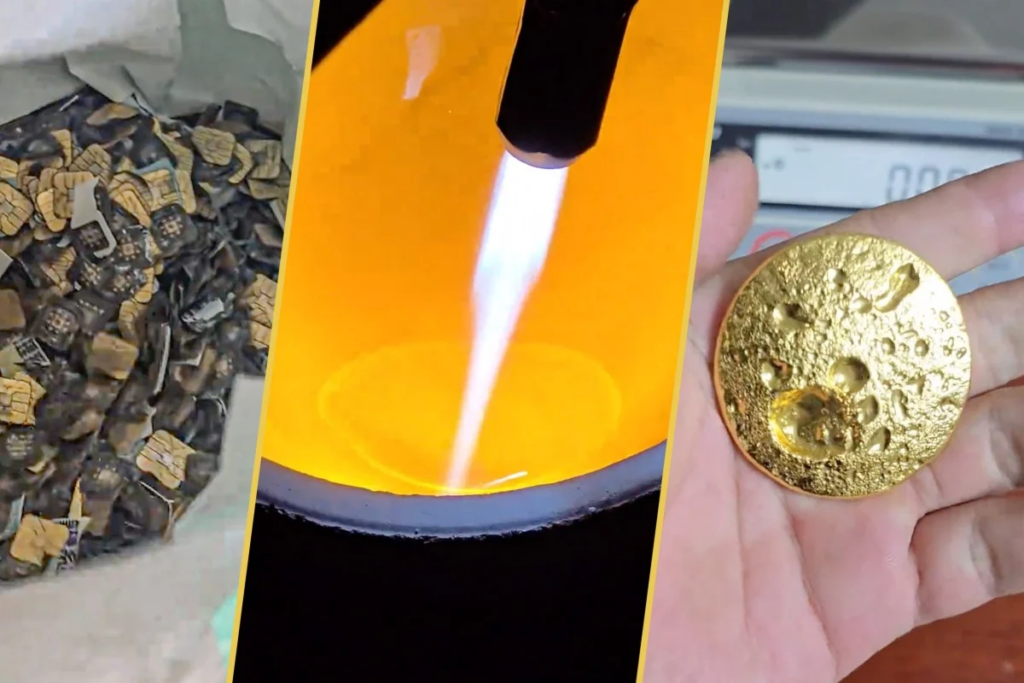
A man in China has gone viral after posting videos showing how he extracts gold from discarded SIM cards, turning electronic waste into precious metal—and igniting a rush among viewers who think they can do the same.
The man, known online as Qiao, has shared footage documenting how he refined 191 grams of gold from scrap materials, a haul worth nearly 200,000 yuan (about $29,000). One of his videos alone has drawn more than five million views, according to Chinese media and the South China Morning Post (SCMP).
The clips show barrels of SIM cards submerged in chemicals, followed by a series of controlled reactions, corrosion, displacement, and heating, ending with a small but striking pile of refined gold.
Who is Qiao, and what does he actually do?
Qiao, who lives in Huizhou, Guangdong province, is not a hobbyist experimenting in his backyard. He specializes in refining precious metals from industrial electronic scrap, a process that requires advanced chemical knowledge and professional handling.
He told the Xiaoxiang Morning Post that SIM cards were only a small part of the material used. In total, he processed nearly two tonnes of scrap, much of it chip waste from the telecommunications electronics industry.
That distinction matters, especially as social media users rush to replicate what they’ve seen online.
How much gold is really in a SIM card?
Despite the viral excitement, the reality is far less glamorous.
According to Qiao and industry data:
- A single SIM card contains less than 0.001 grams of gold
- The gold appears only as a thin plating, used to improve conductivity and resist corrosion
- Similar trace amounts are found in bank card chips and device contact components
In other words, extracting a meaningful amount of gold requires enormous volumes of electronic waste, sophisticated equipment, and controlled conditions.
Why are people suddenly buying SIM cards
The videos have triggered a buying frenzy across mainland Chinese secondhand platforms.
Sellers are marketing bundles of used SIM cards with claims tthat hey can be used for “alchemy.” Some are even offering gold-refining tools and instructional videos for around 485 yuan ($70), capitalizing on the viral trend.
Online commenters have expressed awe at Qiao’s skill, dubbing him the “Alchemist.” One user summed up the sentiment bluntly: “Alchemy has a high chemical threshold.”
The serious dangers behind the process
What many viewers miss is the extreme safety risk involved.
According to Chinese media outlet Xinwenfang, personal gold extraction often involves soaking materials in aqua regia—a highly corrosive mixture of concentrated nitric and hydrochloric acid capable of dissolving gold.
The risks include:
- Release of toxic fumes
- Severe chemical burns
- Violent reactions if handled incorrectly
- Environmental contamination
Qiao himself has warned people not to imitate his work, stressing that he is demonstrating professional skills—not encouraging copycats.
“Emulating the process wrongly can release toxic gases or trigger strong corrosive reactions,” he cautioned.
Why does the trend reflect a bigger issue
The fascination with extracting gold from SIM cards taps into a broader reality: electronic waste contains valuable materials, but recovering them safely and economically is far more complex than social media suggests.
Globally, e-waste recycling is typically handled by:
- Licensed facilities
- Trained chemical engineers
- Regulated industrial processes
When amateurs attempt similar methods, the risks often outweigh any financial gain.
Social media versus science
Qiao’s videos sit at the uneasy intersection of technical expertise and viral culture. What looks like digital-age alchemy is, in practice, applied industrial chemistry.
Experts warn that stripping away the context—training, scale, and safety protocols—creates a dangerous illusion that anyone can turn junk into gold with a few chemicals and a barrel.
In reality, the economics rarely work without scale, and the health risks can be severe.
What to take away from the viral moment
Qiao’s work highlights both the hidden value in electronic waste and the dangers of oversimplifying complex processes online.
His message, often lost in the hype, is straightforward: this is not a DIY project.
TL;DR
- A Chinese metal refiner named Qiao went viral for extracting gold from SIM cards
- He refined 191g of gold, but only by processing nearly two tonnes of scrap
- Each SIM card contains less than 0.001g of gold
- The process involves dangerous chemicals like aqua regia
- Qiao has warned the public not to attempt gold extraction themselves