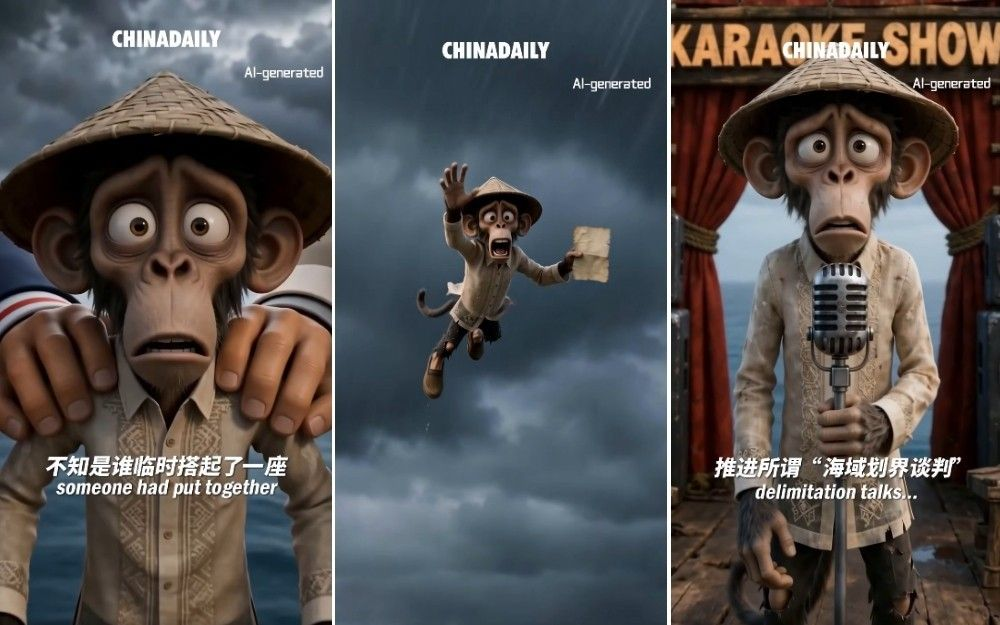
The Philippines has sharply criticized an AI-generated video published by China’s state-run newspaper China Daily, calling it “dehumanising and racist” and demanding that it be removed.
The video, which depicts a monkey wearing clothing associated with the Philippines being manipulated by figures representing the United States and Japan, has intensified an already strained relationship between Manila and Beijing. Philippine officials say the imagery crosses the line from political messaging into racial stereotyping and undermines diplomatic dialogue.
The dispute comes as tensions continue to simmer in the South China Sea, where the two countries have repeatedly clashed over competing territorial claims.
What Does the AI Video Show?
The AI-generated video, shared by China Daily, portrays a monkey wearing a shirt associated with the Philippines being forced onto a karaoke stage aboard a boat by arms carrying U.S. and Japanese flags.
During the video, the character is criticized for singing the wrong song before displaying a document labelled “South China Sea arbitration award.” The character is then thrown into the sea and struck by a high-pressure water cannon.
The imagery appears to reference ongoing disputes over the South China Sea and the role of the United States and Japan in supporting the Philippines.
The video has circulated widely online, drawing criticism from Philippine officials.
Why Did the Philippines Object?
The Philippine Department of Foreign Affairs described the video as inappropriate and harmful.
In a statement, the ministry said disagreements over legal and political issues should not be expressed through imagery that dehumanizes another nation.
According to the department, such content has no place in responsible public discourse and only deepens mistrust between the two countries.
Philippine officials also argued that misinformation and inflammatory content make diplomatic engagement more difficult at a time when tensions are already high.
Philippine Defense Ministry Calls It ‘Propaganda’
The criticism extended beyond the foreign ministry.
Philippine Defense Secretary Gilberto Teodoro described the video as “contemptible propaganda,” saying it reflected poorly on China’s information campaign.
His office argued that the video did not contribute to constructive dialogue and instead inflamed existing political tensions.
China had not publicly responded to the Philippine government’s demand for the video’s removal at the time of publication.
Why Are China and the Philippines Clashing?
The controversy comes against the backdrop of longstanding territorial disputes in the South China Sea.
China and the Philippines both claim parts of strategically important waters that include the following:
- Scarborough Shoal
- Portions of the Spratly Islands
- Other contested maritime features
In recent years, confrontations between vessels from both countries have become increasingly frequent.
The Philippines has accused the Chinese Coast Guard of using high-pressure water cannons against Philippine vessels operating in disputed waters. China, meanwhile, has accused the Philippines of provoking confrontations by entering areas Beijing claims as its own.
These incidents have become a recurring source of diplomatic friction.
Suggested visual: A map showing the disputed areas of the South China Sea, including Scarborough Shoal and the Spratly Islands.
What Is the South China Sea Arbitration Award?
One of the references in the AI video is the “South China Sea arbitration award.”
The document refers to the landmark 2016 ruling by the Permanent Court of Arbitration in The Hague.
The tribunal concluded that China’s expansive “nine-dash line” claims had no legal basis under the United Nations Convention on the Law of the Sea (UNCLOS).
The ruling largely favored the Philippines.
China rejected the decision, arguing that the tribunal lacked jurisdiction and has continued to maintain its maritime claims.
The differing positions remain one of the central issues in the dispute.
How Have Relations Changed Recently?
Relations between Beijing and Manila have deteriorated over the past several years as maritime encounters have increased.
Recent developments have included:
- Repeated confrontations between coast guard vessels.
- Diplomatic protests from both governments.
- The reported use of water cannons during maritime incidents.
- Chinese travel restrictions targeting Philippine Defense Secretary Gilberto Teodoro and members of his immediate family.
- Continued disagreements over access to contested waters.
Although diplomatic channels remain open, mutual trust has become increasingly strained.
Why AI-Generated Political Content Is Becoming More Controversial
The incident also highlights a broader issue: the growing use of artificial intelligence in political messaging.
AI-generated videos can be created quickly and shared widely across social media platforms, making them powerful tools for communication—and, critics argue, for propaganda.
Governments, researchers, and technology companies are increasingly debating how AI-generated political content should be labeled, regulated, and moderated, particularly when it involves sensitive international disputes.
Supporters of stronger oversight argue that AI can amplify misinformation or inflammatory narratives, while others caution against restricting political expression.
The Bottom Line
The Philippines’ condemnation of China Daily’s AI-generated monkey video has added another flashpoint to an already tense relationship between Manila and Beijing. Philippine officials argue the imagery was racist and dehumanizing, while also accusing it of fueling misinformation and damaging diplomatic relations.
The controversy reflects not only the continuing dispute over the South China Sea but also the growing role of AI-generated media in international politics. As governments increasingly use digital platforms to shape public narratives, questions about responsible communication and the limits of political messaging are likely to become even more significant.
TL;DR
- The Philippines has condemned an AI-generated video published by China Daily as “dehumanising and racist.”
- The video depicts a monkey representing the Philippines being pushed by figures symbolizing the United States and Japan.
- Manila has demanded that the video be removed.
- Philippine officials say the content amounts to propaganda that damages bilateral relations.
- The controversy comes amid continuing disputes between China and the Philippines in the South China Sea.