
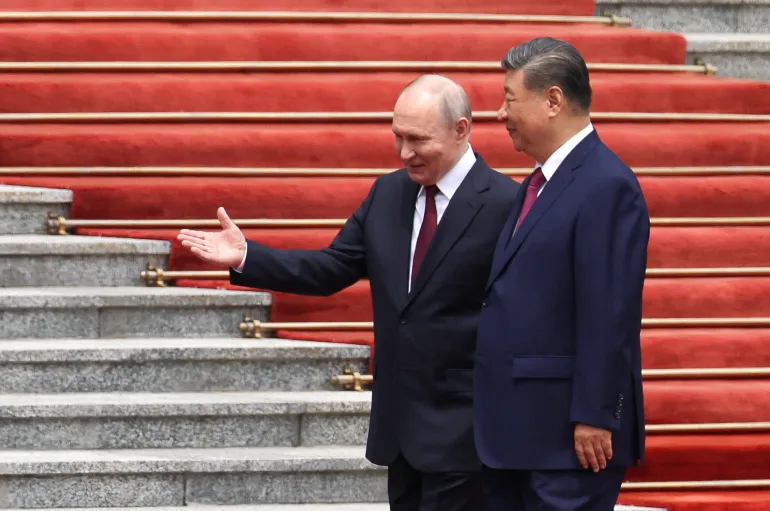
Vladimir Putin and Xi Jinping have signed a sweeping joint declaration calling for the construction of a “multipolar world,” underscoring how Moscow and Beijing are increasingly positioning themselves as a counterweight to Western influence.
The signing ceremony took place at Great Hall of the People, where the two leaders finalized around 20 agreements covering trade, technology, strategic cooperation, and diplomatic coordination. Another 20 documents are expected to follow separately, according to Russian state media.
“We’ll expand our bilateral cooperation and actively engage in international forums where our teams are working closely together to build a strong foundation for a multipolar world,” Putin said during the summit.
The language matters. “Multipolar world” has become a central geopolitical phrase used by China and Russia to describe a global order less dominated by the United States and its allies.
What Does a “Multipolar World” Mean?
The concept of a multipolar world refers to an international system where power is distributed among several major countries rather than concentrated in a single dominant superpower.
For Beijing and Moscow, that vision includes:
- Expanding alternative economic blocs
- Reducing dependence on Western financial systems
- Increasing coordination in global institutions
- Challenging US-led political and security influence
The phrase has appeared repeatedly in China-Russia diplomacy since the war in Ukraine intensified global divisions.
Why China and Russia are emphasizing it now
The summit comes at a moment of growing geopolitical fragmentation:
- US-China tensions remain high over trade, technology, and Taiwan
- Russia continues facing Western sanctions tied to the Ukraine war
- Global supply chains are increasingly politicised
- Middle powers are trying to avoid choosing sides
Against that backdrop, both Putin and Xi are presenting their partnership as a stabilizing alternative to what they describe as Western-led unilateralism.
Xi warned during the meeting against “unilateral and hegemonic countercurrents running rampant,” an apparent criticism of Washington’s global leadership strategy.
Xi Jinping Calls China-Russia Ties ‘Unyielding’
The meeting also marked the 30th anniversary of the China-Russia strategic partnership, giving both leaders an opportunity to frame their relationship as historically durable and politically resilient.
Xi described the partnership as having:
“Continuously deepened and reached the highest level in the new era.”
He added that the relationship represents:
“A new type of major-country relationship.”
The messaging is aimed beyond domestic audiences
Much of the summit’s rhetoric appears designed for international observers — especially medium-sized countries navigating growing competition between major powers.
China and Russia increasingly portray their relationship as:
- Resistant to Western pressure
- Economically pragmatic
- Politically sovereign
- Focused on non-Western partnerships
That narrative may resonate with countries seeking greater flexibility in a fragmented geopolitical environment.
Russia and China Extended a Key Cooperation Treaty
During the summit, the two countries extended the Treaty of Good-Neighborliness and Friendly Cooperation Between China and Russia, originally signed in 2001.
The treaty has long served as the political foundation of modern China-Russia relations.
The extension reinforces continued cooperation in:
- Trade
- Energy
- Security coordination
- Diplomatic alignment
- Technology partnerships
The leaders also signed a separate joint statement focused on strengthening “comprehensive partnership and strategic cooperation.”
Why the Power of Siberia 2 Pipeline Still Matters
Despite the broad agreements announced during the visit, one major project remained unresolved: Power of Siberia 2.
The proposed pipeline would transport around 50 billion cubic meters of Russian natural gas annually from the Yamal Peninsula through Mongolia into northern China.
No timeline suggests ongoing negotiation challenges
While both sides continue discussing the project, no concrete implementation timeline was announced.
That hesitation is significant.
After losing much of its European gas market following the Ukraine invasion, Russia has increasingly looked toward China as a long-term energy customer.
But Beijing appears cautious about overcommitting.
China benefits strategically from:
- Access to discounted Russian energy
- Diversified supply options
- Strong negotiating leverage
At the same time, it likely wants to avoid becoming overly dependent on Russian energy imports.
The absence of a finalised timeline suggests negotiations over pricing, infrastructure costs, and geopolitical leverage are still ongoing.
Putin’s Visit Comes After Trump’s Beijing Trip
The summit also unfolded just one week after Donald Trump concluded a three-day visit to Beijing.
Trump had hinted at major economic agreements before the trip, but no major breakthroughs were ultimately announced.
That timing gave Putin’s visit added geopolitical symbolism.
China is signaling it can engage both Washington and Moscow
Chinese state media highlighted both visits as evidence of Beijing’s growing importance in a divided global order.
But analysts believe China is carefully balancing its relationships rather than choosing exclusive alignment with either power.
That balancing act became especially visible when China announced plans to purchase 200 Boeing aircraft during Putin’s visit — a deal previously reported during Trump’s trip but not formally confirmed at the time.
The announcement served multiple purposes:
- Supporting China-US economic ties
- Demonstrating diplomatic flexibility
- Avoiding excessive dependence on Russia
- Maintaining leverage with both countries
How the Ukraine War Changed China-Russia Relations
Since Russia launched its invasion of Ukraine in 2022, China-Russia ties have deepened considerably.
Western sanctions pushed Moscow closer toward Beijing economically and diplomatically.
That shift accelerated cooperation across:
- Energy trade
- Financial systems
- Technology
- Defense coordination
- Political messaging
China still maintains strategic ambiguity
While China has frequently called for negotiations to end the Ukraine conflict, it has notably avoided explicitly condemning Russia’s military actions.
That position allows Beijing to:
- Maintain economic ties with Russia
- Preserve trade relations with Europe
- Avoid direct confrontation with the West
- Present itself as a potential mediator
The balancing strategy has become one of the defining features of China’s foreign policy in recent years.
Why Medium-Sized Countries Are Watching Closely
The effects of growing China-Russia coordination may extend far beyond the two countries themselves.
For medium-sized nations across Asia, Africa, Latin America, and the Middle East, the emergence of stronger alternative power centers creates new diplomatic opportunities — and new risks.
Countries may increasingly:
- Diversify alliances
- Reduce reliance on US-led systems
- Seek competing investment sources
- Use geopolitical rivalry to gain leverage
That does not necessarily mean a full realignment away from the West.
Instead, many governments appear to be pursuing “multi-alignment” — maintaining relationships with multiple competing powers simultaneously.
Ironically, that approach itself reflects the very multipolar order China and Russia say they want to build.
TL;DR
- Putin and Xi signed a joint declaration promoting a “multipolar world.”
- Around 20 agreements covering trade, technology, and cooperation were finalized in Beijing.
- China and Russia extended their 2001 friendship treaty.
- No timeline was announced for the Power of Siberia 2 gas pipeline.
- The summit came shortly after Donald Trump’s visit to Beijing.
- Analysts say China is carefully balancing relations with both Russia and the US.