
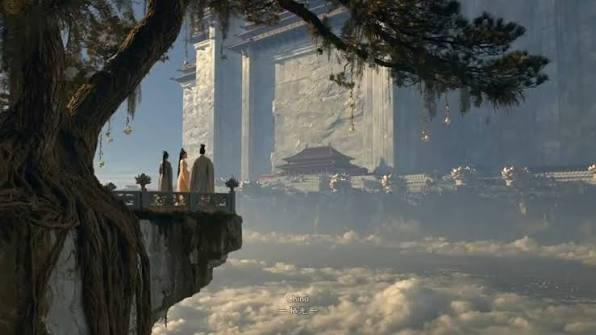
An AI-generated video depicting a fantastical Chinese version of heaven has gone viral after viewers initially assumed it was produced by a professional animation studio. The creator, however, is not a filmmaker or visual-effects specialist. He is an optical shop owner who taught himself AI tools during quiet hours at work.
Qi Guang’s less-than-one-minute video features floating temples, towering celestial palaces, a white jade bridge stretching into the clouds, and cranes flying through an otherworldly landscape. Its distinctly Chinese visual language has helped the clip attract more than 5 million views across social platforms in fewer than four days, according to the supplied report.
The story is notable not only because of the video’s reach, but because of how it was made. Qi spent more than two years learning AI image and video generation, using spare time between customers to experiment with increasingly sophisticated tools.
How did Qi Guang create the viral AI heaven video?
Qi Guang told the Global Times that he has long been fascinated by the grand, ethereal worlds found in Chinese mythology. AI, he said, gave him a way to turn those ideas into visual scenes without needing a traditional film studio.
His workflow involved several stages rather than a single text prompt producing a finished video.
First came the visual concept
Qi first imagined the architecture, atmosphere, composition and camera movements he wanted.
That meant thinking about details such as the shape of the celestial buildings, the appearance of the clouds, the lighting and the overall mood.
He then used text-to-image AI tools to create individual high-quality still images.
The prompts required repeated adjustments
Getting the desired result was not as simple as describing heaven to an AI model.
Qi said he repeatedly adjusted his prompts to control architectural details, colors, lighting and composition. Many of the generated images had to be discarded.
AI systems can also introduce visual errors that are especially noticeable in complex scenes. Qi said the models frequently produced garbled architecture, distorted figures and unnatural movement.
Once he had selected suitable images, he used image-to-video tools to introduce motion and camera effects.
The final stage involved editing and combining the clips and selecting music that matched the atmosphere.
Why did viewers mistake it for a studio production?
The video’s visual scale is part of what made it convincing.
Large cinematic environments, elaborate architecture and atmospheric effects have traditionally required teams of artists, animators, editors and visual-effects specialists.
Generative AI changes that equation by allowing an individual creator to produce pieces of that workflow from a computer.
That does not mean AI eliminates the need for human skill. In Qi’s case, the viral result reportedly followed hundreds of failed or discarded attempts.
The distinction is important: the AI generated the imagery, but the creative direction still came from the person operating it.
What is China’s ‘handcraft’ economy?
Qi Guang’s story has also been linked to a growing phenomenon described in the supplied report as China’s “handcraft” economy.
The term refers to individuals using relatively simple tools and their own skills to turn ideas into products or content without relying on large-scale industrial operations.
The trend is particularly interesting in the AI era because generative tools can reduce some of the costs associated with production.
An individual can potentially:
- Develop an idea without a large production team.
- Generate images, video or audio using AI tools.
- Test multiple creative concepts relatively cheaply.
- Build products or content independently.
- Reach a global audience through social platforms.
The hashtag “Hand-Crafting Everything” has reportedly surpassed 100 million views on Chinese social media.
That suggests the phenomenon extends beyond AI-generated videos. It reflects a broader interest in individuals building things themselves with increasingly accessible digital tools.
How AI is changing who can create visual content
For decades, producing cinematic fantasy imagery required expensive equipment and specialized expertise.
A creator needed access to cameras, sets, lighting, animation software, visual-effects artists and post-production teams.
Generative AI does not completely replace those resources, but it can compress several stages of production into software.
A person can now describe a visual concept, generate alternatives, discard weak results and progressively refine the output.
The barrier has shifted.
Instead of primarily being able to afford the machinery and personnel, creators increasingly need the time and skill to direct the tools effectively.
Qi’s experience illustrates that change. He reportedly spent two years learning the technology rather than producing the viral clip instantly.
Why does human input still matter in AI-generated videos?
The viral “heaven” video is also a reminder that generative AI does not automatically turn an idea into a polished production.
AI models can produce impressive results while simultaneously making basic mistakes.
A building may contain impossible geometry. A person’s hands may become distorted. A character can change appearance between shots. Camera movement may look unnatural. Architectural elements can shift unexpectedly from one frame to another.
Those problems become particularly obvious when several AI-generated shots are edited together.
The creator therefore becomes something closer to a director and editor, deciding which outputs work, which need to be regenerated and how individual pieces should fit together.
Qi’s description of repeatedly modifying prompts captures this less glamorous side of generative AI: the finished clip may look effortless, but producing it can involve a considerable amount of trial and error.
What does Qi Guang’s story say about the future of AI creativity?
The biggest implication may not be the video itself.
Qi is an example of someone outside the conventional film and technology industries using AI to pursue a creative idea that might previously have required a professional production team.
That could have consequences for filmmaking, advertising, design, gaming and independent content creation.
The same technology can give more people access to sophisticated creative workflows while also increasing competition. If one person can create something that once required a studio, thousands of other people can potentially do the same.
The scarce resource may therefore shift from production capacity to originality, judgment and execution.
The AI creator is still doing the hard work
There is an irony at the center of the “handcraft” label.
AI makes digital creation easier in some respects, but Qi’s story suggests that the technology does not necessarily make the process easy.
He reportedly spent years learning the tools and repeatedly generated images that failed to match what he had imagined.
His experience can be summed up in one of his observations: creators can have a perfect image in their heads and still struggle to make an AI system reproduce it accurately.
That gap between imagination and execution remains one of the central challenges of generative AI.
Why this viral video matters beyond the views
The video’s millions of views are an obvious measure of its popularity, but the more interesting story is what happened before anyone saw it.
A shop owner with no traditional animation studio reportedly spent his spare time learning a technology, experimented repeatedly, combined several AI tools and eventually produced a piece of content that audiences initially attributed to a professional production house.
That is the emerging promise of generative AI: not that everyone suddenly becomes an expert filmmaker, but that the tools required to attempt ambitious creative projects are becoming available to people who previously could not access them.
Qi Guang’s “heaven” may have been generated by AI, but getting it from an idea in his head to a viral video still required something decidedly human: patience.