
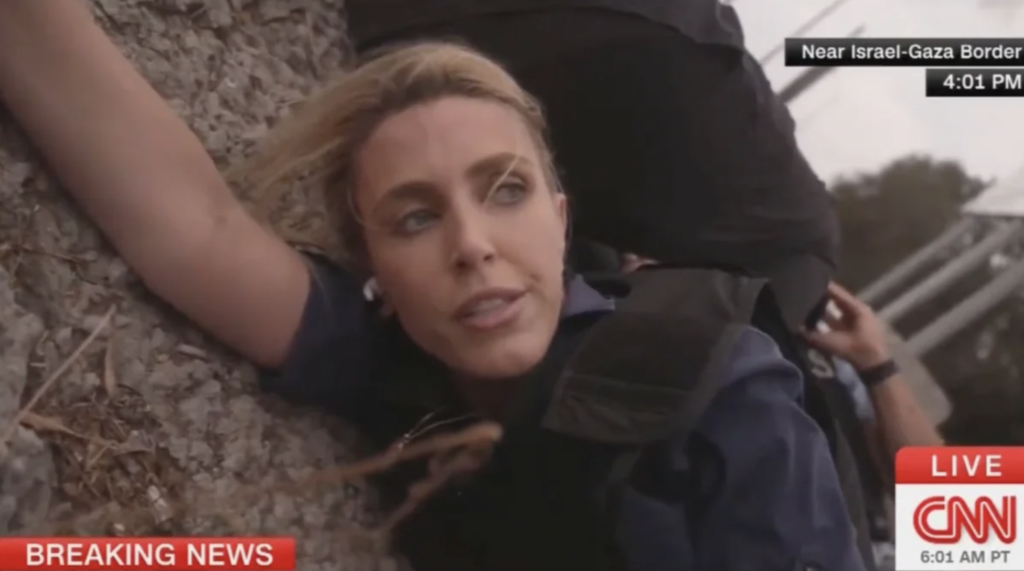


Clarissa Ward, CNN’s chief international correspondent, has become one of the first Western journalists to report from Gaza during the current conflict, despite a media embargo.
The Erez crossing between Israel and Gaza has been closed since October 7, making it impossible for journalists to enter. Since the beginning of the war, journalists have been denied access to the Rafah crossing between Egypt and Gaza.
Ward, on the other hand, has made her way in. So far, at least 63 journalists have been killed in the Israel-Hamas conflict.
She said: “We enjoyed a very privileged position on this occasion, we did feel relatively safe, we were only on the ground for a matter of hours.”
Ward added, when reporting on the damage she saw, “I can honestly say I don’t think we’ve ever seen it quite on this scale.”
The ban on international reporters has forced Palestinian journalists, aid and health workers, and social media users to rely on them for information.
Throughout the war, Israel has repeatedly cut off phone and internet communications from Gaza.
Some journalists have been allowed into Israel, but only under the supervision of the Israeli Defense Force (IDF).
Here’s what Clarissa Ward witnessed in Gaza
CNN witnessed the horror of modern warfare in the streets, littered with trash and rubble from destroyed buildings. People wander around outside like zombies, perhaps trying to make sense of their lives, perhaps with nothing else to do.
The majority of the stores were closed, but there was a long line outside a bakery. The recent rain has caused stagnant water, and the December chill has set in.
Jinan Sahar Mughari, eight, remained immobilized in a full-body cast in another room of the field hospital. “They bombed the house in front of us and then our home,” she told CNN. “I was sitting next to my grandfather, and my grandfather held me, and my uncle was fine, so he was the one who took us out.”
Doctors at the UAE Field Hospital say it’s especially difficult to see and treat innocent child victims of war, but they’re too busy to think about it.
“It’s something that changes your heart,” said Dr. Ahmed Almazrouei of seeing injured children.
Dr. Abdallah Al-Naqbi, the hospital’s medical director, added, “These are obviously civilians.” “They don’t deserve to lose a limb while sitting with family,” he explained.
The hospital was built quickly in a soccer stadium, but its staff and cutting-edge equipment put its 150 beds in high demand. “The people from here ask us to keep our service limited to the severely injured people because they are the ones who are in need. And they cannot wait,” Al-Naqbi said.
Within 15 minutes of CNN’s arrival, there is a loud crack of an airstrike nearby. The doctors make no move. “That’s real life,” Al-Naqbi said, adding that they hear at least 20 strikes per day. “I think we got used to it.”
There is no way of knowing whether a Hamas target or a civilian home or business was hit. However, they soon learn that there are victims to be treated.
“They just called us right now, they will send us two amputated young males from the bombing,” Al-Naqbi said, hurrying to the “Red Area” where new trauma patients are received.
According to the World Health Organization, almost all of Gaza’s more than 2 million residents have been forced from their homes as Israel targeted first the north and then the south of the territory in its operations to destroy Hamas and recover more than 100 hostages still believed to be held by militants.