
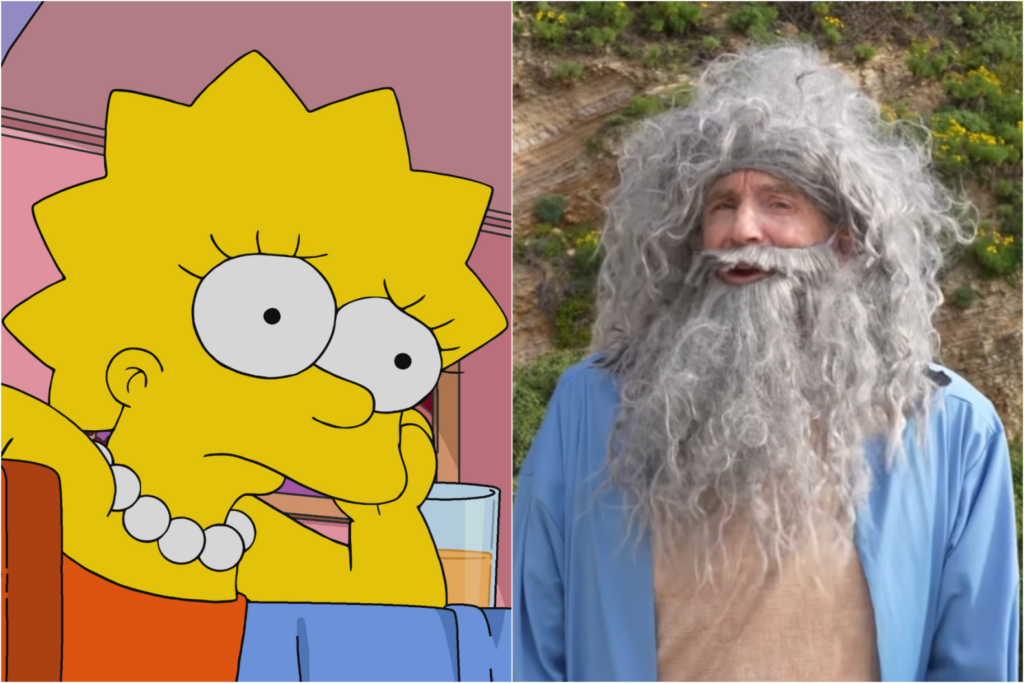
Dan Greaney, the longtime writer behind The Simpsons who has often been credited online with “predicting” Donald Trump’s rise to the White House, now says he wants a presidential run of his own.
The Emmy-winning television writer has reportedly launched a 2028 campaign under an unusual political identity: a “progressive Republican.”
And in classic Simpsons-adjacent fashion, the announcement came wrapped in satire, theatrical visuals, and enough ambiguity to leave people wondering whether the campaign is genuine, performance art, or something in between.
TL;DR
- Simpsons writer Dan Greaney says he is running for president in 2028.
- He describes himself as a “progressive Republican.”
- Greaney has criticised Trump, billionaires, and both political parties.
- His platform reportedly includes universal healthcare and expanding the Supreme Court.
- A campaign filing with the Federal Election Commission suggests at least some formal political intent.
- It remains unclear how serious or viable the campaign actually is.
Who Is Dan Greaney?
Dan Greaney is best known as a writer and producer on The Simpsons, one of the most influential television shows in American pop culture history.
Greaney became widely associated online with the show’s eerily accurate political satire after fans repeatedly pointed to episodes that appeared to foreshadow real-world events — especially Trump’s presidency.
One episode in particular, originally aired in 2000, imagined Trump as a future president years before he actually entered politics.
Although Greaney himself did not singlehandedly “predict” Trump’s rise, internet culture transformed several Simpsons writers into symbolic political prophets.
Now, Greaney appears ready to step directly into politics himself.
What Did Greaney Announce?
In a series of campaign-style videos, Greaney appeared:
- Wearing a flowing blue toga
- Sporting an exaggerated beard
- Delivering theatrical political monologues
During the videos, he criticised:
- Trump
- Vice President JD Vance
- Billionaires
- Political “cowards” in both parties
He framed his campaign around restoring democratic accountability and national unity.
“I’m running for president,” he declared.
The tone blended:
- satire,
- political frustration,
- and genuine policy messaging.
That hybrid style has made it difficult to determine whether the campaign is primarily symbolic or a legitimate political effort.
Why He Calls Himself a “Progressive Republican”
Greaney reportedly describes himself as:
“A progressive Republican in the tradition of Abraham Lincoln and Teddy Roosevelt.”
That label stands out in today’s political climate, where the Republican Party is largely shaped by Trump-era conservatism.
Greaney’s stated positions reportedly include:
- Universal healthcare
- A Green New Deal
- Expanding the US Supreme Court from 9 to 13 justices
- Increased government accountability
- Opposition to “Trump administration lawlessness”
Those positions align more closely with progressive Democrats than with the modern Republican mainstream.
Still, Greaney appears to be attempting something broader: reclaiming older forms of Republican populism rooted in reform, anti-corruption rhetoric, and institutional trust.
Why the “Progressive Republican” Label Matters
The phrase may sound contradictory in 2026 America, but historically, it is not entirely unprecedented.
Historical Figures Greaney References
Abraham Lincoln
Lincoln’s Republican Party was associated with:
- federal authority,
- anti-slavery politics,
- and national unity.
Theodore Roosevelt
Roosevelt embraced:
- corporate regulation,
- environmental conservation,
- and aggressive anti-monopoly policies.
Greaney appears to be invoking that earlier Republican identity rather than modern MAGA conservatism.
Is the Campaign Actually Real?
That remains the biggest question.
On one hand:
- The campaign videos feel intentionally absurdist.
- The toga-and-prophet aesthetic resembles political satire.
- Much of the messaging mirrors entertainment-world political commentary.
On the other hand:
- According to reports, Greaney’s company filed an official campaign committee statement with the Federal Election Commission.
- He has launched a campaign website.
- He has publicly outlined policy positions.
That means the campaign has at least some formal legal structure behind it.
Still, filing paperwork alone does not necessarily indicate a serious presidential operation. Many symbolic, activist, or publicity campaigns register with the FEC each election cycle.
Why Trump Remains Central to the Campaign
Even though Greaney positions himself as anti-establishment, Trump remains the campaign’s central political reference point.
Greaney accused:
- Republicans of enabling Trump
- Democrats of failing to stop him
That reflects a broader frustration increasingly visible among:
- independent voters,
- political moderates,
- and anti-Trump conservatives.
Rather than positioning himself strictly as a Democrat-aligned critic, Greaney appears to be targeting voters disillusioned with both parties.
Whether such a coalition actually exists at scale is another matter entirely.
Could Celebrity and Entertainment Figures Matter More in Politics?
Greaney’s announcement also highlights how blurred the line between entertainment and politics has become in the United States.
Recent decades have seen political influence emerge from:
- reality television,
- podcasting,
- comedy,
- streaming culture,
- and social media personalities.
Trump himself transformed celebrity branding into political capital.
Figures like:
- Oprah Winfrey,
- Dwayne Johnson,
- and Jon Stewart
have all faced periodic speculation about political ambitions.
Greaney’s campaign fits into that broader evolution where cultural relevance can sometimes matter as much as political experience.
The Simpsons’ Political Legacy Still Shapes Public Conversation
For years, The Simpsons has occupied a strange place in American political culture.
The show became famous for:
- satirical exaggeration,
- uncanny parallels with future events,
- and commentary on American institutions.
Internet users frequently treat the series almost like a cultural crystal ball.
That mythology has followed Greaney into his campaign launch, helping amplify attention far beyond what most first-time candidates would receive.
In many ways, the “Simpsons predicted this” meme may now be more powerful than the actual campaign itself.
The Bigger Picture
Whether Greaney seriously expects to compete for the presidency may ultimately matter less than what his campaign represents.
His launch taps into several growing realities in American politics:
- distrust of both parties,
- frustration with political elites,
- celebrity-driven campaigning,
- and the blending of satire with genuine activism.
It also reflects a political culture where viral moments often matter more than traditional party machinery.
For now, Greaney’s candidacy exists somewhere between protest movement, media experiment, and unconventional political campaign.
And given America’s recent political history, dismissing unusual candidates outright has become increasingly risky.