
In a dramatic escalation of US action in Latin America, President Donald Trump on Saturday (January 3) confirmed that the United States carried out large-scale strikes inside Venezuela, resulting in the capture of President Nicolás Maduro and his wife, Cilia Flores.
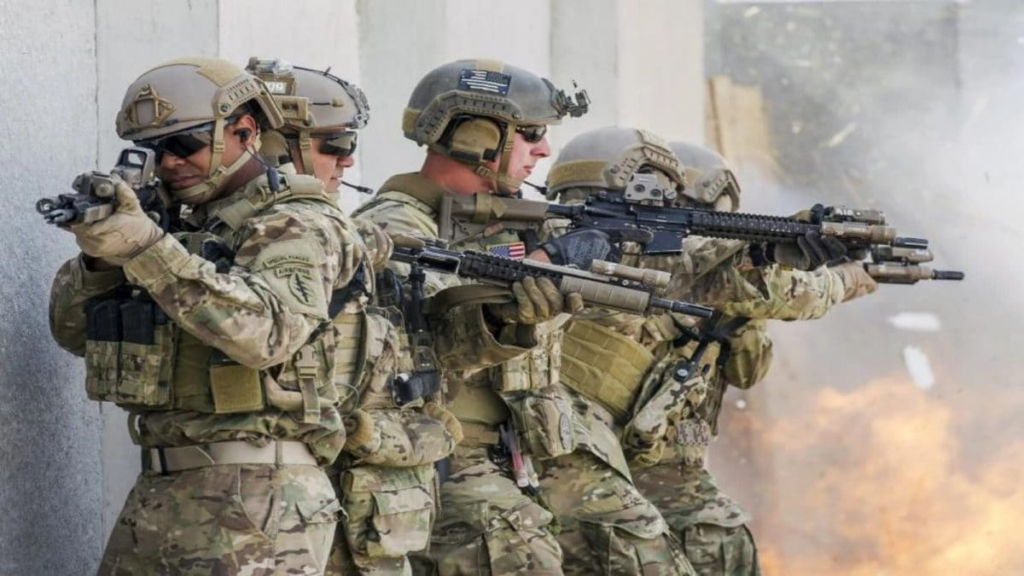
Announcing the operation on Truth Social, Trump said the mission was conducted jointly with US law enforcement and concluded with Maduro being flown out of the country. Initial reports indicate that the operation was spearheaded by Delta Force, one of the most elite and secretive units in the US military.
The announcement has triggered intense global attention, not only because of its political consequences but also because of the unit involved. Here is a closer look at Delta Force’s history, mission, and the high-risk operations that define its legacy.
What is Delta Force, and why does it matter?
Delta Force, officially known as the 1st Special Forces Operational Detachment–Delta (1st SFOD-D), is the US Army’s premier counter-terrorism and hostage-rescue unit.
Established in 1977, Delta Force was created to address a growing threat Washington believed it was unprepared for: international terrorism.
Why was Delta Force created?
The unit was founded by Colonel Charles Beckwith, a career Special Forces officer who had trained with Britain’s Special Air Service (SAS). Beckwith returned convinced that the US needed a permanent, highly specialized force capable of:
- Counter-terrorism missions
- Hostage rescue operations
- Direct action against high-value targets
- Missions requiring extreme secrecy and speed
Delta Force operates under the US Army Special Operations Command and answers directly to the highest levels of the US government.
How secretive is Delta Force?
Unlike conventional military units, Delta Force operates almost entirely in the shadows.
- Missions are rarely acknowledged in real time
- Operators do not use rank insignia publicly
- Identities of members remain classified
- Details often emerge years later, if at all
This secrecy allows Delta Force to conduct politically sensitive missions where plausible deniability and operational surprise are critical.
From Iran to Mogadishu: Delta Force’s early combat history
Operation Eagle Claw (1980)
Delta Force first entered public awareness during Operation Eagle Claw, the failed US mission to rescue American hostages in Iran.
The operation ended after aircraft collisions in the Iranian desert killed eight US servicemen. While the mission was a failure, it became a turning point for US special operations.
Key outcome:
The disaster led to sweeping reforms in joint operations, command structure, and special forces coordination, changes that still shape US military doctrine today.
Panama and the capture of Noriega (1989)
In 1989, Delta Force played a key role during the US invasion of Panama. The unit assisted in locating and capturing Manuel Noriega, the country’s military ruler, demonstrating Delta’s effectiveness in urban, politically charged environments.
Mogadishu, Somalia (1993)
Delta Force operators were heavily involved in US operations in Somalia, including raids against militia leaders loyal to warlord Mohamed Farrah Aidid.
The mission culminated in the Battle of Mogadishu, one of the most intense urban firefights US forces faced since Vietnam. While costly, the operation reinforced Delta Force’s reputation for operating under extreme pressure.
How did Delta Force shape the post-9/11 war on terror?
After the September 11, 2001, attacks, Delta Force became central to America’s global counter-terrorism campaign.
Key post-9/11 roles
- Targeting senior militant leaders
- Conducting night raids and capture-or-kill missions
- Hostage rescue in hostile territory
- Intelligence-driven operations alongside CIA teams
Delta Force has reportedly operated across:
- Afghanistan
- Iraq
- Syria
- Other undisclosed locations
These missions focused on dismantling extremist leadership rather than large-scale troop deployments.
High-profile mission: Abu Bakr al-Baghdadi (2019)
In 2019, Delta Force carried out a highly classified operation in northwest Syria that resulted in the death of Abu Bakr al-Baghdadi, the leader of the Islamic State group.
The raid underscored Delta Force’s core strengths:
- Precision targeting
- Intelligence-led execution
- Minimal time on the ground
- Rapid extraction
The mission was widely seen as a textbook example of modern US special operations.
Why was Delta Force reportedly used in Venezuela?
According to initial reports, Delta Force led the operation to capture Nicolás Maduro in Caracas, one of the most heavily guarded capitals in the region.
Maduro was protected by multiple layers of military, intelligence, and presidential guards, makinga conventional arrest or extradition impossible.
Delta Force is typically deployed when:
- Targets are high-value and heavily protected
- Diplomatic or legal options are exhausted
- Speed and secrecy are essential
- Political consequences are expected to be severe
That combination helps explain why the unit was chosen for such a sensitive mission.
Why Delta Force remains central to US military strategy
Nearly five decades after its creation, Delta Force remains one of the most critical tools in America’s national security arsenal.
Its relevance lies in its ability to operate where:
- Conventional forces would escalate the conflict
- Diplomacy has failed
- Intelligence requires immediate action
The reported capture of Venezuela’s president, if fully confirmed, would represent one of the most politically significant missions in the unit’s history.
The bigger picture
Delta Force’s reported role in Venezuela signals more than a single operation. It reflects a broader shift toward precision, intelligence-led military action, even in regions traditionally managed through diplomacy and sanctions.
As details continue to emerge, the operation will likely be studied as a defining moment in modern US special operations—and a reminder of how much power still operates beyond public view.