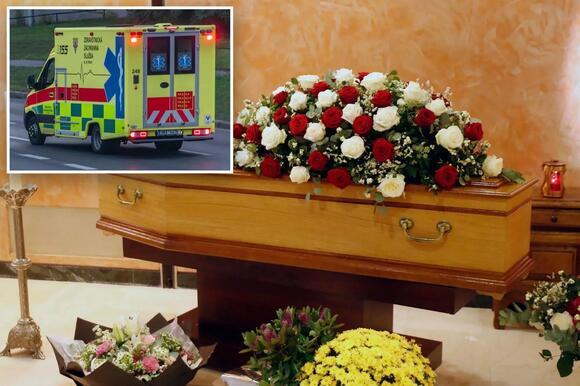
An 88-year-old woman in the Czech Republic, declared dead by paramedics and a coroner, was discovered alive as she was being placed in a coffin—a chilling incident that has stunned medical professionals and sparked discussions about rare resuscitation phenomena.
Woman shows signs of life after being pronounced dead
The harrowing ordeal began when the woman’s husband found her unresponsive in bed and contacted emergency services in Pilsen. According to Blesk.cz, the husband told dispatchers, “She didn’t move, she didn’t breathe.”
Upon arrival, paramedics confirmed her death, and a coroner was called to the scene. After an official declaration, undertakers were summoned to prepare the body for burial. However, as they moved her into the coffin, they made a shocking discovery—the woman was still alive.
“The workers transferred her to the coffin, and when they were right here in the apartment in the hallway by the door, they found out she was alive,” the husband told Blesk.
An ambulance rushed her to the hospital, where she is currently receiving medical care.
The Lazarus Effect: A rare medical phenomenon
While the incident seems like something out of a horror movie, similar cases have been documented before. According to the Cleveland Clinic, this phenomenon is known as the Lazarus Effect, named after the biblical story of Jesus resurrecting Lazarus from the dead.
The Lazarus Effect typically occurs after cardiopulmonary resuscitation (CPR) is performed on a patient who has suffered cardiac arrest. Despite being declared clinically dead, the patient may spontaneously show signs of life minutes after resuscitation efforts cease.
For the phenomenon to be medically recognized, the patient must exhibit sustained vital signs, not just fleeting movements or gasps. According to the National Institutes of Health, there have been 74 confirmed cases of the Lazarus Effect in the U.S. between 1982 and 2022.
Why does it happen?
The exact mechanisms behind the Lazarus Effect remain unclear. Some theories suggest delayed circulation recovery or residual brain activity, but no definitive explanation exists. Medical professionals emphasize the importance of extended monitoring before declaring death to prevent such terrifying scenarios.
This case serves as a grim reminder of the complexities of human biology—and the thin line between life and death.