
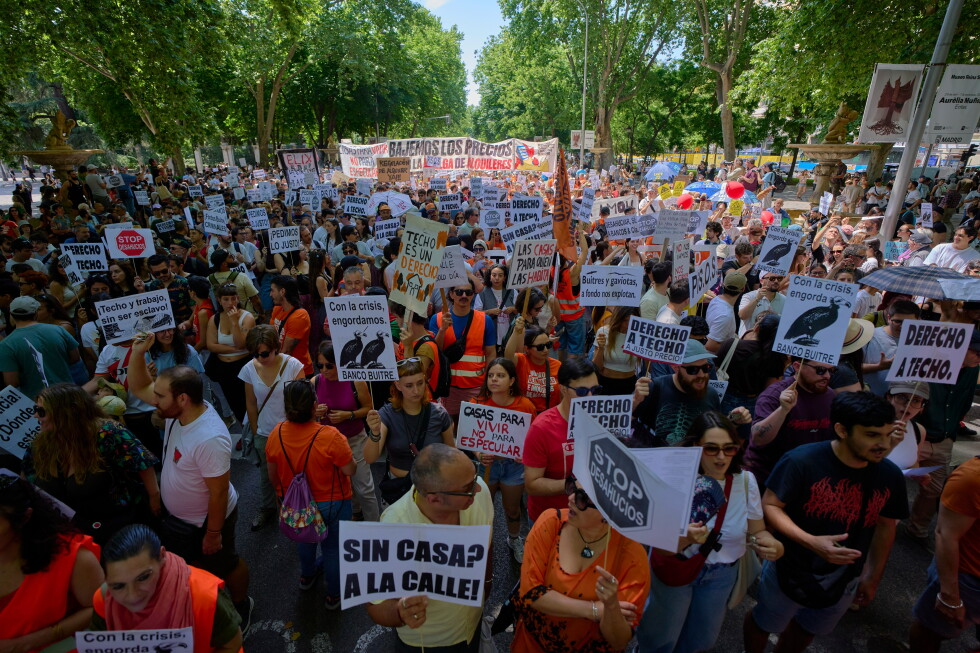
Spain witnessed a politically charged weekend as two separate waves of protests swept through Madrid—one targeting corruption allegations surrounding Prime Minister Pedro Sánchez and another focused on the country’s worsening housing crisis.
Though driven by different grievances, both demonstrations reflected growing public frustration over economic pressure, political distrust, and the feeling among many Spaniards that institutions are failing to respond to everyday concerns.
Why were people protesting in Spain on Saturday?
Anti-government protests in Madrid
Saturday’s protest centered on corruption allegations linked to figures close to Sánchez.
Who organized the march?
The rally was organized by Sociedad Civil Española, a coalition of more than 150 civic associations.
The protest drew support from opposition groups and conservative factions critical of Sánchez’s government.
What were protesters demanding?
The central demand was:
- Pedro Sánchez’s resignation
Protesters accused the government of:
- Corruption
- Abuse of political influence
- Lack of accountability
Far-right Vox leader Santiago Abascal sharply criticized Sánchez ahead of the demonstration, calling his administration corrupt.
What corruption allegations are surrounding Sánchez’s circle?
The protests were fueled by multiple investigations and court proceedings involving people close to the prime minister.
Cases drawing attention include:
- An investigation involving Sánchez’s wife, Begoña Gómez
- A trial involving his brother, David Sánchez, over alleged influence peddling
- Corruption proceedings involving former Transport Minister José Luis Ábalos
Sánchez’s response
Sánchez has repeatedly denied wrongdoing and rejected calls to resign.
He remains firm about continuing in office despite mounting political pressure.
Did the protests turn violent?
Most of Saturday’s demonstration remained peaceful, but tensions escalated briefly.
What happened near Moncloa Palace?
A smaller masked group reportedly broke away from the main protest and attempted to breach police barriers near:
- Moncloa Palace
According to reports:
- Three people were arrested
- Seven police officers were injured
The incident added to the political intensity surrounding the demonstrations.
Dispute over crowd size
Attendance estimates varied significantly:
- Organizers claimed 120,000 attendees
- Government officials estimated around 40,000
Such disagreements are common in politically sensitive protests.
Why did people protest again on Sunday?
Spain housing crisis protests
Sunday’s demonstrations focused on a different issue entirely: housing affordability.
What’s driving Spain’s housing crisis?
Many Spaniards—especially younger residents—say they are being priced out of the market due to:
- Rising rents
- Limited housing supply
- Tourism-driven demand
- Increased urban population pressure
One banner carried by protesters read:
- “We want neighbours, not tourists.”
The slogan reflects growing resentment toward short-term tourism rentals in major Spanish cities.
Why is housing becoming unaffordable in Spain?
Spain has long had a strong homeownership culture, but rental availability remains relatively limited.
Factors pushing prices higher
Key drivers include:
- Expansion of tourism and short-term rentals
- Immigration-related housing demand
- Limited public housing stock
- Rising urban property investment
In cities like Madrid and Barcelona, rents have climbed sharply in recent years.
What renters are saying
Many protesters argued that government measures have not kept pace with the crisis.
Some renters say they are facing:
- Eviction notices
- Aggressive rent increases
- Inability to secure affordable housing
The issue has become one of the country’s most politically sensitive economic challenges.
What is the Spanish government doing about housing?
Earlier this year, Spain’s government announced a multi-billion-euro housing plan.
Key details of the proposal
The plan reportedly includes:
- €7 billion in housing investment over four years
- Expansion of public housing projects
- Support for younger renters and first-time buyers
Why critics say it’s not enough
Housing activists argue that:
- Relief is arriving too slowly
- Rent increases continue to outpace wages
- Structural supply problems remain unresolved
This gap between policy announcements and lived experience is helping fuel protests.
Why these protests matter politically
The back-to-back demonstrations highlight mounting pressure on Sánchez from multiple directions.
A government facing overlapping crises
The administration now faces criticism over:
- Corruption allegations
- Cost-of-living pressures
- Housing affordability
- Public trust and political fatigue
A broader European trend
Spain is not alone.
Across Europe, governments are facing growing unrest linked to:
- Housing shortages
- Inflation
- Political polarization
- Distrust of institutions
The Madrid protests reflect these wider tensions playing out domestically.
Could the protests impact Spanish politics?
That depends on whether public frustration continues to grow.
What to watch next
- Court developments in corruption cases
- Government housing policy implementation
- Opposition efforts to capitalize on unrest
- Future protest mobilizations
If economic and political pressures persist simultaneously, Sánchez’s government could face increasing instability.
TL;DR
- Madrid saw two major protests over the weekend
- Saturday’s rally targeted corruption allegations linked to Pedro Sánchez’s circle
- Sunday’s demonstrations focused on Spain’s housing crisis and rising rents
- Protesters criticized both political corruption and housing affordability
- The protests reflect broader social and economic tensions in Spain