
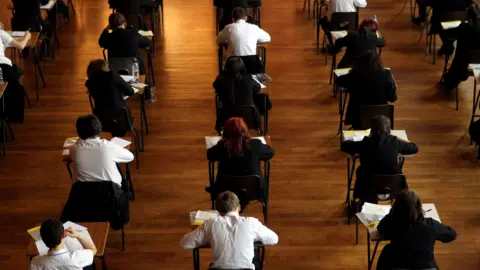
Thousands of students across Scotland are demanding a review of this year’s Higher Maths exam after a paper many expected to be difficult turned into something they say was deeply unfamiliar.
More than 11,000 people have signed a petition criticizing the May 7 exam, arguing that the wording and structure differed sharply from previous years’ papers. Students say the confusion left many panicked, emotionally distressed, and fearful about the impact on university admissions and future career plans.
For some pupils, the frustration was not about advanced equations or impossible calculations. It was about language.
They say they knew the math. They just did not recognize the exam.
Why students are protesting the Higher Maths exam
The controversy centers on Scotland’s Higher Maths qualification, one of the country’s most important secondary school exams.
Nearly 20,000 students sat the paper this year under the newly established Qualifications Scotland, which replaced the former Scottish Qualifications Authority earlier in 2026.
What students say went wrong
According to the petition:
- Questions were “poorly worded”
- Instructions felt inconsistent
- The structure differed from previous exams
- Key “command words” appeared unfamiliar
Command words are the instructional terms that guide students on:
- How much detail to provide
- Whether to explain or calculate
- Which method to use
- How marks are awarded
Students argued that they had spent months preparing using past papers, only to face phrasing they say looked completely different on exam day.
For many, the issue became less about mathematics and more about interpretation under pressure.
What are “command words,” and why do they matter?
In standardized testing, command words act like the operating system of an exam.
A tiny wording shift can completely change:
- What the examiner expects
- How students structure answers
- Which methods earn marks
For example:
- “State” usually requires a short answer
- “Explain” demands reasoning
- “Hence” signals use of a previous result
- “Determine” may require full working
Students claim this year’s paper used wording that felt unfamiliar compared with prior exam formats.
Students say panic spread through exam halls
The emotional reaction to the paper quickly became part of the story itself.
Several students described scenes of:
- Confusion
- Silence during the exam
- Crying afterward
- Anxiety carries into the second paper
An S5 student from Aberdeen told the BBC she had practiced four years of previous papers and entered the exam feeling prepared.
But after struggling with the first section, she said the stress carried over into the second paper.
Another student described people leaving the exam “in tears,” calling it a potentially “future-altering” experience.
That phrase resonated widely online because Higher Maths is viewed as a gateway subject for
- Engineering
- Physics
- Economics
- Computing
- Medicine
- University admissions
In Scotland’s education system, a disappointing result can significantly affect academic pathways.
Why this controversy matters beyond one exam
The backlash arrives at an especially sensitive moment for Scotland’s education system.
This was the first exam cycle overseen by Qualifications Scotland after the dissolution of the SQA.
Why was the SQA replaced
The SQA faced years of criticism over:
- Grading controversies during the COVID-19 pandemic
- Concerns about fairness
- Public trust issues
- Handling of previous national exams
The restructuring was intended to rebuild confidence in Scotland’s qualification system.
Now, the Higher Maths controversy risks becoming an early credibility test for the new organization.
The timing could hardly be worse:
A new institution trying to establish stability has suddenly inherited a nationwide argument about fairness.
What Qualifications Scotland said:
Qualifications Scotland defended the exam process and rejected claims that the paper was unfair.
A spokesperson stated:
- Exams are created by experienced subject teachers
- Papers undergo multiple checks
- Questions are reviewed for clarity and fairness
The organization maintains that the exam met required academic standards.
Maths teachers are separated from students
Interestingly, many mathematics teachers do not appear to agree with the backlash.
Members of the Educational Institute of Scotland reportedly said the paper itself was fair.
That disconnect highlights a larger debate in modern education:
Should exams test pure subject knowledge alone or also a student’s ability to interpret unfamiliar phrasing under pressure?
Critics argue that
- Exams should assess mathematical understanding
- Not a student’s ability to decode unusual wording
Supporters of tougher papers counter that
- Real problem-solving involves unfamiliar situations
- Strong students should adapt to new phrasing
The dispute reflects a broader global shift in education toward the following:
- “Application-based” questions
- Critical thinking assessments
- Less predictable exam formats
Why do students rely heavily on past papers
One reason the backlash escalated so quickly is that past-paper preparation dominates modern exam culture.
Students often:
- Memorize recurring structures
- Learn typical phrasing
- Practice standard command words
- Build timing strategies around historical formats
When an exam diverges sharply from expectations, it can feel like the map changed moments before takeoff.
That creates a difficult balance for exam boards:
- Too predictable, and papers become repetitive
- Too unfamiliar, and students feel blindsided
Social media amplified the outrage rapidly
Within hours of the exam:
- TikTok reactions spread widely
- Petition signatures climbed quickly
- Students shared emotional accounts online
The internet transformed what might once have been a local classroom complaint into a national conversation almost instantly.
In previous decades, students would leave the exam hall and vent to friends.
Now thousands compare answers, reactions, and anxieties in real time across social platforms, creating a kind of digital aftershock that can shape public perception before official reviews even begin.
Could results be adjusted?
At the moment, there is no indication that the exam will be withdrawn or rewritten.
However, exam authorities sometimes adjust grade boundaries if:
- A paper proves unexpectedly difficult
- National performance drops significantly
- Statistical reviews show anomalies
Students are now waiting to see whether
- Marking standards change
- Grade thresholds shift
- Qualifications Scotland responds further
The bigger issue: trust in high-stakes exams
At its core, the controversy is about more than one math paper.
It reflects growing tension around:
- High-pressure testing
- Academic expectations
- Mental health
- Educational fairness
- Institutional trust
For many students, exams increasingly feel less like assessments and more like narrow bridges suspended above future opportunities.
And when the wording on that bridge suddenly changes, panic spreads fast.
TL;DR
More than 11,000 people have signed a petition criticizing Scotland’s 2026 Higher Maths exam, saying unfamiliar wording and unexpected command terms left students confused and stressed. The controversy comes during the first year of Qualifications Scotland, the new body replacing the SQA, and has sparked debate about fairness, exam design, and the pressure of high-stakes testing.