
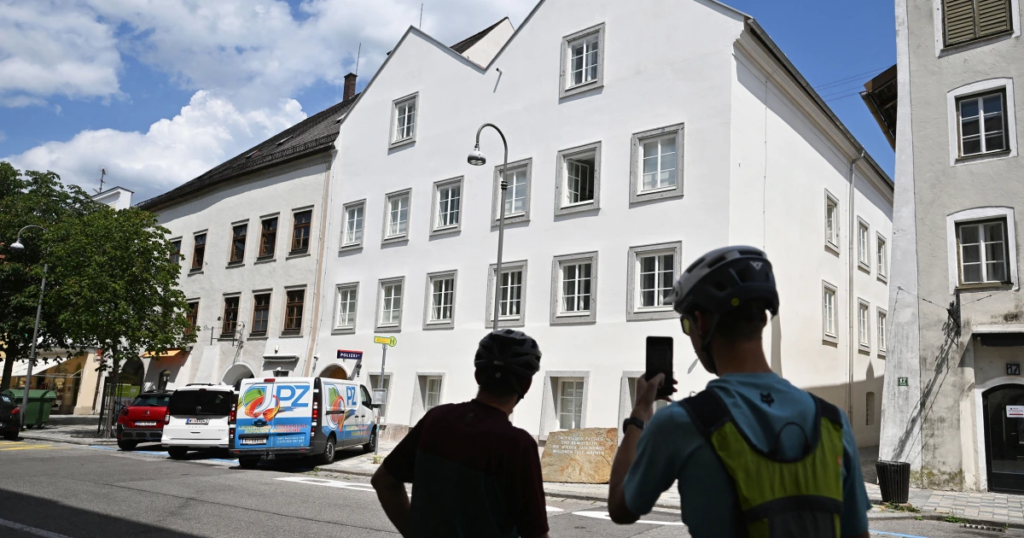
Austria has officially given one of Europe’s most controversial buildings a new identity. The house where Adolf Hitler was born in 1889 has reopened as a police station, marking the end of years of debate over how to handle a site long associated with one of history’s most notorious dictators.
Located in the town of Braunau am Inn near the German border, the building officially begins its new role on Wednesday. Austrian officials say converting the property into a police station is intended to remove any symbolic value it may hold for neo-Nazis and prevent it from becoming a destination for extremist visitors.
The decision reflects Austria’s broader effort to confront its Nazi-era past while ensuring the building does not become a shrine celebrating Hitler.
TL;DR
- Adolf Hitler’s birthplace in Braunau am Inn, Austria, has officially reopened as a police station.
- Austria says the conversion is meant to discourage neo-Nazi pilgrimages and strip the site of its symbolic appeal.
- The government compulsorily purchased the building in 2017 after years of legal disputes with its private owner.
- Critics argue the site should do more to educate visitors about Nazi crimes instead of minimizing its historical identity.
- The building bears no reference to Hitler, with only a “Police” sign on its exterior.
Why Has Austria Turned Hitler’s Birth House Into a Police Station?
The Austrian government believes the best way to neutralize the building’s historical significance is to give it a practical public function.
Officials say transforming the house into a police station removes any sense of reverence or symbolism that extremist groups could attach to it.
“The aim was to prevent any association with Adolf Hitler, so as to strip it of that mystique,” Stephan Mlczoch, head of the Austrian Interior Ministry’s history department, told reporters during a tour of the building.
The strategy is designed to replace a site associated with dictatorship and Nazi ideology with one representing democratic law enforcement.
Where Is Hitler’s Birth House?
The building is located in Braunau am Inn, a town in northern Austria near the German border.
Hitler was born there on April 20, 1889, but historians note that he lived in the house for only a few weeks before his family moved elsewhere.
Despite Hitler’s brief connection to the property, the building has remained internationally recognized because of its historical significance.
During Nazi rule, the house was transformed into an art museum dedicated to Hitler, reinforcing the personality cult surrounding the German dictator.
What Does the Building Look Like Today?
The property has been intentionally redesigned to appear ordinary.
The white facade now carries only a simple sign reading “Police.”
One reminder of the site’s darker history remains outside the building: a memorial stone from the Mauthausen concentration camp bearing the inscription, “Never again fascism.”
Notably, the memorial does not mention Hitler by name.
Officials say this understated approach is deliberate, ensuring the building does not attract attention as a historical attraction.
Suggested visual: A before-and-after comparison showing the building during its previous use alongside its new police station exterior.
Why Was the Building So Controversial?
For decades, Austria struggled to decide what should become of Hitler’s birthplace.
The property remained privately owned for years and was previously used by a charity supporting people with disabilities.
After lengthy legal disputes, the Austrian government compulsorily purchased the building in 2017.
Two years later, officials announced plans to convert it into a police station following recommendations from an expert commission that considered several possible uses.
Authorities concluded that an official government function would discourage tourism focused on Hitler while preventing the building from becoming an easily accessible gathering place.
Has the Plan Been Widely Accepted?
Opinion remains divided.
Braunau Mayor Johannes Waidbacher, who served on the commission that evaluated the site’s future, said local residents have largely accepted the decision.
“I think on the whole the people of Braunau have accepted it and can live with it,” he said.
Waidbacher added that converting the property into another charitable institution would have left it more open to visitors.
Some residents, however, would have preferred the previous charity to remain.
Others believe the police station is a practical solution that discourages extremist activity.
Critics Say Austria Is Missing an Opportunity
Not everyone agrees with the government’s approach.
The Mauthausen Committee, Austria’s leading Holocaust survivors’ organization, argues that converting the building into a police station risks downplaying its historical significance rather than educating future generations.
Robert Eiter, a representative of both the Mauthausen Committee and the Network Against Racism and Right-Wing Extremism, said the project sends the wrong message.
He argued that while Austria commemorates Holocaust victims at the Mauthausen memorial with the promise of “Never again,” Braunau appears to be encouraging people to move on from the site’s history instead of confronting it.
Eiter also questioned whether the conversion would actually reduce visits from neo-Nazi sympathizers.
“The world won’t forget where the worst mass murderer in history was born,” he said, arguing that historical records and online information ensure the location will remain well known.
Does the House Still Attract Neo-Nazis?
Local officials say extremist-related incidents have become relatively rare.
Visitors continue to stop outside the building to take photographs, although authorities say organized neo-Nazi activity now occurs only occasionally.
Austria maintains some of Europe’s strictest laws against Nazi symbolism.
Public displays of Nazi emblems, the Hitler salute, and other forms of Nazi propaganda are prohibited under Austrian law.
Supporters of the redevelopment hope the police station’s presence will further discourage extremist gatherings.
Why Does This Decision Matter Beyond Austria?
The debate over Hitler’s birthplace reflects a broader challenge faced by many countries: how should societies preserve places connected to painful history without glorifying those responsible?
Different countries have adopted different approaches.
Some controversial sites become museums focused on education and remembrance. Others are demolished or repurposed to remove their symbolic power.
Austria has chosen a third path by converting Hitler’s birthplace into an ordinary government building while leaving a modest anti-fascist memorial outside.
Whether this approach becomes a successful model for dealing with difficult historical landmarks remains to be seen.
What Happens Next?
With the police station now officially opening, Austria hopes the building’s future identity will gradually replace its past reputation.
Supporters believe the site’s everyday function will diminish its appeal to extremists over time.
Critics remain unconvinced, arguing that history cannot simply be repurposed and that stronger educational efforts are needed to confront the legacy of Nazism.
The building may have a new purpose, but the debate over how nations should remember difficult chapters of history is unlikely to end anytime soon.