
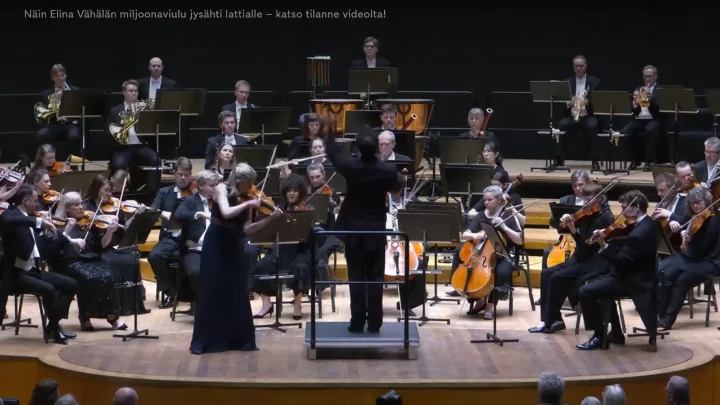
A live classical performance in Finland turned briefly chaotic when a conductor’s baton sent a rare violin spinning through the air. The incident, involving British conductor Matthew Halls and violinist Elina Vähälä, could have ended in disaster. Instead, it became a near-miraculous save that has since gone viral.
What happened during the concert?
The moment unfolded at Sibelius Hall in Lahti, Finland, during a performance of a violin concerto.
A split-second accident
While conducting, Halls’ baton accidentally struck Vähälä’s instrument, knocking it out of her hands. The violin, an 18th-century Guadagnini valued at around £1 million (roughly ₹12 crore), flipped multiple times in mid-air. The orchestra continued playing for a few seconds as the audience processed what had just happened. Vähälä reacted instantly, managing to cushion the fall with her foot before the instrument hit the ground fully.
A pause, then composure
Halls quickly signaled an apology and halted the performance, allowing a brief pause to assess the damage. Remarkably, Vähälä resumed playing shortly afterward, maintaining composure in what could have been a career-defining disaster.
Why was the violin so valuable?
The instrument involved was not just expensive. It was historically significant.
The legacy of Guadagnini violins
The violin was crafted by Giovanni Battista Guadagnini, one of the most respected violin makers of the 18th century. Guadagnini instruments are prized for their tonal richness and rarity, often valued in the millions.
What makes such instruments fragile yet resilient
Despite their age, these violins are designed with a degree of structural flexibility:
- The seams are glued in a way that allows them to loosen under stress
- This prevents cracks in the main wooden body
- Repairs can often be made without permanent damage
In this case, one seam reportedly gave way, exactly as intended, sparing the instrument from more serious harm.
How did Elina Vähälä save the violin?
The defining moment of the incident came down to instinct.
A reflex that made the difference
As the violin fell, Vähälä extended her foot to soften the impact. That split-second reaction reduced the force of the fall, likely preventing cracks or structural damage.
Afterward, she joked about her quick reflexes, describing the move with understated humor. But for musicians and collectors, the moment was anything but lighthearted.
Professional composure under pressure
Equally notable was her decision to continue the performance. For a soloist, maintaining focus after such a shock is no small feat. It reinforced her reputation as a seasoned performer capable of handling high-pressure situations.
What was Matthew Halls’ response?
Halls’ reaction reflected both professionalism and visible regret.
Immediate acknowledgment
He raised his hand in apology almost instantly, signaling awareness of the mistake. After the brief continuation, he stopped the orchestra to ensure the instrument was checked.
Public praise for the soloist
Following the incident, Halls expressed strong admiration for Vähälä, emphasizing her composure and skill. His remarks helped shift the narrative from blame to appreciation of her response.
Why is this incident gaining global attention?
The story has spread widely, not just because of the accident but because of what it represents.
High stakes of classical performance
Classical concerts operate with the following:
- Expensive, often irreplaceable instruments
- Tight coordination between the conductor and the soloist
- Minimal room for error in live settings
This incident highlights how even small miscalculations can have major consequences.
The rarity factor
A £1 million Guadagnini violin is not just valuable. It is irreplaceable. The fact that it survived without significant damage adds an element of relief that resonates beyond classical music circles.
Viral appeal
The combination of:
- A dramatic near-miss
- A high-value object at risk
- A calm recovery
makes for compelling viewing, especially in short video formats.
What does this reveal about orchestral dynamics?
Behind the elegance of a symphony lies a highly coordinated system.
The conductor’s physical role
Conductors use expressive, often sweeping gestures to guide musicians. While visually compelling, these movements carry inherent risk in close proximity to soloists.
Spatial awareness on stage
Incidents like this underscore the importance of:
- Clear spacing between performers
- Controlled conducting gestures
- Awareness of instrument positioning
While rare, such accidents serve as reminders of the physical dimension of live performance.
TL;DR
- A baton from conductor Matthew Halls accidentally knocked a £1 million violin from Elina Vähälä’s hands
- The incident occurred at Sibelius Hall in Finland during a live concert
- The violin, made by Giovanni Battista Guadagnini, survived with minimal damage
- Vähälä cushioned the fall with her foot and resumed playing
- The moment has gone viral as a rare near-disaster with a fortunate ending