
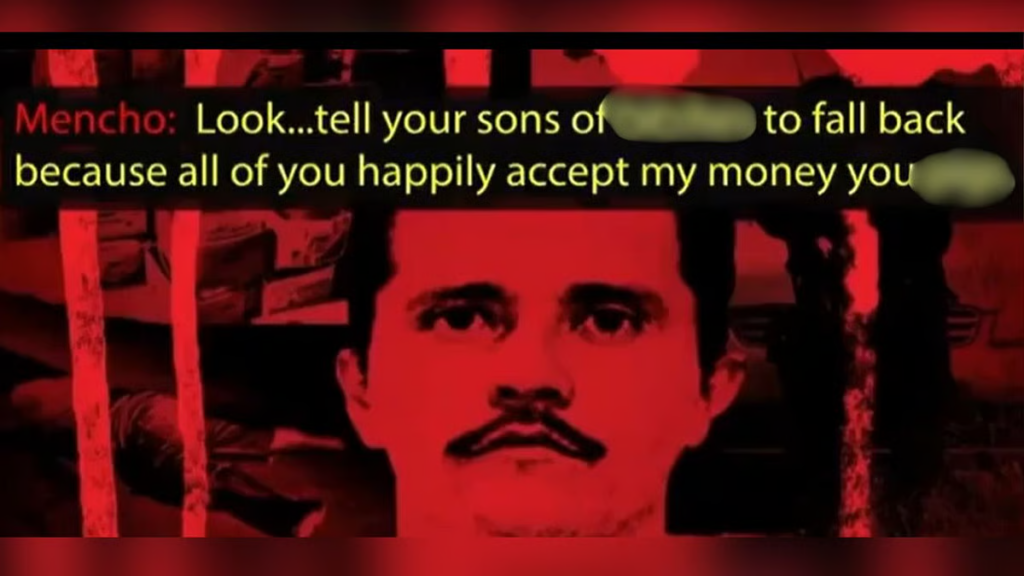
Within hours of the death of Nemesio “El Mencho” Oseguera Cervantes, leader of the Jalisco New Generation Cartel, Mexico was once again confronting a familiar question: how deep did the cartel’s influence run? Now, a leaked audio clip circulating online is intensifying that scrutiny.
The recording, reportedly from 2016, appears to capture El Mencho threatening a police officer and ordering security forces to retreat. The officer’s response is what’s drawing equal attention. He repeatedly addresses the cartel leader as “boss” and “sir,” and agrees to pull units back.
The clip has not been independently verified by major outlets. But even as an unconfirmed artifact, it underscores a reality Mexico has grappled with for years: organized crime’s ability to intimidate, infiltrate, and, in some cases, co-opt law enforcement.
What does the El Mencho leaked audio reveal?
The El Mencho leaked audio, if authentic, offers a rare window into how cartel power allegedly operated behind the scenes.
In the recording, a voice identified as El Mencho delivers explicit threats. He orders the officer to “tell your sons of b****s to fall back,” and claims to have identified dozens of officers. He allegedly warns that failure to comply would result in violence against the officer and his squad.
The officer’s responses are calm and deferential. He assures the caller that he will instruct units to withdraw. At one point, the alleged cartel leader references prior cooperation and payments, suggesting a transactional relationship between criminal leadership and police officials.
Why this matters beyond the shock value
Leaked cartel recordings are not new in Mexico. What makes this one significant is the tone. It is not a chaotic exchange during a firefight. It sounds procedural. Direct. Managerial.
If verified, it would reinforce three long-standing concerns:
- Cartels exerting real-time operational control over police movements.
- Corruption or coercion inside local security forces.
- The normalization of criminal authority in certain regions.
How did El Mencho’s death trigger nationwide unrest?
The emergence of the El Mencho leaked audio coincides with fresh instability following his reported killing during a Mexican military operation.
Authorities say unrest erupted across 20 of Mexico’s 32 states. In Jalisco, suspected cartel members allegedly:
- Torched buses and commercial vehicles.
- Blocked highways with burning debris.
- Clashed with security forces.
- Forced temporary shutdowns of businesses.
Officials reported more than 250 blockades nationwide, with Guadalajara grinding to a near standstill.
The U.S., Canada, India, and other governments issued shelter-in-place advisories for citizens in affected regions. Several airlines suspended flights to tourist hubs, including Puerto Vallarta.
What does this say about cartel influence over police?
For years, anti-corruption advocates have warned that some local police forces in Mexico operate under intense cartel pressure.
The alleged conversation in the El Mencho leaked audio reflects two possible dynamics, both troubling:
Corruption through payment
The cartel leader’s reference to officers “happily accept[ing] my money” suggests bribery. This aligns with longstanding reporting by outlets such as Reuters and The New York Times on cartel infiltration of municipal police forces.
Compliance through fear
Even absent bribery, the threat of violence can be enough. Cartels in Mexico have targeted police officers and their families in the past. A single credible threat can turn a badge into a survival calculation.
The exchange in the recording suggests the officer was either compromised or cornered. In either case, the result is the same: state authority bends.
Who could succeed El Mencho?
El Mencho’s death leaves a leadership vacuum inside the Jalisco New Generation Cartel. Analysts have floated several potential successors, including family members and senior lieutenants.
Among names often cited in open-source reporting:
- Juan Carlos Valencia González, also known as “El Pelón.”
- Jessica Johanna Oseguera González, sometimes referred to as “La Negra.”
- Gonzalo Mendoza Gaytán, known as “El Sapo.”
Each faces constraints, including legal pressure and internal rivalries. Cartel succession is rarely clean. It can splinter into violent competition.
How did U.S. authorities assist in the operation?
While Mexican forces conducted the operation that reportedly killed El Mencho, U.S. agencies have long cooperated with Mexico in targeting cartel leadership.
The U.S. government had offered a multimillion-dollar reward for information leading to his capture. The State Department and DEA have classified the CJNG as a major transnational criminal organization.
This context matters because cartel operations are not confined to Mexico. The CJNG has been tied to drug trafficking networks stretching into the United States and beyond.
Why the leaked audio amplifies the stakes
The timing of the El Mencho leaked audio matters. It surfaces at a moment when Mexico is attempting to reassert control following his death.
If the recording is authenticated, it may fuel:
- Public outrage over police corruption.
- Internal investigations within Mexican security agencies.
- Political pressure on President Claudia Sheinbaum’s administration.
If it is proven false or manipulated, it raises a different concern: disinformation campaigns designed to destabilize institutions during a volatile transition.
In either scenario, transparency becomes crucial.
What happens next?
Cartel violence often spikes after a kingpin’s death. Power vacuums invite competition. Rival groups test boundaries. Local commanders make moves.
Security experts will watch for:
- Turf wars within CJNG factions.
- Encroachment by rival cartels.
- Retaliatory attacks on officials.
- Shifts in trafficking routes.
Mexico’s challenge is not only suppressing violence in the short term. It is restoring institutional credibility. The leaked audio, authentic or not, reinforces how fragile that credibility can be.
TL;DR
- A leaked 2016 audio clip allegedly captures El Mencho threatening a police officer and ordering units to withdraw.
- The officer appears to comply, calling him “boss” and agreeing to fall back.
- The clip remains unverified but highlights longstanding concerns about cartel influence over law enforcement.
- El Mencho’s reported killing has already triggered unrest across 20 Mexican states.
- Leadership uncertainty inside the CJNG could fuel further instability.