The Agriculture Department will send farmers $8 billion in one-time “Harvest Fuel Relief” payments. The money will track planted acres and modeled losses, not the diesel bills farmers actually paid. Payment rates for corn, soybeans, wheat and other major crops are due in November, after Election Day, and the Farm Service Agency (FSA) will run the program.
President Donald Trump announced the program on October 19 at a rally in Park City, Kansas, and USDA posted the details in a press release the same night. The timing is hard to separate from the calendar. The announcement came 15 days before the November 3 midterms, in a state where Republicans are defending a Senate seat.
Diesel is near record highs in the middle of harvest
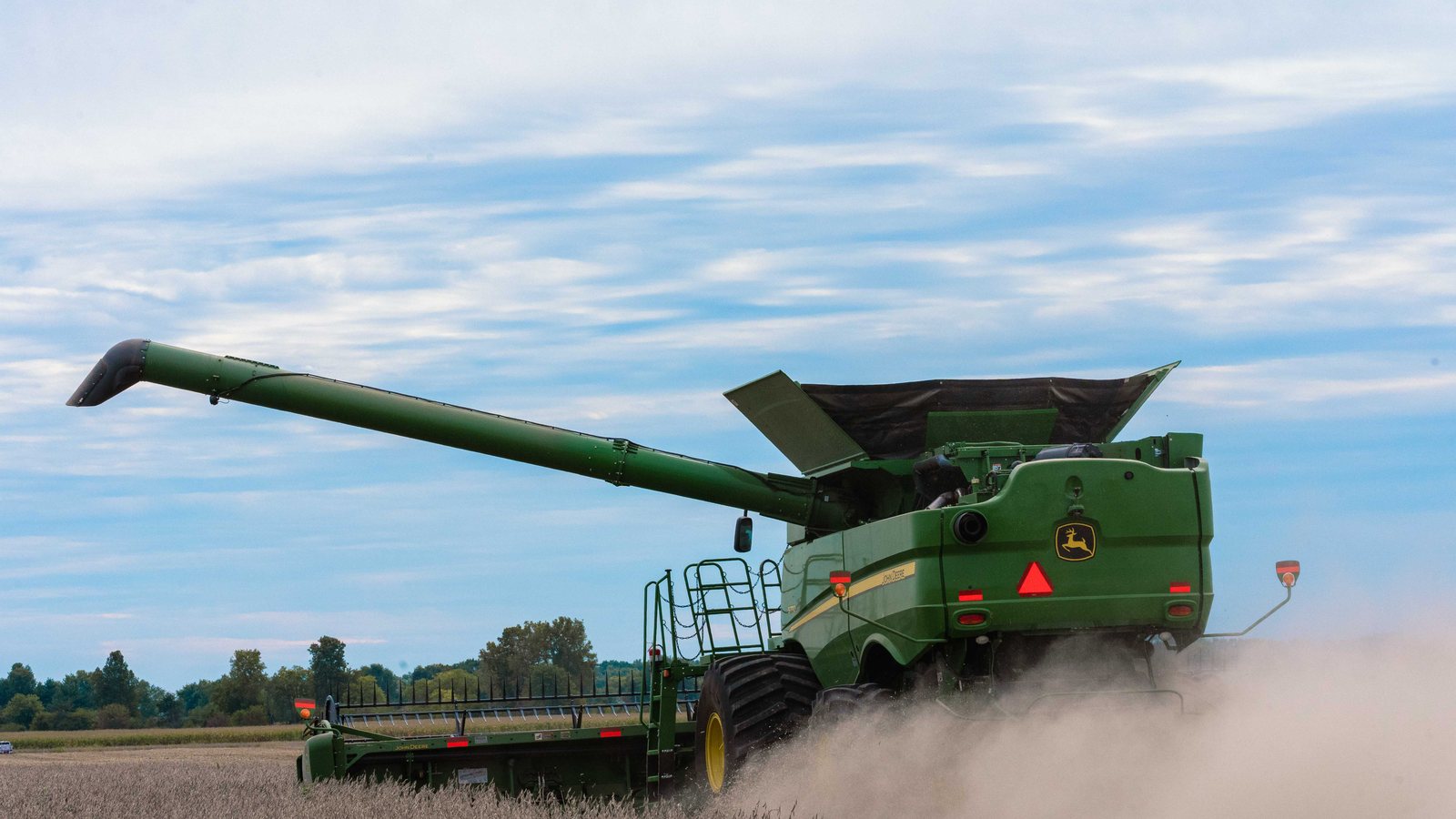
Fall harvest runs on diesel. Combines, grain trucks and dryers burn it for weeks, and this year it has rarely been more expensive.
The Energy Information Administration put the national average on-highway price at $6.18 a gallon in the week of October 12. That is about $2.51 more than a year earlier. The price peaked at $6.53 in late September, above the previous record of $5.81 set in June 2022.
The climb began in early March, when the weekly price jumped from $3.90 to $4.86. In its October Short-Term Energy Outlook, EIA blamed higher crude prices and wider refinery margins. It expects Middle East oil flows to stay constrained through the end of the year. Reuters and the Associated Press tie the spike to the U.S.-Israeli war with Iran.
On farms the squeeze is just as tight. On October 1, the American Farm Bureau Federation put farm diesel “in the heart of the Corn Belt” close to $6 a gallon. That pressure lands on a sector already earning less. USDA’s Economic Research Service forecasts 2026 net farm income at $158.4 billion, down 2.6% from 2025.
The formula pays by the acre, not by the gallon
USDA describes the payments as “simple, proportional support” for “a portion of modeled losses during the 2026 crop year.” It will estimate those losses nationally from three of its own data sets: FSA-reported planted acres, Economic Research Service cost-of-production figures, and the yields and prices in its World Agricultural Supply and Demand Estimates. It is the same approach USDA used for last winter’s bridge payments.
The practical result is that a farm’s check depends on what it planted, not on how much fuel it bought. Large row-crop operations will collect the most, whether or not they locked in cheaper diesel early. A small farm that burned more fuel per acre gets no extra credit for it. Agri-Pulse noted that USDA has not yet explained how the formula will work for individual crops.
First in line are growers of corn, soybeans, wheat, cotton, rice and the other “Title I” commodities, the crops covered by the farm bill’s main programs. Specialty crop growers and fishermen will have to wait for a method USDA says it “will announce at a later date.” In the meantime, USDA is asking them to email fuel-cost data to [email protected] to help set their rates.
Farmers do not need crop insurance to qualify. USDA is telling eligible producers to set up a Login.gov account linked to USDA now, because applications will arrive pre-filled online once the program opens. The agency has not announced application or payment dates.
The money comes from a USDA credit line Congress didn’t vote on
USDA is paying for the program through the Commodity Credit Corporation (CCC). The CCC is a Depression-era federal corporation that can borrow up to $30 billion at a time from the Treasury. The CCC Charter Act gives the agriculture secretary wide discretion over how to spend it, which is why the program needed no vote in Congress.
That borrowing room is already under strain. In a July 29 analysis, American Farm Bureau economist John Newton wrote that the Congressional Budget Office expects the CCC to hit its $30 billion cap every year for the next decade. That cap hasn’t moved since 1987.
Without more room or an early top-up from Congress, Newton warned, USDA could have to “prioritize or prorate” regular program payments. USDA has not said how the new $8 billion fits under the limit this fiscal year.
Trump’s new aid lands on top of $12 billion in bridge payments
The program adds to a run of earlier aid. USDA’s Market Facilitation Program paid $23 billion during the 2018–19 trade war, according to the Government Accountability Office. At the Kansas rally, Trump put his first-term total at “$28 billion,” Fox Business reported, a figure higher than GAO’s count for the trade program alone.
Last December USDA announced $12 billion in bridge payments, which it says reached more than 560,000 farmers. Those payments followed a year in which tariff fights with China hit soybean growers hard. USDA also says nearly $14 billion in gross Agriculture Risk Coverage and Price Loss Coverage payments went out two weeks ago.
Farm groups wanted relief, but not necessarily this kind
Farm groups asked for help with fuel before this program existed. AFBF President Zippy Duvall wrote to the White House on October 1. He then praised Trump’s October 5 executive order allowing tax-exempt red-dyed diesel on public roads. “Every cent per gallon matters when you’re running a fleet of grain trucks,” he said.
As of Tuesday, AFBF had not posted a statement on the $8 billion program itself.
The National Farmers Union was cooler on that approach. In an October 15 post, before the announcement, it noted that the dyed-diesel order only defers the 24.4-cent federal highway tax through year-end. It called ad hoc aid and tax holidays “band aid solutions,” and urged Congress to expand biofuels and allow year-round E15 instead.
Glenn Brunkow, president of the Kansas Farm Bureau, put the case for help more simply. “The margins are tight, and anything that cuts into that margin really hurts,” he told the AP.
Democrats have focused on the war rather than the remedy. A July Joint Economic Committee report from committee Democrats estimated that farmers spent $1.4 billion more on diesel this spring than a year earlier.
“American farmers have been left paying the price,” said Sen. Amy Klobuchar of Minnesota, the top Democrat on the Senate Agriculture Committee. We found no Democratic statement on the new program itself.
Kansas is where the politics and the payments meet
Trump gave the credit to Sen. Roger Marshall, Newsweek reported. The Cook Political Report and Sabato’s Crystal Ball rate Marshall’s race against Democrat Adam Hamilton a toss-up. “Roger Marshall is the leader who fought for that to happen,” Trump told the crowd, adding that being president gives “a little bit of an advantage.”
Reuters counted the program among several pre-election pledges, including a proposed $5,000 check to adults and a one-time $90 payment to Medicare enrollees. Control of the House is also on the line, with a handful of competitive districts likely to decide it.
For farmers, the next real milestone comes after Election Day. USDA says it will publish rates for the major crops in November. Only then will a corn or soybean grower know what the program is worth per acre. EIA updates diesel prices every Monday and releases its next Short-Term Energy Outlook on November 10.