
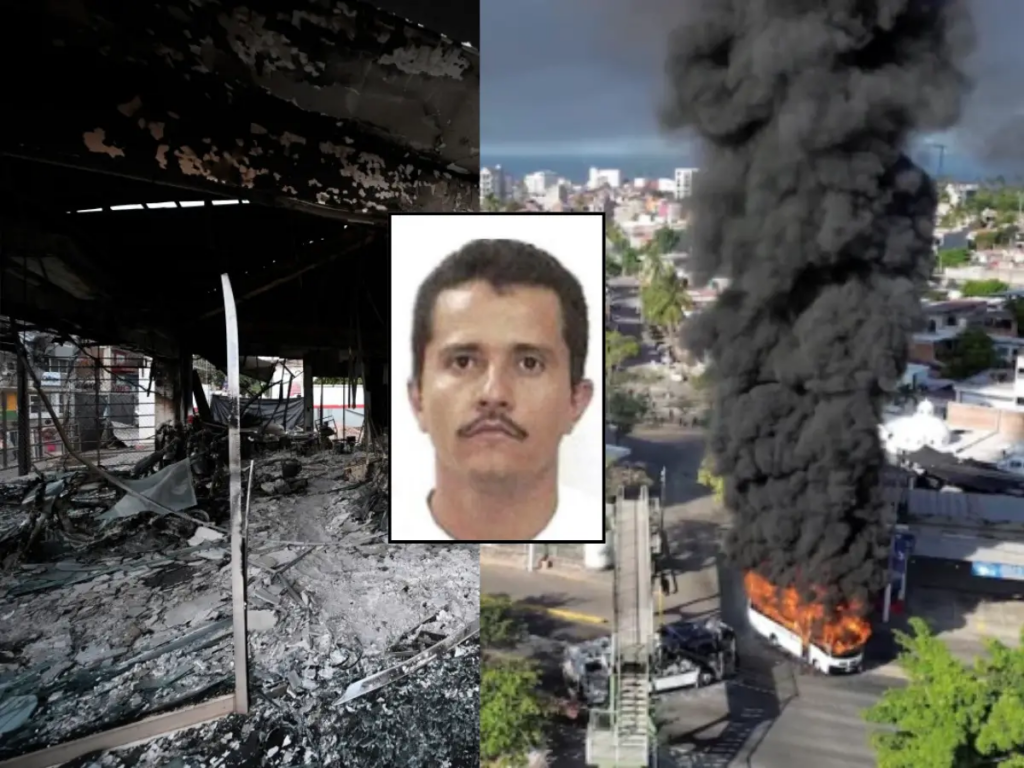
Flights disrupted, army on the road, and rising fears of turf wars define Mexico 24 hours after El Mencho’s killing. The death of Nemesio “El Mencho” Oseguera Cervantes, leader of the Jalisco New Generation Cartel, triggered immediate violence, travel advisories, and a nationwide security response.
While authorities say the situation is stabilizing, tensions remain high across western Mexico. The coming days will determine whether this marks a turning point or the start of a new cartel power struggle.
What is the situation 24 hours after El Mencho’s killing?
More than a day after El Mencho was killed in a Mexican Army operation, parts of the country are slowly returning to routine. But the calm is fragile.
In the immediate aftermath, cartel members reportedly set up roadblocks, torched vehicles, and clashed with security forces. Several countries, including the United States, Canada, India, and the United Kingdom, issued advisories urging citizens to shelter in place or avoid non-essential travel to affected regions.
Although some restrictions have been narrowed, authorities remain on high alert.
Are flights and travel still disrupted in Mexico?
Travel disruptions remain one of the most visible effects 24 hours after El Mencho’s killing.
Airport operations
Guadalajara International Airport has resumed normal operations, according to reports. However, the recovery is uneven.
Flights to Puerto Vallarta have been significantly affected, with airlines including Air Canada and United canceling multiple services. Travelers continue to face uncertainty, particularly in coastal and western states.
Road and bus services
Long-distance bus services from Mexico City to several western states remain suspended. Cartel roadblocks have been reported in certain corridors, creating safety concerns for commercial and private vehicles.
Toll highways are under heavy guard, with National Guard units stationed at key junctions.
Travel advisories
The US advisory has been narrowed but still urges caution in Puerto Vallarta and surrounding areas in Jalisco and Nayarit. The UK Foreign Office has advised against all but essential travel to Jalisco, Colima, and Guerrero.
A map highlighting affected states and travel advisory levels would add clarity for readers tracking the evolving risk landscape.
How has Mexico’s government responded?
Mexico’s security apparatus moved quickly after El Mencho’s killing.
Troop deployment
Authorities have deployed approximately 10,000 troops nationwide to prevent further escalation. The Mexican Air Force has been used in regions where cartel forces reportedly outgunned local police units.
“Red Code” alerts
A “Red Code” alert remains active in states including Baja California. Under this status, the National Guard and Army maintain an indefinite presence, focusing on deterrence and rapid response.
High-risk zones
States identified as high-risk include:
• Jalisco
• Michoacán
• Guanajuato
Security forces are concentrating on highways, urban centers, and strategic infrastructure to prevent coordinated attacks.
Is Mexico at risk of a cartel turf war?
The central question 24 hours after El Mencho’s killing is what happens inside the Jalisco New Generation Cartel.
Leadership decapitation often creates instability. Analysts have pointed to past power struggles within other cartels as a cautionary example.
Lessons from Sinaloa
When leadership uncertainty emerged within the Sinaloa cartel, rival factions competed violently for control. Experts warn that CJNG could face similar internal fractures.
Power vacuum concerns
El Mencho’s top family members are either imprisoned or under scrutiny. That complicates succession and increases the likelihood of:
• Internal rivalries
• Splinter groups forming
• Rival cartels moving in
The Sinaloa cartel and other criminal groups may attempt to exploit any perceived weakness.
Tourists and residents fear being caught in crossfire, particularly during so-called “narcoblockades,” where cartels block roads and ignite vehicles to disrupt security operations.
Who could lead CJNG next?
The question of succession is critical.
El Tuli’s role
Security forces reportedly killed CJNG’s second-in-command, known as “El Tuli,” after he orchestrated retaliatory attacks following El Mencho’s death. Though not formally in line to succeed, he stepped into an operational leadership role during the immediate crisis.
His death further complicates the chain of command.
Family members
• Rubén Oseguera González, known as “El Menchito,” is serving a life sentence in a US federal prison.
• Rosalinda González Valencia, El Mencho’s wife, has faced legal scrutiny in the past, though her current whereabouts remain unclear.
• Jessica Johanna Oseguera, a US citizen, has been mentioned in reports as potentially influential.
• Juan Carlos Valencia González, a stepson, and Gonzalo Mendoza Gaytán, known as “El Sapo,” are also cited as possible figures within the organization.
Authorities consider Laisha Michelle Oseguera González a person of interest, though she maintains a low profile.
At this stage, much of the succession discussion remains speculative. Official confirmation of any leadership change has not been announced.
For responsible reporting, ensure all claims about succession are sourced from credible law enforcement or judicial records.
Why this moment matters beyond Mexico
El Mencho’s killing is not just a domestic event. CJNG’s operations extend into the United States and beyond, affecting drug trafficking routes, money laundering networks, and cross-border violence.
Short-term volatility could disrupt trafficking flows. But history suggests cartels adapt quickly. The larger question is whether Mexico can prevent fragmentation that leads to smaller, more unpredictable criminal cells.
TL;DR
• More than 24 hours after El Mencho’s killing, Mexico is stabilizing but remains tense.
• Flights to key destinations such as Puerto Vallarta are disrupted, and bus routes are suspended.
• Around 10,000 troops have been deployed nationwide.
• Analysts warn of possible turf wars within CJNG and attempts by rival cartels to fill the vacuum.
• Leadership succession remains uncertain following the reported killing of second-in-command El Tuli.