
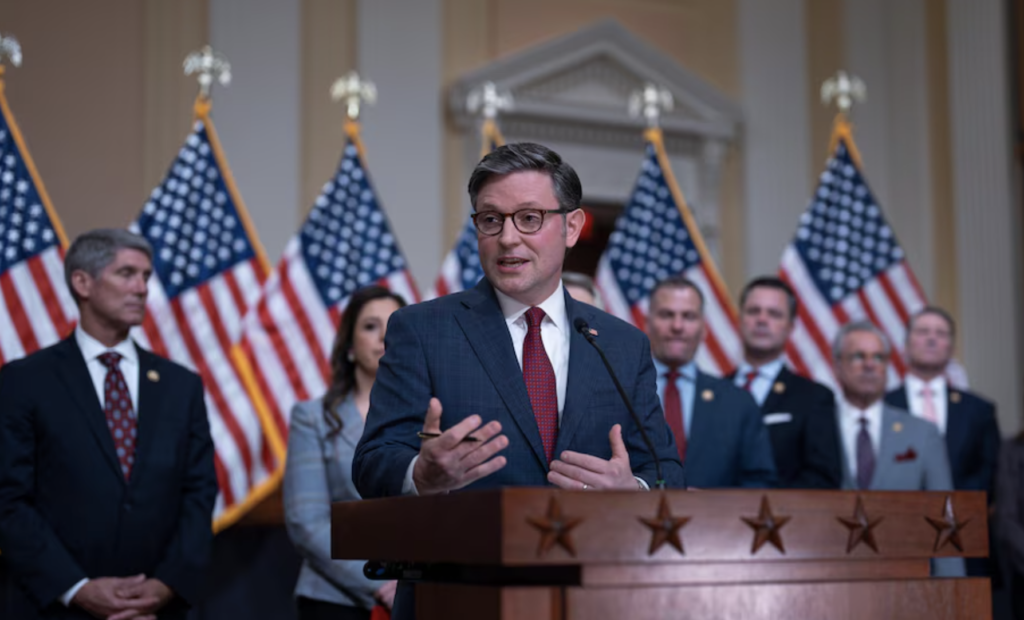


The House approved a $460 billion package of spending bills on Wednesday that will keep money flowing to key federal agencies for the rest of the fiscal year. The Senate is expected to take up the legislation before the shutdown ends at midnight on Friday.
Lawmakers are negotiating a second package of six bills, including defense, in an effort to fully fund all federal agencies by March 22. Finally, total discretionary spending set by Congress is expected to be around $1.66 trillion for the entire fiscal year.
The House voted 339-85 in favor of the bill
A significant number of House Republicans have come out in opposition to the spending packages, forcing House Speaker Mike Johnson, R-La., to use an expedited process to bring the bill up for a vote. To pass, the measure must receive two-thirds of the House’s votes.
The House voted 339-85 in favor of the bill.
What is a $460 billion package of spending bills?
Nondefense spending in this year’s bills remains relatively flat compared to the previous year. Supporters argue that keeping spending below the rate of inflation is equivalent to a reduction, forcing agencies to be more frugal and focus manpower on top priorities. Johnson cited a 10% cut to the Environmental Protection Agency, a 7% cut to the Bureau of Alcohol, Tobacco, Firearms and Explosives, and a 6% cut to the Federal Bureau of Investigation.
However, many Republican lawmakers wanted much steeper cuts and more policy victories. The House Freedom Caucus, which includes dozens of the GOP’s most conservative members, urged Republicans to vote against the first spending package and oppose the second currently being negotiated.
“Despite giving Democrats higher spending levels, the omnibus text released so far punts on nearly every single Republican policy priority,” the group said.
Johnson countered that House Republicans have only a two-vote majority in the House, whereas Democrats control the Senate and White House.
“We have to be realistic about what we’re able to achieve,” Johnson was quoted as saying.
The bill would fully fund a nutrition program for low-income women, infants, and children, totaling approximately $7 billion for the WIC program
Democrats were able to block the majority of the policy riders proposed by House Republicans for the package. For example, they defeated an attempt to block new rules that would increase access to the abortion pill mifepristone.
Democrats also stated that the bill would fully fund a nutrition program for low-income women, infants, and children, totaling approximately $7 billion for the WIC program. That represents a $1 billion increase over the previous year.
As part of those talks, House Republicans pushed to give a few states the authority to prohibit the purchase of non-nutritious foods, such as sugary drinks and snacks, through the food stamp program SNAP. The GOP’s effort was initially unsuccessful, but supporters say they will try again in next year’s spending bills.
Another provision enhances gun rights for certain veterans
“The bill certainly does not have everything we could have wanted, but I am very proud to say that we successfully defeated the vast majority of the extreme cuts and hundreds of harmful policy riders proposed by the House Republicans,” said Rep. Rosa DeLauro, the top Democrat on the House Appropriations Committee.
Another provision enhances gun rights for certain veterans.
The Department of Veterans Affairs is required by law to send a beneficiary’s name to the FBI’s National Instant Criminal Background Check System whenever a fiduciary is appointed to help manage someone’s benefits because they lack the mental capacity to manage their own affairs. This year’s spending package prohibits the department from disclosing that information unless a relevant judicial authority determines that the beneficiary poses a threat to himself or herself or others.
Rep. Mark Takano, the top Democrat on the House Veterans’ Affairs Committee, stated that the VA’s determination of mental incompetency is typically based on “very serious mental health conditions like schizophrenia and dementia.”
“They wanted so badly to make sure that vulnerable veterans could access more firearms,” Takano said. “This is wrong. Lives are on the line. Veterans’ lives are on the line, and I will not agree to legislation that will cause more people’s lives to be lost to gun violence.”
Republicans contend that current VA policy discourages some veterans from seeking the care and benefits they have earned.
In a closed-door meeting with the House GOP, Johnson read from a news report about how Democrats were having “heartburn” over the gun provision, according to a Republican familiar with the conversation who was not authorized to discuss it publicly.
Opponents of the bill were skeptical about how much the process had changed
The bills to fund federal agencies are more than five months overdue, with the fiscal year beginning October 1. House Republicans, however, describe an improved process, claiming that they have broken the cycle of passing all spending bills in one massive package that lawmakers have little time to study before being asked to vote on or risk a government shutdown.
However, opponents of the bill, such as Rep. Scott Perry, R-Pa., were skeptical about how much the process had changed.
The first package includes the Departments of Veterans Affairs, Agriculture, Interior, and Transportation, among others.
Democrats overwhelmingly supported the bill, with 207 voting yes and two voting no. The Republicans voted 132 to 83.
“Once again, Democrats protected the American people and delivered the overwhelming majority of votes necessary to get things done,” House Democratic leader Hakeem Jeffries said.
Rep. Kevin Hern, R-Okla., stated his opposition to the bill, saying, “I’ve not made any bones about it since I’ve been here. We have to get spending under control and we’ve lost the leverage.”