
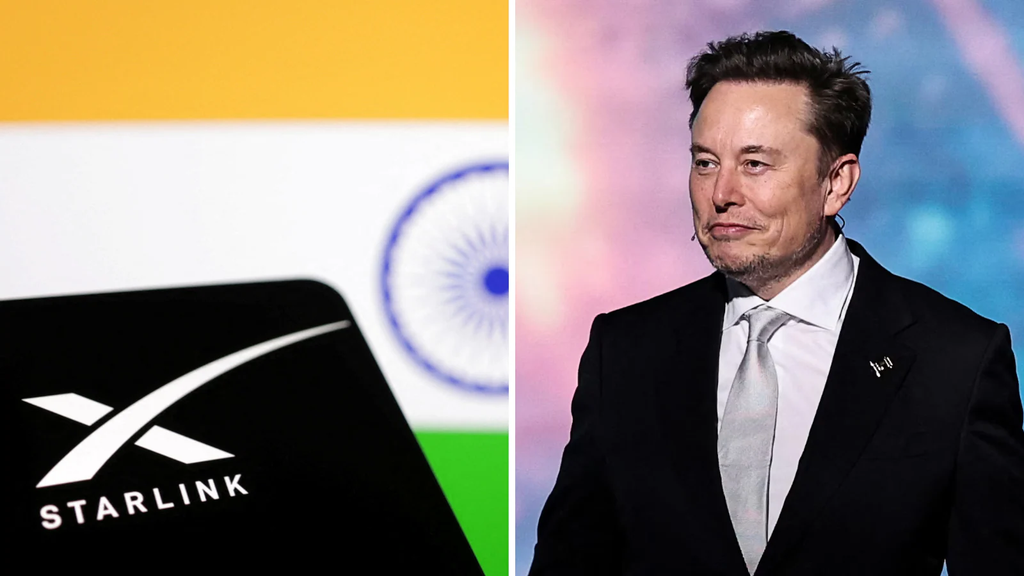
India has pushed back against Elon Musk’s allegations that powerful business interests are obstructing Starlink’s entry into the country, insisting that its satellite communications framework is fair and does not favor any single company. Communications Minister Jyotiraditya Scindia said on October 9 that India would not permit a monopoly in satellite communications and confirmed that Reliance Jio, Eutelsat OneWeb and Starlink had received the relevant licenses. All three, however, still need to complete security assessments before they can move to the next stage of obtaining spectrum for commercial services.
Scindia also identified Amazon as another company seeking to enter India’s satellite internet market. Its application remains under examination, according to the Ministry of Communications.
The clarification follows a public outburst by Musk, who accused unnamed business interests of protecting their market dominance by delaying Starlink’s launch. The dispute has brought renewed attention to India’s regulatory process, its expanding satellite broadband market and the competition between traditional telecom operators and global technology companies.
What did Elon Musk accuse India of?
Musk criticized the delays surrounding Starlink’s planned Indian launch, alleging that influential business interests were trying to preserve their control over the country’s internet market.
In a post on X, he accused unnamed “oligarchs” of maintaining a “monopolistic chokehold” over Indian consumers by preventing Starlink from entering the market.
Musk argued that blocking the service would hurt people who lack reliable internet access, particularly those living in remote and underserved areas where conventional broadband infrastructure can be difficult or expensive to establish.
His criticism followed years of regulatory engagement between SpaceX and Indian authorities. Although Starlink has secured an initial license, it has not yet received every approval required to begin commercial operations.
Musk’s remarks subsequently drew attention to Reliance Industries chairman Mukesh Ambani and the broader rivalry between satellite broadband operators and India’s established telecom companies. However, his initial accusation did not provide evidence establishing that a particular company had improperly influenced the government’s decisions.
How did India respond to the monopoly allegations?
The Ministry of Communications rejected Musk’s suggestion that India’s licensing framework was being applied unfairly.
In a statement issued on October 8, the ministry said the country’s regulatory framework for satellite communications was “fair and non-discriminatory.” It added that all three licensed satellite operators were undergoing security assessments and were at broadly the same regulatory stage.
Scindia reinforced that position the following day.
“India does not allow a monopoly in any sector,” the minister said, arguing that the government had authorized multiple operators rather than selecting a single company for the market.
He also emphasized that licensing did not automatically entitle a company to begin commercial services. Operators must satisfy the applicable security requirements and complete the remaining regulatory steps.
The government’s position is that the delays are part of a common approval process rather than evidence that Starlink is being deliberately blocked.
Which satellite internet companies have received licenses in India?
The three companies with the relevant licenses are Starlink, Reliance Jio and OneWeb.
Starlink, operated by Musk’s SpaceX, plans to provide broadband connectivity through a large constellation of low-Earth-orbit satellites.
Reliance Jio is developing its own satellite communications business, while OneWeb, which operates under the Eutelsat group, is pursuing satellite connectivity services through its Indian operations.
Their licenses represent an important step, but they do not mean that all three can immediately begin providing commercial satellite internet to customers.
According to the government, each operator must complete its security assessment before moving to the next stage of obtaining spectrum.
That distinction explains why Starlink can describe itself as licensed while still awaiting clearance to launch its Indian service.
Where does Amazon fit into India’s satellite internet plans?
Amazon is another potential entrant, but its regulatory position differs from that of the three licensed operators.
Amazon Kuiper Services India Private Limited has applied for authorization to provide satellite communications services in the country. Its application was still under examination in the Ministry of Communications’ latest publicly available update.
The distinction matters because Amazon has not been identified as one of the three companies that have received the relevant license.
Amazon’s satellite broadband project, known as Project Kuiper, aims to use a network of low-Earth-orbit satellites to provide internet connectivity, including in locations where terrestrial networks have limited reach.
If its Indian application is approved and it satisfies the required conditions, Amazon could become another competitor in the country’s satellite internet market.
Its presence would add another major international technology company to a field that already includes SpaceX and established Indian telecom interests.
Why is satellite internet becoming a major battleground in India?
Satellite broadband can provide connectivity in places where traditional networks are difficult to deploy.
Remote villages, mountainous regions, coastal communities and border areas can be expensive to connect using fiber-optic cables or conventional mobile infrastructure. Satellite systems can potentially reach these locations without requiring the same density of ground-based network equipment.
India has a large population living outside major urban centers, making rural connectivity an important part of its digital development strategy.
Satellite internet could also serve businesses, emergency services and organizations operating in locations where terrestrial networks are unreliable.
The commercial opportunity has attracted international companies because India’s growing digital economy offers a potentially substantial market.
However, satellite operators must also satisfy national requirements governing telecommunications, spectrum use, data security and lawful access to communications.
Those requirements are particularly important for networks that rely on infrastructure and satellites operating across international borders.
What is delaying Starlink’s commercial launch?
The immediate obstacles are security assessments, spectrum assignment and the finalization of the pricing framework for satellite communications.
India’s Department of Telecommunications and the Telecom Regulatory Authority of India have been involved in discussions concerning the pricing and allocation of satellite spectrum.
Scindia said the government was approaching a decision on the pricing framework.
He also clarified that the decision to assign satellite spectrum administratively rather than through an auction had already been made. The outstanding questions concern the applicable framework and the conditions that operators must satisfy before services can begin.
Security clearance is another requirement.
The government says all three licensed operators must demonstrate compliance with the relevant security conditions. Once an operator completes this process, it can proceed to the next stage of seeking spectrum assignment.
This means Starlink’s license alone is not sufficient to authorize a commercial launch.
Why are security clearances important?
Satellite communications raise questions that extend beyond ordinary market competition.
Governments typically need to ensure that telecommunications systems comply with national security requirements, including applicable rules for monitoring communications, protecting data and responding to lawful requests from authorities.
India has emphasized that satellite operators must meet its security requirements before providing commercial services.
These checks also help explain why a company may receive a license but remain unable to activate its service.
The government says the process is being applied to Starlink, Jio and OneWeb alike.
Musk’s criticism focuses on the time Starlink has spent trying to secure final approval, while India’s response emphasizes that the remaining requirements apply to every licensed operator.
The disagreement therefore involves both the pace of regulatory approval and the question of whether the process is being applied consistently.
Could Jio and OneWeb benefit from Starlink’s delay?
The delay leaves established operators and other satellite providers without a new commercial competitor in the Indian market.
Jio is a major force in India’s telecom industry and has its own satellite communications ambitions. OneWeb is backed by the Eutelsat group and has developed a satellite network aimed at providing broadband connectivity to businesses, governments and underserved regions.
Starlink’s eventual launch would add another large operator and could intensify competition over prices, coverage, reliability and business customers.
Musk’s allegation is that influential companies want to protect their existing market positions by keeping Starlink out.
India has rejected the suggestion that its regulatory process is discriminatory.
No publicly established finding cited in the current dispute proves that Jio, OneWeb or another company improperly influenced the approval process.
The competitive implications are clear, but the alleged motive behind the delays remains disputed.
What could Starlink mean for Indian consumers?
If Starlink receives the remaining approvals and launches commercially, its service could provide another connectivity option for households, businesses and institutions outside well-served urban areas.
Satellite broadband is particularly relevant where laying fiber or expanding mobile networks is difficult because of terrain, distance or limited infrastructure.
However, satellite service is not automatically cheaper or better than conventional broadband in every location.
The final consumer experience will depend on the prices Starlink is permitted to charge, the cost of the user equipment, network capacity, service coverage and local competition.
Starlink will also need to comply with India’s security and operational requirements.
The company may be well established in other markets, but its commercial model in India will ultimately depend on the terms under which it is authorized to operate.
What happens next in India’s satellite internet race?
The next major steps are the completion of security assessments, the resolution of outstanding spectrum and pricing arrangements, and further progress on Amazon’s application.
Starlink, Jio and OneWeb are all waiting to complete requirements before moving toward commercial operations under the current approval framework.
Amazon remains at an earlier stage, with its application still being examined.
Scindia’s statements are intended to underline that the government is not selecting a single winner in advance. Whether that process produces a timely launch for Starlink and its competitors will depend on how quickly the remaining regulatory steps are completed.
The dispute also illustrates the tension between rapid market entry and government oversight. Satellite internet companies want predictable approval timelines so they can invest in infrastructure and plan commercial launches. Governments, meanwhile, want to ensure that operators meet national security and spectrum requirements.
For now, Musk has made his frustration public, and India has rejected the accusation of favoritism.
The larger contest is no longer just about whether Starlink can enter India. It is about how India manages competition among global satellite networks, domestic telecom giants and new entrants such as Amazon while deciding the rules for a rapidly evolving communications market.