
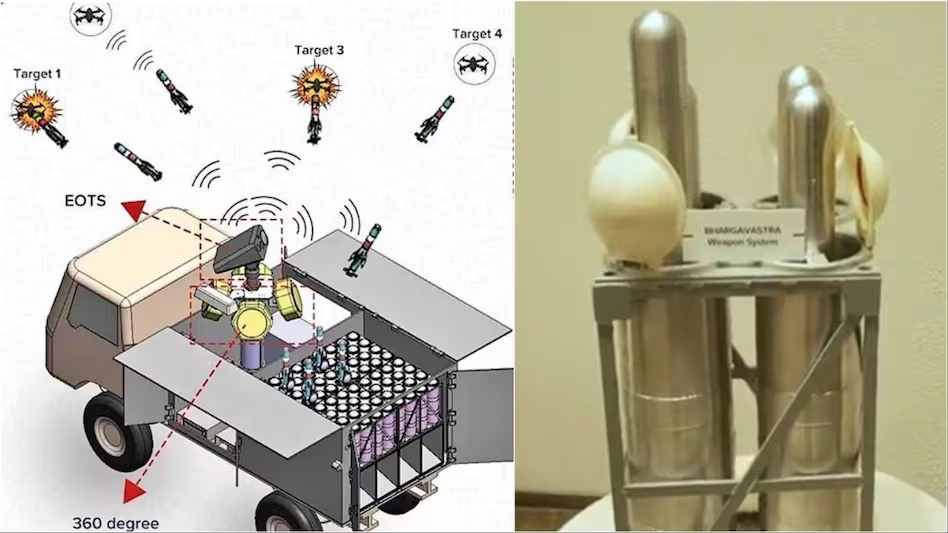
After more than three weeks of India-Pakistan tensions, India on Wednesday (May 14) successfully test-fired “Bhargavastra”, a low-cost and indigenous system to counter drones, especially those flying in large groups or swarms.
Indigenous defence technology demonstrates promising results
Solar Defence and Aerospace Limited (SDAL) created the system, which is being seen as a big step forward in protecting the nation from potential drone threats in the future.
The “Bhargavastra” underwent rigorous field trials at the Seaward Firing Range in Gopalpur on May 13, in the presence of Army Air Defence senior officials.
Indian news agency ANI reported, citing Solar Defence, that two trials were conducted by firing one rocket each and one trial by firing two rockets in salvo mode within 2 seconds.
About Bhargavastra
Bhargavastra is developed by Economic Explosives Ltd (EEL), a subsidiary of Solar Group. It uses guided micro-munitions that are capable of destroying small and incoming drones at a range of up to 2.5 km, with radar detection extending up to 6 km.
It further has a soft-kill method like jamming and spoofing enemy drones to distract them away from high-value targets.
The modular system of Bhargavastra allows the configuration of its sensors and launchers per mission need.
How does it work?
The Bharagavastra system functions with a two-tiered approach. The first layer features unguided micro rockets with a 20-metre lethal radius, designed to tackle mass drone incursions.
While the second layer of precision-guided micro missiles complements the first layer, validating through independent tests, and offering surgical accuracy against high-value or elusive aerial targets.
The architecture of Bharagavastra allows the integration of multiple sensor systems, including radar, electro-optical (EO), and radio frequency (RF) receivers, enabling layered air defence cover tailored to mission-specific requirements.