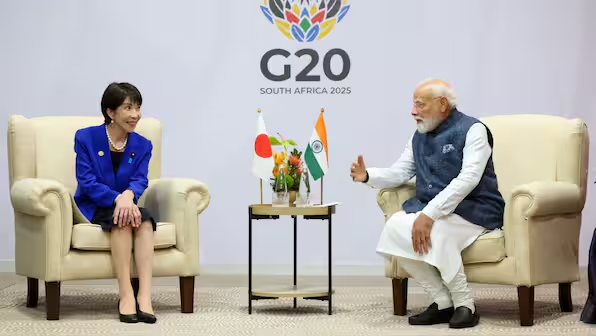
As Japanese Prime Minister Sanae Takaichi prepares to visit India for high-level talks with Prime Minister Narendra Modi, attention is naturally focused on the diplomatic agenda. But the meeting is about much more than protocol. It comes at a time when India and Japan are expanding cooperation across infrastructure, defense, clean energy, semiconductors, digital technology, and space exploration.
The two countries formally elevated their relationship to a Special Strategic and Global Partnership in 2014, laying the foundation for one of Asia’s most significant bilateral partnerships. Since then, Japan has become one of India’s largest development partners, financing critical infrastructure while working closely with New Delhi on emerging technologies and regional security.
From India’s first bullet train to joint lunar exploration, the India-Japan partnership has evolved into a relationship that is shaping the future of both countries—and increasingly, the Indo-Pacific.
TL;DR: India and Japan are deepening cooperation across transportation, clean energy, digital technology, semiconductors, and space. Ahead of Prime Minister Sanae Takaichi’s visit to India, here’s a look at the biggest agreements and why they matter.
Why the India-Japan partnership matters
The India-Japan partnership extends well beyond traditional diplomacy. Both countries share democratic values, support a free and open Indo-Pacific, and seek to build resilient supply chains amid growing geopolitical uncertainty.
For India, Japan brings world-class technology, long-term infrastructure financing, and manufacturing expertise. For Japan, India offers one of the world’s fastest-growing major economies, a vast consumer market, and an increasingly important strategic partner in Asia.
This alignment has resulted in billions of dollars in investments and decades-long collaboration on projects designed to transform India’s infrastructure and industrial landscape.
What are the biggest India-Japan projects?
Mumbai-Ahmedabad High-Speed Rail: India’s first bullet train
Perhaps no project better symbolises India-Japan cooperation than the Mumbai-Ahmedabad High-Speed Rail Corridor.
Stretching 508 kilometres, the corridor is India’s first bullet train project and is being developed using Japan’s renowned Shinkansen technology.
Japan is not only supplying the technology but is also providing significant financial support through highly concessional loans.
Why it matters
The project is expected to:
- Reduce travel time dramatically between Mumbai and Ahmedabad.
- Introduce globally proven high-speed rail technology to India.
- Develop India’s expertise in high-speed rail engineering and maintenance.
- Create long-term economic opportunities along the corridor.
Western Dedicated Freight Corridor: The backbone of industrial logistics
While the bullet train often grabs headlines, the Western Dedicated Freight Corridor (WDFC) could have an even greater economic impact.
The 1,506-kilometre electrified freight railway is largely funded through Official Development Assistance (ODA) loans from the Japan International Cooperation Agency (JICA), which financed nearly 80 percent of the project’s total cost.
Why it matters
The corridor serves as the logistics backbone for the Delhi-Mumbai Industrial Corridor (DMIC) by:
- Reducing freight transit times.
- Lowering logistics costs.
- Improving cargo reliability.
- Supporting industrial manufacturing and exports.
For a country seeking to become a global manufacturing hub, efficient freight movement is critical.
Metro rail expansion across India’s biggest cities
Japan has quietly become India’s largest external supporter of urban metro systems.
Japanese funding has supported metro rail development in cities including:
- Delhi
- Mumbai
- Bengaluru
- Chennai
- Kolkata
- Ahmedabad
These projects improve urban mobility while reducing congestion and pollution.
Beyond financing, Japanese agencies have contributed technical expertise, project management practices, and operational planning.
How are India and Japan working together on clean energy?
Energy transition has emerged as one of the fastest-growing areas of cooperation.
Hydrogen and renewable ammonia
Through the India-Japan Clean Energy Partnership, both countries are developing plans for:
- A hydrogen-ammonia trade corridor.
- Large-scale renewable ammonia production in Odisha.
- Low-carbon industrial fuel alternatives.
Hydrogen is widely viewed as one of the fuels that could help decarbonise sectors where electrification remains difficult, including heavy industry and shipping.
Carbon reduction initiatives
The partnership also includes the Joint Crediting Mechanism (JCM), which encourages investments in technologies that reduce greenhouse gas emissions while allowing both countries to share the environmental benefits.
As India pursues ambitious climate goals, Japanese technology and financing are expected to play a growing role.
How is digital technology strengthening India-Japan ties?
The digital economy has become another pillar of the relationship.
5G and Open RAN collaboration
Under the India-Japan Digital Partnership, companies such as NEC and Reliance Jio are collaborating on:
- 5G deployment.
- Open RAN infrastructure.
- Telecommunications innovation.
Open RAN aims to create more flexible and interoperable mobile networks, reducing dependence on a limited number of equipment suppliers.
AI, IoT, and digital innovation
The partnership also supports collaboration in:
- Artificial intelligence.
- Internet of Things (IoT).
- Cybersecurity.
- Digital infrastructure.
These initiatives reflect both countries’ desire to build secure and resilient digital ecosystems.
Why are semiconductors becoming a priority?
Semiconductors have become central to global economic and national security discussions.
India and Japan are working together to strengthen semiconductor supply chains while reducing vulnerabilities exposed during recent global chip shortages.
Key developments include:
- Development of an OSAT (Outsourced Semiconductor Assembly and Test) facility in Sanand, Gujarat.
- Japanese investment in semiconductor-related manufacturing.
- Technology collaboration aimed at building India’s semiconductor ecosystem.
These efforts align with India’s broader push to become a major electronics manufacturing destination.
Japan’s manufacturing investments are expanding
Japanese companies continue investing heavily in India’s manufacturing sector.
One notable example is Proterial (formerly Hitachi Metals), which announced an investment of approximately ₹2,250 crore ($270 million) to establish a permanent magnet manufacturing facility.
Permanent magnets are essential components used in:
- Electric vehicles.
- Wind turbines.
- Consumer electronics.
- Industrial machinery.
The investment supports India’s broader manufacturing ambitions while strengthening supply chain resilience.
How is Japan supporting development in Northeast India?
Strategic infrastructure in Northeast India has become another major focus through the Act East Forum.
Projects supported under this initiative include:
- Road connectivity.
- Hydropower development.
- Water supply systems.
- Forest management.
- Regional infrastructure.
The goal is to improve connectivity between India’s Northeast and neighbouring countries in South and Southeast Asia, supporting trade and regional integration.
India and Japan are also reaching for the Moon
The partnership extends beyond Earth.
LUPEX lunar mission
The Lunar Polar Exploration (LUPEX) mission represents one of the most ambitious collaborations between the Indian Space Research Organisation (ISRO) and the Japan Aerospace Exploration Agency (JAXA).
The mission aims to explore the Moon’s polar regions, where scientists believe water ice may exist beneath the surface.
Water resources on the Moon could play a critical role in future lunar exploration and long-term human missions.
The collaboration highlights how India and Japan are moving beyond infrastructure into advanced scientific research.
A symbol of cultural cooperation: Rudraksh Convention Centre
Not every partnership is measured in rail lines or satellites.
The Rudraksh International Cooperation and Convention Centre in Varanasi, built with Japanese grant assistance, reflects the cultural dimension of bilateral ties.
The center has become a venue for conferences, cultural exchanges, and international events, symbolising people-to-people cooperation alongside strategic collaboration.
Why the upcoming Modi-Takaichi meeting matters
Prime Minister Sanae Takaichi’s visit comes amid shifting geopolitical dynamics across the Indo-Pacific.
As supply chains diversify, technology competition intensifies, and regional security challenges evolve, India and Japan are finding increasing strategic alignment.
The meeting is expected to reinforce cooperation in:
- Infrastructure investment.
- Defense and maritime security.
- Semiconductor manufacturing.
- Clean energy.
- Digital technologies.
- Supply chain resilience.
- Space exploration.
Rather than announcing an entirely new direction, the discussions are likely to build on a partnership that has steadily expanded over the past decade.
The bigger picture
The India-Japan relationship has grown into one of Asia’s most comprehensive strategic partnerships. While flagship projects like the Mumbai-Ahmedabad bullet train attract public attention, the broader relationship spans logistics, clean energy, advanced manufacturing, semiconductors, digital infrastructure, and space science.
As both countries navigate an increasingly complex geopolitical environment, their partnership is becoming less about individual projects and more about long-term strategic alignment. The upcoming Modi-Takaichi meeting is expected to reinforce that trajectory, highlighting a relationship that continues to evolve from development assistance into a broad-based collaboration with regional and global significance.