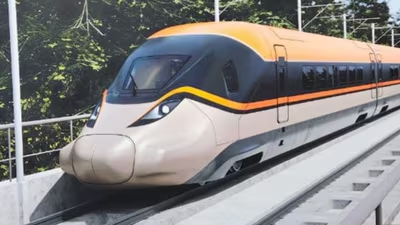
India has unveiled the design of its first proposed bullet train, offering a glimpse into the future of high-speed rail travel in the country.
The image of the train is currently on display outside Gate Number 4 of the Ministry of Railways in New Delhi and marks a major milestone for the long-awaited Mumbai-Ahmedabad High-Speed Rail (MAHSR) corridor.
Once operational, the bullet train is expected to slash travel time between Mumbai and Ahmedabad from several hours to roughly two hours, dramatically reshaping intercity travel in western India.
The 508-kilometer corridor will pass through Maharashtra, Gujarat, and the Union Territory of Dadra and Nagar Haveli.
What is the Mumbai-Ahmedabad Bullet Train project?
The Mumbai-Ahmedabad High-Speed Rail project is India’s first dedicated bullet train corridor and one of the country’s most ambitious infrastructure initiatives.
The line is being developed using Japanese Shinkansen-inspired high-speed rail technology and is expected to become the foundation for India’s future bullet train network.
The route will include 12 stations:
- Mumbai
- Thane
- Virar
- Boisar
- Vapi
- Billimora
- Surat
- Bharuch
- Vadodara
- Anand
- Ahmedabad
- Sabarmati Railway Station
The corridor is expected to improve regional connectivity, reduce pressure on aviation routes, and modernise India’s passenger rail network.
Construction progress across Gujarat and Maharashtra
Railway officials say significant progress has already been made on station infrastructure and civil construction.
Foundation work has been completed at eight stations in Gujarat:
- Vapi
- Billimora
- Surat
- Bharuch
- Anand
- Vadodara
- Ahmedabad
- Sabarmati
In Maharashtra, construction activity is underway at:
- Thane
- Virar
- Boisar
Meanwhile, excavation work at the underground station inside Mumbai’s Bandra Kurla Complex (BKC) is nearing completion.
The BKC station is considered one of the most technically challenging parts of the project because of its underground construction requirements in a densely populated urban zone.
Major bridges and India’s first undersea rail tunnel
The project also includes extensive bridge and tunnel infrastructure.
So far:
- 17 river bridges have been completed
- Work is progressing on four major bridges across the Narmada, Mahi, Tapti, and Sabarmati rivers in Gujarat
- Four river bridges are under construction in Maharashtra
One of the project’s headline engineering features is an undersea tunnel section near Mumbai.
According to officials:
- Excavation work at BKC station is about 91% complete
- Around 4.8 kilometres of the undersea tunnel between Ghansoli and Shilphata have already been completed
The tunnel section is expected to become one of India’s most sophisticated rail engineering projects.
Bullet trains will be manufactured in India
A major focus of the MAHSR project is domestic manufacturing under the Indian government’s “Make in India” initiative.
The train sets are being jointly developed by:
- Integral Coach Factory in Chennai
- BEML Limited in Bengaluru
The trains are being designed for speeds of up to 280 km/h.
Officials say the project is intended not only to improve transport infrastructure but also to help India develop indigenous expertise in high-speed rail technology.
That could eventually support future bullet train corridors planned across the country.
Why the Mumbai-Ahmedabad Bullet Train matters
The project represents more than just faster travel.
Supporters argue the bullet train corridor could:
- Boost economic integration between major business hubs
- Encourage urban development around stations
- Reduce traffic congestion and aviation pressure
- Generate high-skilled engineering jobs
- Accelerate India’s modernisation push
Critics, however, have questioned the project’s high costs and land acquisition challenges over the years.
Still, the government continues to position the bullet train as a symbol of India’s infrastructure ambitions and technological advancement.
When will India’s first bullet train start operating?
The Mumbai-Ahmedabad High-Speed Rail corridor is currently targeted for launch on August 15, 2027.
If completed on schedule, it will mark the beginning of India’s entry into the global high-speed rail club alongside countries such as:
- Japan
- China
- France
- Spain
For India’s railway system — one of the largest in the world — the launch could become a defining infrastructure milestone of the decade.
TL;DR
- India has unveiled the first design of its proposed Mumbai-Ahmedabad bullet train.
- The 508-km corridor will connect 12 stations across Maharashtra and Gujarat.
- Construction is progressing on bridges, tunnels, and underground stations.
- India’s first undersea rail tunnel is also under development.
- The train sets are being developed domestically under the Make in India initiative.
- The bullet train route is expected to open on August 15, 2027.