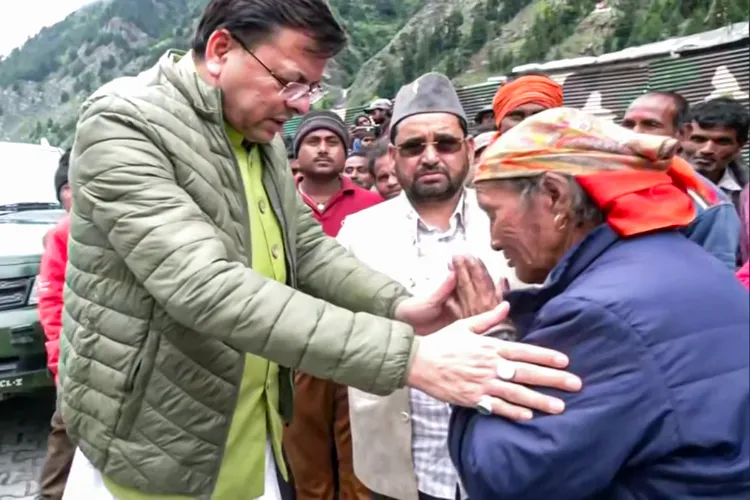
In the fragile Himalayan terrain of Uttarakhand, a natural disaster is never just a passing news headline. For the local people, a landslide or flash flood means the disruption of everyday life—shattered homes, vanished roads, and jeopardised livelihoods.
Under the leadership of Chief Minister Pushkar Singh Dhami, the state government has realised that a crisis response cannot end when the rescue teams leave. In the wake of recent natural disasters, the state has pioneered what is now widely recognised as the “Dhami Model” of disaster management, a holistic approach that transitions seamlessly from emergency rescue to long-term rehabilitation and climate-resilient rebuilding.
From Immediate Rescue to Lifelong Rehabilitation
When devastating flash floods and debris flows struck the Dharali and Tharali regions a year ago, the government’s immediate priority was saving lives. Elite forces, including the SDRF, NDRF, and the Indian Army, were instantly mobilised alongside the local administration.
However, what set the state’s response apart was the immediate transition into aftercare. CM Dhami personally visited ground zero to meet affected families, issuing strict directives to bypass bureaucratic red tape. Compensation, infrastructure repair, and the restoration of essential services—like drinking water, electricity, and mountain roadways in Dharali, Tharali, Harsil, and Bhatwari—were fast-tracked.
In the mountains, a broken irrigation channel can ruin an entire agricultural season, and a blocked road cuts off vital medical access. The Dhami Model recognises these unique geographical challenges, prioritizing the swift restoration of these economic lifelines.
A ₹33 Crore Investment in Mountain Recovery
To ensure that families could properly rebuild their lives, the Uttarakhand government committed over ₹33 crore towards relief, rehabilitation, and regional development over the past year.
Here is how the recovery funds are being utilized:
- Direct Financial Relief: More than ₹17 crore was disbursed directly to affected families under various state relief measures.
- Infrastructure & Agriculture: Over ₹16 crore was invested through key departments—including Public Works, Agriculture, Energy, and Rural Development.
- Restoring Livelihoods: Recognising that replacing a home isn’t enough if the income source is gone, the government provided compensation for damaged orchards, distributed new crop saplings, and offered financial support for traditional sheep and goat rearing.
Rebuilding With the Next Disaster in Mind
Rebuilding in a Himalayan state comes with complex challenges like slope stability, river behaviour, and drainage pressure. Simply recreating what was lost means recreating old vulnerabilities.
To combat this, Uttarakhand has established a proactive disaster management framework, focusing on:
- Advanced weather tracking platforms and early warning systems.
- Regular monsoon review drills to ensure operational readiness.
- Disaster-resilient infrastructure, including strategic landslide mitigation walls and riverbank flood protection.
“The Dharali disaster was not merely a challenge of rebuilding infrastructure; it was a responsibility to restore the lives and future of the affected families. Our commitment is to make the Bhagirathi Valley safer, stronger, and more prosperous than before.” — Pushkar Singh Dhami, Chief Minister of Uttarakhand
The Joshimath Crisis: A True Test of the Dhami Model
The core principles of the Dhami Model—protecting people first and staying with them through recovery—were put to the ultimate test during the Joshimath land subsidence crisis in late 2022 and early 2023.
When large cracks began appearing in homes and streets, the government executed a swift, multi-tiered response:
- Immediate Evacuation & Zoning: Joshimath was systematically divided into Danger, Buffer, and Safe zones. Families in unsafe areas were swiftly moved to relief camps in hotels, schools, and guest houses.
- Risk Mitigation: Severely damaged structures, including prominent hotels, were subjected to controlled demolitions to prevent catastrophic collapses. Construction on the Helang-Marwari bypass and the NTPC Tapovan Vishnugad tunnel was instantly halted.
- Financial Safety Nets: The government waived water and electricity bills, provided ₹4,000 in monthly rent support, and issued an interim payment of ₹1.5 lakh to affected families.
A Scientific, Long-Term Vision for Joshimath
To ensure a permanent solution, the state brought in top-tier scientific agencies—including IIT Roorkee, GSI, and CSIR-CBRI—to assess ground stability. Backed by the central government, NDMA, and state funds, a massive ₹1,658.17 crore Recovery and Reconstruction Plan was approved for slope stabilisation and resettlement.
Families were empowered with three distinct rehabilitation choices:
- Financial compensation for their damaged land and buildings.
- A new plot of safe land (up to 75 sq m) alongside building compensation.
- A brand-new, government-built house on a secure plot of land.
Whether dealing with sudden flash floods in Dharali or the slow-moving geological crisis in Joshimath, the Dhami Model proves that effective disaster management requires more than just reactive measures. By prioritising resilient infrastructure, rapid financial aid, and long-term livelihood support, Uttarakhand is writing a new playbook for protecting its people against the unpredictable forces of nature.