
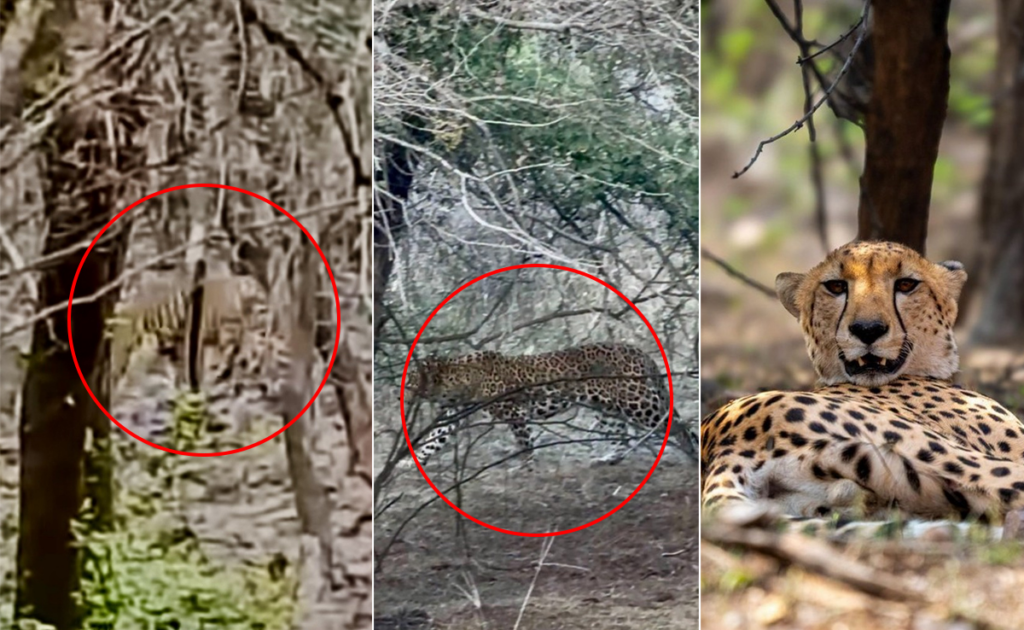
In a scene that feels almost scripted by nature itself, three of India’s most elusive big cats were spotted within the same stretch of forest at Ranthambore Tiger Reserve. A tiger, a leopard, and a cheetah appearing in the same window of time has left wildlife experts and enthusiasts both fascinated and cautious about what this moment really represents.
The sighting, captured in Zone 9 of the reserve, has been described by forest officials as “rare” and “unscripted.” For a landscape defined by territorial instincts and silent rivalries, this brief overlap is less a peaceful gathering and more a fleeting alignment of paths.
What exactly happened in Ranthambore?
According to the Rajasthan Forest Department, tourists and officials observed the three predators within the same general area near the Chakal River zone, roughly 45 minutes from the core park.
The department shared visuals on social media, noting that such moments cannot be planned or predicted. The animals were not interacting directly but were present in the same landscape during a narrow timeframe.
That distinction matters. This was not a coexistence moment in the literal sense. It was more like three apex actors briefly crossing the same stage, each following its own script.
Why is this sighting considered rare?
Big cats are solitary and territorial by design. Their survival depends on maintaining distance, not proximity.
Territorial behavior
A tiger typically dominates large territories and avoids overlap with other major predators except during conflict or mating.
A leopard, while more adaptable, tends to steer clear of tigers, often shifting activity patterns to avoid direct encounters.
A cheetah, built for speed rather than combat, is even more cautious and avoids areas with larger predators whenever possible.
Different ecological niches
Each species occupies a slightly different role in the food chain:
• Tigers hunt large prey and control dominant territories
• Leopards adapt to varied prey and terrain, often using trees for safety
• Cheetahs rely on open spaces and speed to chase smaller prey
Seeing them in overlapping zones suggests either a temporary convergence of prey availability or unusual movement patterns.
How did a cheetah end up in Ranthambore?
The presence of a cheetah in Ranthambore raises the most questions.
India’s cheetah population is currently centered in Kuno National Park, where the species has been reintroduced after going extinct in the country decades ago.
Officials believe the cheetah spotted in Ranthambore may be a young male that dispersed from Kuno, a natural behavior as animals seek new territory.
This kind of movement is not entirely unexpected, but the distance and overlap with tiger territory make it notable.
What does this reveal about Ranthambore’s ecosystem?
The sighting underscores the ecological richness and unpredictability of Ranthambore.
A dense predator landscape
The reserve hosts more than 80 tigers, along with leopards, sloth bears, and other carnivores. High predator density increases the chances of indirect overlap, even if direct encounters remain rare.
Diverse terrain
From dry deciduous forests to open grasslands and water bodies, the landscape supports varied hunting strategies and species.
Dynamic wildlife movement
Animal movement is not confined by park boundaries. Corridors, seasonal changes, and competition all influence where animals travel.
In simple terms, the forest is not static. It is constantly reshaping itself through movement, pressure, and opportunity.
Does this signal a change in wildlife patterns?
It is tempting to read deeper meaning into such sightings, but experts would urge restraint.
One-off vs trend
A single observation does not indicate a long-term ecological shift. Wildlife behavior is highly situational.
Possible contributing factors
• Seasonal prey movement
• Dispersal of young animals
• Human-induced habitat pressures outside protected areas
To confirm any trend, repeated sightings and long-term tracking data would be necessary.
Consider linking to your article on wildlife corridors or big cat conservation in India here for broader context.
Why moments like this matter for conservation
Even if rare, such sightings carry symbolic and practical importance.
Public awareness
Images of multiple big cats in one frame capture attention and renew interest in conservation.
Scientific curiosity
They raise questions about territory overlap, prey distribution, and habitat health.
Policy implications
If dispersing animals are moving into high-risk zones, it highlights the need for stronger wildlife corridors and buffer zones.
A closer look at Ranthambore Tiger Reserve
Located in Rajasthan’s Sawai Madhopur district, Ranthambore Tiger Reserve spans roughly 1,334 square kilometers.
Originally a royal hunting ground, it became part of Project Tiger in 1973, marking a turning point in India’s conservation efforts.
Today, it is one of the country’s most visited wildlife parks, drawing hundreds of thousands of tourists annually.
What makes Ranthambore unique?
• High probability of daytime tiger sightings
• A mix of historical and natural landscapes, including the iconic fort within the park
• Over 300 species of birds alongside diverse mammals and reptiles
TL;DR
A tiger, leopard, and cheetah were spotted in the same area in Ranthambore
Such sightings are rare due to the territorial nature of big cats
The cheetah likely dispersed from Kuno National Park
The moment highlights ecosystem richness, not necessarily a long-term shift
It reinforces the importance of conservation and wildlife corridors