What happened near the Red Fort on Monday evening?
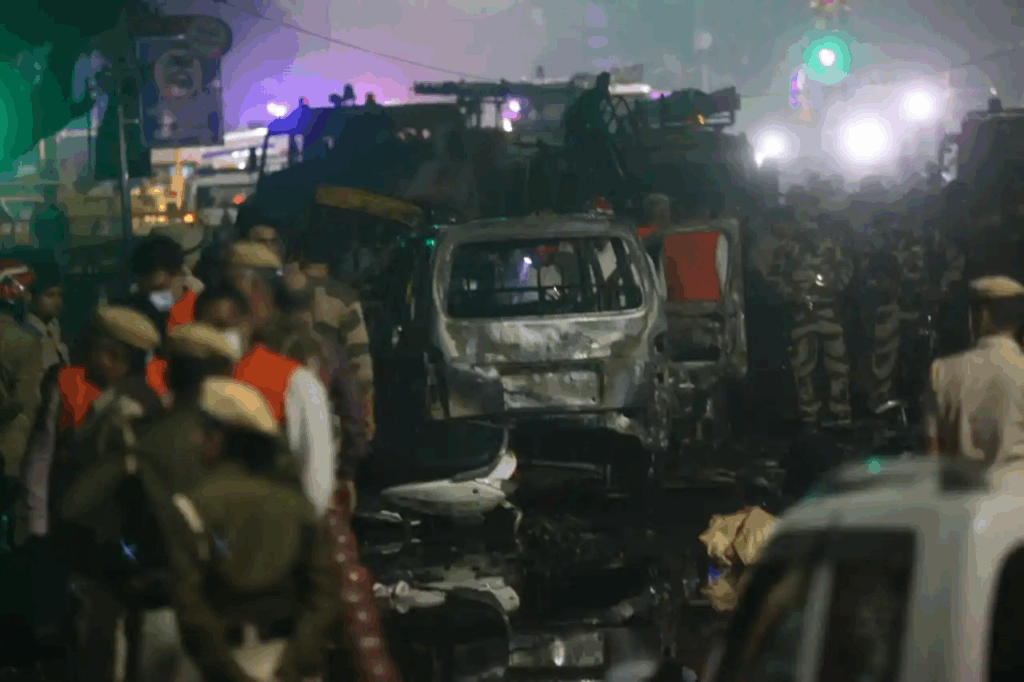
A powerful explosion ripped through Delhi’s heritage district near the Red Fort at 6:52 pm on Monday, killing at least 13 people and injuring 24 others. The blast occurred outside Gate No. 1 of the Lal Quila Metro Station, a busy intersection linking Old Delhi’s bustling markets with key tourist and commuter routes.
According to Delhi Police Commissioner Satish Golcha, the explosion originated in a slow-moving vehicle halted at a red light. “There were passengers inside. Other vehicles got affected. All the agencies are taking stock of the situation,” he told reporters. The incident sent shockwaves through the national capital, which was teeming with office-goers and tourists at the time.
Within minutes, the Red Fort area was engulfed in flames and chaos. Commuters rushed for cover as vehicles caught fire and shrapnel littered the road.
How quickly did emergency teams respond?
At 7:29 pm, about 37 minutes after the first blast report, the Delhi Fire Department declared the fire under control. Deputy Chief Fire Officer A.K. Malik confirmed that seven fire units were immediately dispatched to the scene.
Eyewitnesses described scenes of devastation. “One person’s body was torn into pieces. I saw a hand on the road,” a local witness told NDTV. In total, 22 vehicles were damaged, and nearly 20 fire engines were deployed to douse secondary fires and assist in rescue operations.
Officials credited quick coordination between the Delhi Police, Metro authorities, and fire services for preventing a larger disaster—especially given the dense crowd in the area.
What do early investigations suggest?
While the exact cause of the explosion remains under investigation, security agencies suspect a premeditated attack involving a vehicle-borne explosive device (VBIED). Teams from the National Investigation Agency (NIA) and the Intelligence Bureau (IB) are examining forensic evidence collected from the site, including metal fragments and traces of accelerants.
Notably, the explosion occurred just hours after authorities in Faridabad, Haryana—only 50 km away—recovered 2,900 kg of explosives in a separate operation. Though officials have not publicly confirmed a link, investigators are exploring whether the two incidents are part of a larger coordinated network.
If confirmed, the attack would represent the most significant urban terror event in Delhi since the 2011 High Court blast, which killed 15 people.
How did authorities respond across India?
In the wake of the explosion, Delhi, Mumbai, and Uttar Pradesh were placed on high alert. Metro and railway stations across the National Capital Region saw a surge in security checks, while major landmarks, including India Gate and Connaught Place, were cordoned off for surveillance.
Prime Minister Narendra Modi reviewed the situation in real time, receiving briefings from Home Minister Amit Shah, who coordinated with Delhi Police and central intelligence agencies. The Home Ministry has directed an all-agency probe to identify any terror or extremist links.
A senior Home Ministry official, speaking on condition of anonymity, said, “The pattern indicates precision and planning. We are not ruling out the possibility of sleeper cell involvement.”
Why does this incident raise deeper security concerns?
The Red Fort—a UNESCO World Heritage Site and symbol of India’s sovereignty—is among the most heavily guarded locations in the capital. It hosts the Prime Minister’s Independence Day address each year, making it a high-value symbolic target.
That such an explosion could occur within view of the fort’s gates underscores serious vulnerabilities in urban intelligence and traffic surveillance systems. Security experts suggest three critical gaps that may have contributed to the breach:
- Inadequate vehicular scanning near sensitive zones: Despite being a protected area, routine traffic near the Red Fort rarely undergoes deep vehicle checks due to congestion.
- Overreliance on CCTV footage without real-time monitoring: Cameras often record but are not actively supervised, delaying response.
- Lack of integrated communication between municipal, metro, and police units during emergencies.
According to a 2024 Ministry of Home Affairs report, Delhi has over 3,000 “high-risk” intersections but limited on-ground patrol coverage during peak hours.
What happens next in the Red Fort blast investigation?
The National Security Guard (NSG) and NIA forensic teams are conducting detailed residue analysis to identify the type of explosive used. Preliminary visuals suggest a high-temperature chemical reaction, indicating the use of industrial-grade materials rather than crude devices.
Investigators are also reviewing digital data from mobile towers near the Red Fort area to track potential communication before and after the blast. A joint task force is expected to submit an initial report within 72 hours.
Meanwhile, families of the victims are being assisted by the Delhi government’s emergency relief fund, and hospitals have set up help desks for identification and counseling.
Could this mark a shift in Delhi’s threat landscape?
Experts warn that the Red Fort blast could signal a resurgence of coordinated urban terrorism in India’s metro cities. Over the past year, intelligence agencies have reported increased chatter from cross-border networks, especially around the festive season.
Former RAW officer Vikram Sood told a local daily, “Delhi’s challenge isn’t just about preventing attacks, it’s about predicting them. We need data fusion centers capable of synthesizing alerts from multiple agencies before something happens.”
If confirmed as a terror strike, the attack could prompt a complete overhaul of Delhi’s heritage-zone security grid, including the deployment of AI-based vehicle scanning and behavioral anomaly detection at major tourist hubs.
TL;DR
A devastating explosion near Delhi’s Red Fort on Monday evening killed 13 and injured 24. The blast, triggered by a car outside Lal Quila Metro Station, was brought under control in 37 minutes. Investigators suspect a possible link to a massive explosives seizure in nearby Faridabad earlier that day. The attack exposes significant lapses in urban security around one of India’s most protected landmarks.