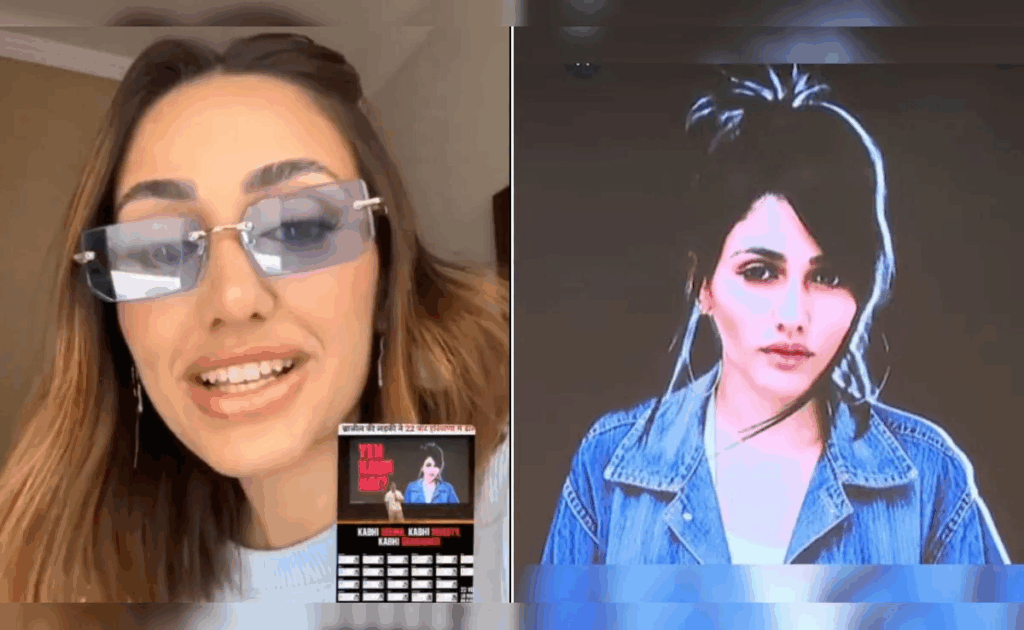
A photo of Brazilian hairdresser Larissa Nery has gone viral in India after Congress leader Rahul Gandhi claimed it was used to commit voter fraud in Haryana. Nery, who lives in Belo Horizonte, Brazil, says she’s not a model and had no idea her image was being used in India’s elections.
Who Is Larissa Nery, and How Did She End Up in an Indian Election Controversy?
When Congress leader Rahul Gandhi alleged that a “Brazilian model’s” photo was used to cast 22 fraudulent votes in Haryana, few could have guessed that the woman behind the image was actually a Brazilian hairdresser who had never even heard of India’s Election Commission until this week.
The woman in question, Larissa Nery, runs a small salon in Belo Horizonte, the capital of the southeastern Brazilian state of Minas Gerais. Far from the glitz of modeling, she spends her days cutting and styling hair.
Speaking to Brazilian fact-checking outlet Aos Fatos, which collaborated with ThePrint to trace her identity, Nery said she found the situation “a comedy.”
“This photo is very old. I am not even a model,” she told Aos Fatos. “I posed for a friend who needed help with a photography project. I have no idea where the image went after that.”
The Photo That Sparked an International Scandal
According to reports from ThePrint and Hindustan Times, the photo in question was taken by Brazilian photographer Matheus Ferrero in 2017 and uploaded to Unsplash, a popular royalty-free photo website.
Unsplash allows users to download and reuse images for any purpose, often without the subject’s knowledge, once uploaded. Ferrero has since deleted Nery’s portrait and deactivated his Instagram account after receiving hundreds of messages from Indian users.
Nery said she had “seen it used in millions of things” over the years but never imagined it would end up in a political controversy in another country.
“They are using a photo of mine to run… I don’t know if it’s an election or something where you have to vote. In India, they are portraying me as an Indian woman to scam others,” she said in a video statement that has since gone viral in both Brazil and India.
Brazilian model Larissa Nery reacts after Rahul Gandhi alleges her old photo was used in Haryana voter fraud
She claimed that the picture being shown in Gandhi’s presser is of her when she was “about 20-years-old.”
During a press conference on Wednesday, Gandhi claimed that a photo of a foreign woman had been uploaded from a central server and used to vote 22 times across 10 polling booths in Haryana.
He showed the image as evidence of alleged voter fraud, saying the manipulation reflected the dangers of centralized digital control in the election system.
ADVERTISEMENT
The statement instantly became a viral talking point on Indian social media, with users launching an online “hunt” to identify the mysterious woman. Within hours, journalists from India and Brazil connected the dots, revealing her true identity.
The Internet Reacts, and So Did Larissa
Once identified, Nery’s Instagram account, where she has around 5,400 followers, was flooded with comments from Indian users.
In her posts, she expressed disbelief:
“Oh my God, how crazy. What madness is this, what world are we living in?” she said in Portuguese, adding that even reporters had started calling her salon after the controversy broke.
A clip circulating on social media shows Nery laughing in disbelief as she says she’s now “famous in India” for something she had no part in.
The Bigger Issue: Misuse of Stock and Open-Source Photos
The bizarre episode underscores a growing problem: misuse of publicly available images on stock and free photo platforms like Unsplash and Pexels.
Since these sites operate under permissive Creative Commons licenses, anyone can download and repurpose photos without informing the subject. Once an image circulates online, it’s nearly impossible to trace how and where it’s used.
Digital experts have long warned that AI tools, deepfakes, and open-source photo libraries can easily be exploited for misinformation or identity-based manipulation, particularly during elections.
“This is exactly why image provenance and digital watermarking need to become standard,” one cybersecurity analyst told ThePrint after the incident.
What Happens Next
As of now, India’s Election Commission has not issued an official statement about Gandhi’s claim. Meanwhile, the Congress party has maintained that the example was meant to highlight potential flaws in the voting system, not to accuse a specific individual of wrongdoing.
Larissa Nery, on the other hand, seems eager to return to her normal life. In her latest Instagram Story, she joked, “I hope this is over soon. I have clients waiting for a haircut.”