
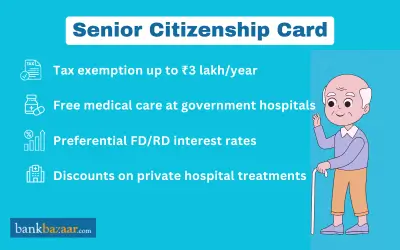
India’s population is aging fast, and government services are slowly catching up. One small but useful tool is India’s Senior Citizen Card. Issued by state governments to residents aged 60 and above, the card works as an official identity document and a gateway to discounts, welfare schemes, and priority services.
It is not a replacement for Aadhaar in all cases, but it often functions as an alternative proof of identity and residence for older adults, especially when accessing age-specific benefits.
What is India’s Senior Citizen Card?
The Senior Citizen Card is a government-issued ID provided by individual state administrations. Eligibility begins at age 60.
Its core purposes:
- certify a person’s age status as a senior citizen
- simplify access to welfare schemes
- enable concessions in travel, healthcare, and banking
- act as local domicile proof in many cases
Unlike Aadhaar, which is a universal identity infrastructure, this card is benefit-oriented. Think of Aadhaar as your passport into the system and the senior card as your priority pass inside it.
Who issues it?
Each state runs its own program. Examples include:
- Delhi Senior Citizen ID Card
- Maharashtra Senior Citizen Card
- Kerala Vayomithram-linked ID services
Because states administer it, benefits may vary slightly. The broad categories remain consistent nationwide.
What benefits does India’s Senior Citizen Card provide?
The biggest value lies in day-to-day savings and administrative priority rather than one large subsidy.
Financial and tax advantages
- Higher interest rates on fixed and recurring deposits in many banks
- Income tax exemption threshold up to ₹3 lakh (subject to prevailing tax rules)
- Easier processing for pension and government assistance programs
Note: Readers should verify updated tax slabs from the Income Tax Department website before filing returns.
Travel concessions
Cardholders may receive reduced fares when booking:
- state transport buses
- select railway categories (often linked with railway senior concessions)
- some airline discounts on specific tickets
States decide exact percentages, so concessions differ.
Healthcare support
- free treatment in many government hospitals
- discounted treatment at participating private hospitals
- priority queues in outpatient departments
Several states integrate the card with geriatric care schemes and mobile medical camps.
Legal and administrative priority
One lesser-known benefit: senior citizens may request faster hearing dates in certain courts, especially High Courts, where age-based priority systems exist.
This can significantly reduce waiting time in civil disputes.
Why does the government offer this card?
India is projected to have over 190 million senior citizens by 2031.
Administrative systems often require repeated age verification. The card solves three recurring problems:
- Documentation burden for elderly people
- Welfare scheme eligibility checks
- Queue delays in public services
Instead of repeatedly submitting certificates, one verified ID centralizes recognition.
How to apply for India’s Senior Citizen Card online
The online process varies by state but follows the same general flow.
Step-by-step application
- Visit the National Government Services Portal (India.gov.in)
- Select your state’s citizen services section
- Locate the Senior Citizen Card application
- Fill in personal details
- Upload required documents
- Upload passport-size photograph
- Pay the small registration fee (if applicable)
- Submit the application
After verification, authorities either mail the card or request collection from a local office.
How to apply offline
Offline applications remain popular because many seniors prefer in-person help.
Steps
- Visit a Sewa Kendra, Tehsildar office, or designated local service center
- Request the application form
- Fill and attach documents
- Submit with nominal fee (often around ₹10 depending on state)
- Collect acknowledgment receipt
Processing time typically ranges from a few days to several weeks.
What documents are required?
Applicants must prove identity, residence, and age.
Identity proof (any one)
- Aadhaar card
- Voter ID
- Driving licence
- Pension card
- Government ID
- Bank certificate
Address proof
- Passport
- Utility bill
- Rental agreement
- Registered property document
- Bank passbook
Age proof
- Birth certificate
- School leaving certificate
- PAN card
Authorities may request originals for verification.
Is the card mandatory?
No. It is optional but useful.
People who already use Aadhaar for everything might not feel urgency. However, seniors dealing with hospitals, courts, pensions, or travel concessions often find it convenient because staff instantly recognize eligibility.
Common misunderstandings
It replaces Aadhaar
False. Aadhaar remains the primary national identity. The senior card supplements benefits.
Benefits are identical across India
False. States control implementation and concessions.
It guarantees private hospital discounts everywhere
Not universal. Only empaneled or participating hospitals offer reductions.
TL;DR
- Issued by state governments to residents aged 60+
- Helps access travel, healthcare, tax, and welfare benefits
- Works as age and domicile proof in many cases
- Can be applied online via India.gov.in or offline at local offices
- Requires identity, address, and age documents