
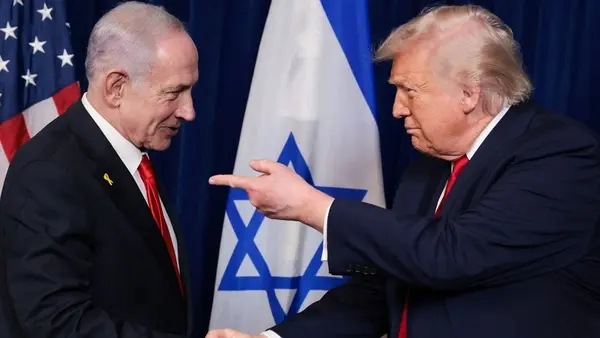
US President Donald Trump has pushed back against allegations that Israeli Prime Minister Benjamin Netanyahu manipulated him into a conflict with Iran, insisting that the decision to confront Tehran was his own and driven by concerns over Iran’s nuclear ambitions.
Speaking to Miranda Devine, the host of Pod Force One, Trump dismissed suggestions that Netanyahu had influenced or pressured him into taking a hardline stance against Iran. Instead, the president portrayed himself as the driving force behind the policy, arguing that preventing Iran from obtaining a nuclear weapon has long been one of his top priorities.
The remarks come as tensions surrounding US-Iran relations remain a major topic in global politics and as debates continue over Washington’s close relationship with Israel.
What did Trump say about Netanyahu and Iran?
During an appearance on Pod Force One, hosted by journalist Miranda Devine, Trump was asked about reports suggesting he had privately criticized Netanyahu and accused the Israeli leader of pushing the United States toward conflict with Iran.
Trump rejected the claim outright.
According to the president, while he has occasionally disagreed with Netanyahu on specific issues, those disagreements did not involve Iran. Instead, he pointed to concerns over Israel’s military operations in Lebanon.
“I said, ‘Bibi, we gotta stop this,'” Trump recalled, referring to discussions about continued fighting in Lebanon.
Despite policy differences, Trump emphasized that his relationship with Netanyahu remains strong.
“I like Bibi a lot,” he said, describing the Israeli leader as a wartime prime minister facing significant regional challenges.
Why is the “Netanyahu tricked Trump” claim gaining attention?
The allegation that Netanyahu persuaded or manipulated Trump into a confrontation with Iran has circulated among some political commentators and critics of US-Israel policy.
The theory generally argues that Israel’s security concerns and Netanyahu’s opposition to Iran’s nuclear program heavily influenced Washington’s approach toward Tehran.
Trump dismissed the accusation as politically motivated.
According to the president, critics attempting to portray him as someone who was “tricked” by Netanyahu are largely political opponents seeking to undermine his foreign policy decisions.
He argued that the policy was his own and that he never needed convincing when it came to opposing Iran’s nuclear ambitions.
“I’m the one who started it”
One of the most striking moments of the interview came when Trump directly addressed the criticism.
“I heard the other day for the first time that he tricked me, and I’m like, I’m the one who started it,” Trump said.
The comment reflects Trump’s longstanding position that Iran should never be allowed to develop a nuclear weapon.
His administration’s Iran strategy has consistently centered on economic pressure, sanctions, and opposition to Tehran’s nuclear activities.
By claiming ownership of the policy, Trump sought to distance himself from suggestions that foreign leaders dictated American decision-making.
How does this connect to the Iran nuclear deal?
Trump used the podcast interview to revisit one of the defining foreign policy decisions of his first presidency: withdrawing the United States from the Iran nuclear agreement.
The deal, formally known as the Joint Comprehensive Plan of Action (JCPOA), was negotiated during the administration of former President Barack Obama and aimed to limit Iran’s nuclear program in exchange for sanctions relief.
Trump has long criticized the agreement, arguing that it failed to permanently prevent Iran from developing nuclear capabilities.
During the interview, he reiterated that position, describing the deal as deeply flawed and claiming it provided a pathway for Iran to eventually acquire nuclear weapons.
Supporters of the agreement, however, have argued that it successfully imposed restrictions and monitoring mechanisms that limited Iran’s nuclear activities while it remained in force.
Trump’s claim: “There would be no Israel”
Trump also made a broader statement about US support for Israel, arguing that his administration played a crucial role in safeguarding the country’s security.
He claimed that without his leadership and policy decisions, Israel’s position in the region would be significantly weaker.
The remark reflects Trump’s long-standing effort to highlight his administration’s pro-Israel policies, which included:
- Recognizing Jerusalem as Israel’s capital
- Moving the US embassy to Jerusalem
- Supporting the Abraham Accords normalization agreements
- Adopting a tougher stance toward Iran
These policies remain central to Trump’s foreign policy legacy and continue to shape debates about America’s role in the Middle East.
Why Trump’s comments matter
Trump’s remarks arrive at a time when US policy toward Iran remains under intense scrutiny.
Questions surrounding Iran’s nuclear program, regional security, and the US-Israel relationship continue to influence diplomatic discussions across the Middle East.
The interview is notable because it offers a direct response to claims that have circulated among critics regarding Netanyahu’s influence over American policy.
Rather than portraying himself as responding to pressure from Israel, Trump presented himself as the principal architect of the strategy.
Whether supporters or critics agree with that characterization, the comments provide insight into how Trump wants the public to view one of the most consequential foreign policy issues of his presidency.
The bigger picture
The debate over who shaped US policy toward Iran is unlikely to disappear anytime soon.
For critics, the discussion raises questions about the influence of allies on American foreign policy decisions. For supporters, it underscores Trump’s willingness to pursue an aggressive approach toward Tehran regardless of external pressure.
What is clear from the podcast is that Trump rejects the idea that Benjamin Netanyahu led him into confrontation with Iran.
Instead, the president insists the policy originated with him and was rooted in a belief that preventing Iran from obtaining a nuclear weapon is essential to regional and global security.
TL;DR
Donald Trump has denied claims that Israeli Prime Minister Benjamin Netanyahu tricked him into confronting Iran. Speaking on a podcast, Trump said the policy was his own and stemmed from his determination to prevent Iran from acquiring a nuclear weapon. While acknowledging past disagreements with Netanyahu over Lebanon, he described their relationship as strong and rejected suggestions that Israel dictated US policy.