
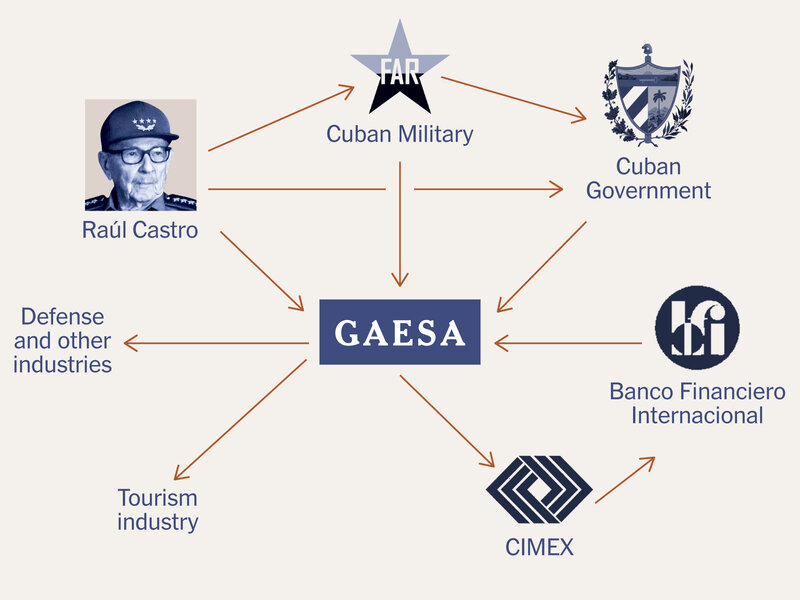
In most countries, the military protects the economy. In Cuba, critics say the military effectively runs it. At the center of that system sits GAESA, a sprawling and deeply opaque business empire controlled by the Cuban armed forces. While little official data exists, analysts and economists estimate GAESA may control anywhere between 40% and 70% of Cuba’s economy, making it arguably more influential than the Communist Party itself.
What began as a survival mechanism after the collapse of the Soviet Union has evolved into one of the most unusual economic power structures in the world: a military conglomerate overseeing hotels, banks, retail chains, fuel networks, telecommunications, tourism infrastructure, and foreign currency operations across an entire nation.
For many Cubans, GAESA is invisible in public life but unavoidable in daily reality.
What is GAESA?
GAESA stands for Grupo de Administración Empresarial S.A., a military-run holding company created under the leadership of Raúl Castro when he served as Cuba’s defense minister.
Originally intended to help the military generate revenue during an economic crisis, GAESA gradually expanded into nearly every profitable sector of the Cuban economy.
Today, the conglomerate oversees a network of subsidiaries and state-linked businesses that dominate the following:
- Tourism
- Banking
- Retail
- Fuel distribution
- Telecommunications
- Foreign trade
- Currency exchange
- Remittances
Unlike ordinary state agencies, GAESA reportedly operates with minimal public oversight.
Critics argue it functions almost like a parallel government economy hidden behind military structures and state secrecy.
A useful infographic here could map the following:
- GAESA’s major subsidiaries
- Sectors it controls
- Estimated share of Cuba’s economy
- Revenue flows between military and civilian institutions
Why was GAESA created?
To understand GAESA, you have to go back to 1991.
That year, the collapse of the Soviet Union triggered an economic catastrophe in Cuba.
For decades, the Soviet Union had subsidized the Cuban economy through the following:
- Cheap oil
- Trade support
- Financial assistance
- Strategic backing
When the Soviet system collapsed, Cuba entered what became known as the “Special Period,” a severe economic crisis marked by:
- Food shortages
- Fuel scarcity
- Blackouts
- Industrial decline
- Currency collapse
The Cuban military suddenly faced major funding problems.
Fidel Castro allowed Raúl Castro to expand military business operations as a way to generate revenue independently from the struggling civilian economy.
The strategy initially worked.
Military-run enterprises proved more disciplined and commercially efficient than many state bureaucracies, helping stabilize parts of the economy during the 1990s crisis.
But over time, those emergency powers evolved into something far larger.
What sectors does GAESA control?
GAESA’s reach now extends across much of Cuba’s most valuable economic infrastructure.
Tourism and luxury hotels
Tourism is one of Cuba’s most important sources of foreign currency, and GAESA dominates much of it.
The conglomerate reportedly controls:
- Luxury resorts
- Tourist transportation
- High-end retail outlets
- Hotel development projects
This includes some of the island’s most profitable tourism assets.
Critics argue that while ordinary Cubans face shortages of food and medicine, state resources continue flowing into hotel construction projects targeting foreign visitors.
Banking and foreign currency
GAESA also controls Banco Financiero Internacional, one of Cuba’s key financial institutions.
That gives the military enormous influence over:
- Foreign currency reserves
- International transactions
- Investment flows
- Financial operations tied to tourism and trade
In a heavily sanctioned economy, access to hard currency is one of the country’s most powerful economic levers.
Retail, fuel, and remittances
The conglomerate reportedly operates:
- Gas stations
- Supermarkets
- Currency exchange systems
- Remittance businesses
For many Cubans, interactions with military-linked commercial systems are part of everyday life.
Telecommunications and internet services
One of the most striking examples of GAESA’s influence is its role in communications infrastructure.
The organization reportedly controls Cuba’s only internet provider, giving the state enormous leverage over digital connectivity and information access.
That concentration of power has raised concerns among critics who argue economic and information systems have become deeply intertwined.
Why critics call GAESA a “state within a state”
One of the biggest controversies surrounding GAESA is the lack of transparency.
According to reports:
- Its finances are not publicly audited
- Revenue details do not fully appear in the national budget
- Civilian oversight appears extremely limited
Even Cuba’s own comptroller reportedly admitted in 2024 that she lacked access to GAESA’s finances before later losing her position.
That opacity has fueled criticism from the following:
- Economists
- Cuban dissidents
- US policymakers
- Transparency advocates
Critics argue the conglomerate concentrates wealth and influence among military elites while ordinary citizens struggle with inflation, shortages, and deteriorating public services.
A comparison graphic here could show:
- Estimated GAESA economic share
- Cuban state budget size
- Tourism investment vs healthcare and education spending
Why the Trump administration is targeting GAESA
Donald Trump’s administration has made GAESA a central focus of its Cuba policy.
Washington argues the conglomerate acts as:
- An economic pillar of the Cuban political system
- A mechanism for elite enrichment
- A tool of state control
US officials, including Marco Rubio, have defended sanctions targeting GAESA-linked businesses.
Rubio recently described the conglomerate as a company “stealing from the Cuban people to benefit a few.”
The sanctions strategy aims to:
- Restrict military-linked revenue
- Increase pressure on Cuba’s leadership
- Limit access to international financial systems
However, critics of sanctions argue that broader economic pressure often hurts ordinary Cubans more than elites.
The family connections surrounding GAESA
GAESA has long been closely tied to the Castro family network.
For years, the conglomerate was led by Luis Alberto Rodríguez López-Calleja, Raúl Castro’s son-in-law.
After he died in 2022, leadership reportedly passed to Ania Guillermina Lastres Morera.
Reports also continue linking Raúl Castro’s grandson, known by the nickname “El Cangrejo,” to influential behind-the-scenes roles.
Those family connections have strengthened accusations that Cuba’s economic structure increasingly resembles a tightly controlled military-business network.
Is GAESA’s economic model failing?
Despite its massive reach, GAESA faces growing criticism over economic performance.
One major concern involves tourism.
The conglomerate invested heavily in:
- New luxury hotels
- Resort infrastructure
- Tourism expansion projects
But Cuba’s tourism recovery has struggled in recent years due to the following:
- Sanctions
- Economic instability
- Pandemic disruptions
- Infrastructure problems
- Reduced international demand
At the same time, many Cubans face worsening shortages in:
- Food
- Electricity
- Healthcare
- Transportation
Economists argue the imbalance between tourism investment and domestic economic needs has become increasingly difficult to defend.
One critic summarized the contradiction bluntly:
the government condemns sanctions while simultaneously building luxury hotels as if external economic pressures barely exist.
Why GAESA matters far beyond Cuba
GAESA represents something larger than a single state-owned company.
It offers a rare example of:
- Military capitalism
- Centralized state-commercial power
- Opaque hybrid governance
- Sanctions-era economic adaptation
For policymakers and analysts, understanding GAESA is crucial to understanding modern Cuba itself.
Behind the island’s official political institutions lies an economic machine that quietly controls much of the country’s money, infrastructure, tourism, and strategic industries.
And despite its enormous influence, much of it still operates behind closed doors.
TL;DR
- GAESA is a military-run conglomerate estimated to control 40% to 70% of Cuba’s economy
- It oversees tourism, banking, retail, fuel, telecommunications, and remittances
- The group was created after the Soviet Union collapsed to help stabilize Cuba’s economy
- Critics call GAESA a “state within a state” due to limited oversight and secrecy
- The Trump administration has expanded sanctions targeting the conglomerate
- Analysts say GAESA’s heavy tourism investments have not solved Cuba’s worsening economic problems