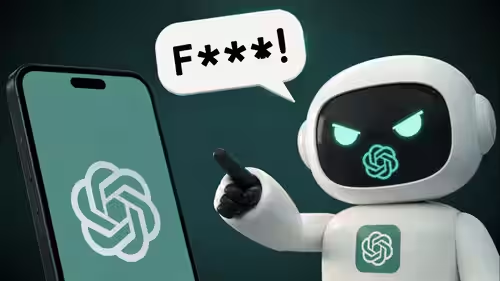
ChatGPT appears to be getting a little less formal — and, in some conversations, considerably more colorful.
Users have recently reported instances of the chatbot using profanity, including the F-word, in otherwise ordinary conversations. The reports gained attention after Business Insider documented screenshots of ChatGPT using casual and explicit language, including one recipe response that reportedly described “big ass kolaches.”
The timing is notable. OpenAI recently expanded access to its newer GPT-5.6 Luna model for Free users and introduced updates aimed at making ChatGPT more natural and better adapted to everyday conversations.
However, there is no public confirmation from OpenAI that it deliberately changed ChatGPT to swear more.
Why is ChatGPT suddenly using swear words?
There does not appear to be one confirmed explanation.
Business Insider reported that users began noticing more profanity in early August 2026, around the time ChatGPT’s newer model generation was being rolled out. Some users reported the behavior across both casual and technical conversations, while others said it became less noticeable over time.
One possible explanation is that newer models are becoming better at matching the conversational style of the person talking to them.
If a user writes casually, uses slang or swears, an AI model may sometimes mirror elements of that language.
But that does not explain every reported example. Some users say they encountered profanity even when they were not using particularly informal language themselves.
That is why it would be premature to conclude that OpenAI intentionally introduced an “uncensored” ChatGPT.
Did OpenAI deliberately make ChatGPT more casual?
OpenAI has clearly been working on making its models more natural.
Its recent GPT-5.6 updates describe improvements aimed at making everyday conversations more useful and focused. OpenAI says GPT-5.6 Sol was tuned to adapt its level of detail to the question and provide more natural interactions.
OpenAI has also introduced personality and characteristics controls that allow users to influence how ChatGPT communicates.
The company’s documentation says personality controls affect style and tone rather than what ChatGPT is capable of doing or which safety rules it follows.
Characteristics can similarly adjust aspects such as warmth, enthusiasm, brevity and formatting.
That means a more conversational ChatGPT is not necessarily evidence of a deliberate decision to make the chatbot swear.
A model can become more natural without becoming deliberately profane.
What changed with GPT-5.6 Luna?
OpenAI announced on August 6 that GPT-5.6 Luna would become the default model for Free users and that access would be expanded. The company also introduced a Think option for harder questions.
That rollout is relevant because the reported increase in profanity coincided with the transition to the newer model.
But correlation is not proof of causation.
OpenAI has not publicly said that GPT-5.6 Luna was specifically trained or configured to use more profanity.
The company’s publicly documented updates focus on improvements to everyday conversations, reasoning and response quality rather than introducing more explicit language.
Could ChatGPT be mirroring users?
Yes, and this may explain at least some of the reports.
Large language models generate responses based partly on the conversational context they receive.
If someone communicates using slang, informal expressions or profanity, the model can sometimes adopt aspects of that conversational style.
This is one reason the same model can sound very different in two conversations.
One user might receive a formal, professional answer, while another might get something considerably more relaxed.
OpenAI’s personality documentation explicitly acknowledges that ChatGPT’s style can be influenced by personality settings, instructions and the context of the conversation.
That makes “ChatGPT is swearing now” an oversimplification.
The more accurate description is that some users are encountering more profanity in certain conversational contexts.
Why would an AI use the F-word at all?
There are situations where profanity can be linguistically appropriate.
For example, if a user asks ChatGPT to analyze dialogue from a movie, explain slang, reproduce a phrase or write realistic fictional dialogue, the model may need to discuss or use offensive language.
The unusual part of the recent reports is that some profanity appeared in ordinary conversations where users were not specifically requesting it.
That can feel strange because people tend to expect AI assistants to maintain a consistently neutral tone.
A sudden swear word therefore stands out much more than it would in a conversation between two humans.
Is ChatGPT becoming “more human”?
In some ways, that appears to be the broader direction.
AI companies have spent years trying to make chatbots sound less mechanical.
Users generally prefer systems that understand conversational language, remember context and respond naturally rather than producing rigid, robotic answers.
But greater naturalness comes with a trade-off.
Human conversation contains slang, sarcasm, jokes, profanity, ambiguity and emotional language.
An AI that becomes better at reproducing human conversational patterns may occasionally reproduce aspects of speech that some users do not want.
The challenge for AI developers is therefore not simply making models sound human.
It is giving users enough control over how human-like that behavior becomes.
Can users control how ChatGPT talks?
To an extent, yes.
OpenAI currently provides personality controls that allow users to choose different communication styles.
The available options include styles such as Default, Professional and Friendly, among others. OpenAI says personality changes how ChatGPT communicates rather than changing its underlying capabilities or safety rules.
Characteristics provide another layer of control, allowing users to adjust things such as warmth, enthusiasm and formatting.
Users can also directly instruct ChatGPT.
For example, someone can ask it to remain professional, avoid slang or never use profanity unless specifically quoting someone.
Those instructions can influence the tone of future responses.
Does the Free version swear more?
There has been speculation that the reported behavior could be connected to ChatGPT’s Free tier.
But there is currently no confirmed evidence establishing that Free users are specifically receiving a more profane version of the model.
OpenAI’s recent update did change the default model for Free users to GPT-5.6 Luna.
That makes the timing interesting, but it does not establish that the Free tier itself is responsible.
Differences in model availability, personalization settings and conversation context can all affect what individual users see.
Why are some users actually enjoying it?
Not everyone is complaining.
Business Insider reported that some users welcomed the more informal behavior, saying that occasional slang or profanity made ChatGPT feel more natural and relatable. Others found it entertaining precisely because it was unexpected.
For these users, a chatbot that never uses slang can feel artificial.
An occasional “damn” or even stronger expression may make the interaction feel closer to speaking with another person.
But that preference is highly subjective.
Someone using ChatGPT for work, education or professional communication may find exactly the same behavior inappropriate.
Why are other users unhappy?
The problem is predictability.
People use ChatGPT for very different purposes.
The same account might be used to write a business email in the morning, research a legal issue in the afternoon and ask for a recipe at night.
If the model unexpectedly inserts profanity, users may wonder whether the behavior reflects a change in the underlying model, their personalization settings or something else.
That uncertainty can be particularly frustrating for people who expect consistent professional language.
It also raises a broader question about AI assistants: how much personality should they have?
What has OpenAI said about the reports?
As of the latest reporting, OpenAI has not publicly provided a specific explanation for the reported increase in profanity.
Business Insider reported that OpenAI declined to comment on the observations.
OpenAI’s published documentation does, however, confirm that its models and personality systems are being actively updated.
The company’s August 18 Model Spec update, for example, introduced changes and clarifications concerning how models should behave, including guidance around unsupported premises and the assistant’s capabilities and limitations.
Nothing in that publicly documented update establishes that OpenAI intentionally changed ChatGPT to swear more.
Is this a bug or a feature?
Right now, there is not enough public evidence to call it either.
If the behavior is the result of a model becoming better at matching conversational context, it could be an unintended side effect of improved naturalness.
If OpenAI intentionally allows more flexibility in conversational tone, it could instead be a product decision that has not been publicly highlighted.
There is also a third possibility: different users may be experiencing different combinations of models, personality settings and conversation contexts.
That could make the phenomenon appear more widespread or consistent than it actually is.
What does this tell us about AI chatbots?
The episode highlights an important shift in AI development.
Early chatbots were generally easy to distinguish from humans because their responses were rigid and predictable.
Modern models are much better at adapting to users.
They can change tone, vocabulary and level of detail based on context.
That makes them more useful — but it also means their behavior can be less predictable.
The occasional F-word may seem trivial compared with debates over AI safety, misinformation or autonomous systems.
But it illustrates the same fundamental challenge: the more flexible an AI becomes, the harder it is to guarantee that every response will match every user’s expectations.
The bigger picture
Reports of ChatGPT using more profanity are not evidence that OpenAI has simply decided to turn its chatbot into an uncensored assistant.
What is clear is that ChatGPT’s behavior is becoming increasingly configurable and conversational.
OpenAI has recently rolled out GPT-5.6 updates, expanded GPT-5.6 Luna to Free users and introduced more controls over personality and response characteristics.
Some users are now reporting that this greater conversational flexibility occasionally includes slang and profanity.
Whether that reflects a deliberate personality change, modelling behaviour, contextual mirroring or an unintended side effect remains unclear.
For now, the safest conclusion is simple: ChatGPT has not been officially declared a more profane chatbot.
But some users are clearly seeing it behave that way — and the phenomenon offers an interesting glimpse into how quickly AI assistants are moving away from sounding like traditional software and toward sounding more like conversational partners.