
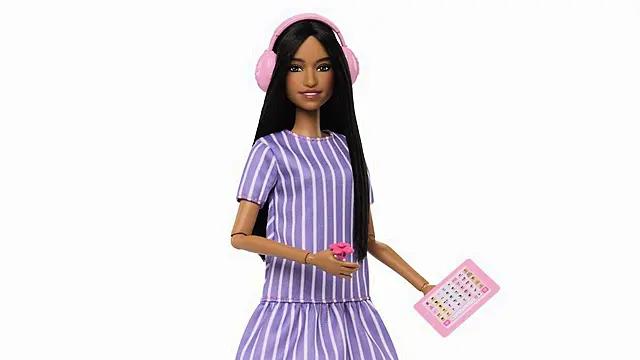
The launch of the first autistic Barbie doll has been widely welcomed by autism campaigners, charities, and neurodivergent creators as a meaningful step toward representation that feels authentic, joyful, and informed by lived experience.
More than just a new addition to the Barbie lineup, the doll reflects a growing shift in how major brands approach inclusion—moving away from surface-level symbolism toward thoughtful design shaped by the communities being represented.
Within hours of its unveiling, the autistic Barbie sparked conversations about visibility, diagnosis gaps among girls, and how play can influence understanding of neurodiversity from an early age.
What Is the Autistic Barbie Doll?
The autistic Barbie is part of Mattel’s broader effort to make its iconic brand better reflect the diversity of children who play with its products.
Unlike earlier dolls that focused primarily on physical disabilities or medical conditions, this Barbie represents neurodivergence, a category that is often misunderstood or invisible.
Mattel says the doll is designed to help more children “see themselves represented in Barbie,” while also encouraging non-autistic children to better understand differences in how people experience the world.
Importantly, the doll was not designed in isolation.
How Was the Autistic Barbie Designed?
Collaboration With the Autistic Community
Mattel worked closely with the Autistic Self Advocacy Network (ASAN), an organization led by and for autistic people. The goal was to ensure the doll reflected real experiences rather than stereotypes.
ASAN described the finished product as a “milestone” in representation, emphasizing that autistic children deserve to see versions of themselves that are positive and empowering.
“It is so important for young autistic people to see authentic, joyful representations of themselves, and that’s exactly what this doll is,” the organization said.
This kind of direct consultation is increasingly seen as essential when companies attempt to represent marginalized communities—particularly those that have historically been spoken about rather than with.

What Design Features Reflect Autistic Experiences?
Clothing, Accessories, and Sensory Awareness
The autistic Barbie includes several design elements intended to reflect experiences that some autistic people may relate to:
- Loose-fitting clothing to reduce fabric-to-skin contact, which can be uncomfortable for people with sensory sensitivities
- A slightly averted eye gaze, representing how some autistic people may avoid direct eye contact
- Noise-cancelling headphones to block background sound and reduce sensory overload
- A pink fidget spinner, designed to support focus and help manage stress
Each of these features reflects common, but not universal, autistic experiences. Mattel has emphasized that the doll represents one expression of autism, not the entire spectrum.
Why Does the Doll Include a Tablet?
Communication and Assistive Technology
One of the more subtle but meaningful accessories is a pink tablet, symbolizing how some autistic people use digital tools to support everyday communication.
For many autistic individuals, assistive and augmentative communication (AAC) devices play a vital role in expressing needs, emotions, and ideas. Including this accessory signals that communication differences are not deficits—but variations.
It also normalizes technology use in a way that reflects real life, rather than treating it as something unusual or stigmatizing.
Why Representation Matters: Especially for Girls
The Gender Diagnosis Gap
Autistic writer and content creator Ellie Middleton described the doll as a “powerful symbol” for young girls, particularly given how often autism in girls goes unnoticed.
“Statistics show that young girls are often undiagnosed or misdiagnosed,” she said.
“To have a powerful symbol like this autistic Barbie doll helps bring the conversation around neurodivergence in women to the forefront so that autistic girls can feel accepted and seen.”
Research has consistently shown that autism has historically been diagnosed based on male-presenting traits, leaving many girls and women without support well into adulthood.
Is There a Risk of Oversimplifying Autism?
“Autism Is a Spectrum”
The National Autistic Society (NAS) welcomed the doll but also offered an important reminder: autism is not a single experience.
Autistic people can have vastly different strengths, challenges, communication styles, and sensory needs.
NAS describes autism as a “lifelong neurodivergence and disability” that shapes how individuals experience and interact with the world. The organization estimates:
- More than 1 in 100 people are autistic
- At least 700,000 autistic adults and children live in the UK alone
Peter Watt, NAS managing director of national programs, said representation matters, but accuracy matters just as much.
“It’s really important that these representations are authentic and based on extensive consultation with autistic people, and we’re pleased Mattel involved the autistic community in the development of this doll.”
Why Toys Play a Bigger Role Than We Think
Learning Through Play
Children often form their earliest ideas about difference and inclusion through play. Dolls, in particular, act as social scripts—teaching kids who belongs, who is “normal,” and who gets stories.
By placing an autistic Barbie alongside other Barbies, the message is subtle but powerful:
- Autism is not something separate or hidden
- Neurodivergent people belong in everyday narratives
- Difference does not need to be “fixed” to be valued
For autistic children, the impact can be deeply personal. Seeing a doll that reflects their own coping tools and behaviors can validate experiences they may otherwise feel pressure to hide.
How This Fits Into Mattel’s Broader Inclusion Strategy
A Pattern, Not a One-Off
The autistic Barbie is not Mattel’s first attempt at inclusive design. In recent years, the company has introduced:
- A blind Barbie
- A diabetic Barbie with a glucose monitor
- A Barbie with Down syndrome
Together, these releases suggest a long-term strategy rather than a marketing experiment.
The challenge, however, lies in consistency, ensuring that inclusion is sustained, well-researched, and responsive to feedback over time.
What Critics and Supporters Agree On
Despite differing perspectives, most advocates agree on a few key points:
- Representation is better than invisibility
- Consultation with the autistic community is essential
- No single doll can represent the entire autism spectrum
The autistic Barbie does not claim to tell every autistic story. Instead, it opens space for conversation—among children, parents, educators, and toy makers alike.
Why This Launch Matters Beyond Barbie
At a time when discussions around disability, neurodiversity, and inclusion are increasingly politicized, the autistic Barbie offers a quieter—but potentially lasting—form of change.
It doesn’t rely on slogans or campaigns. It shows up in toy boxes, bedrooms, and classrooms, shaping understanding through everyday play.
And for many autistic children, especially girls who rarely see themselves reflected, that visibility can be transformative.
TL;DR
- Mattel has launched its first autistic Barbie doll, designed with input from autistic advocates
- Features include sensory-friendly clothing, noise-cancelling headphones, a fidget spinner, and a communication tablet
- Campaigners say the doll offers an authentic, joyful representation
- Autism charities stress that autism is a spectrum and no single doll can represent everyone
- The launch reflects a broader shift toward inclusion in toys and children’s media