
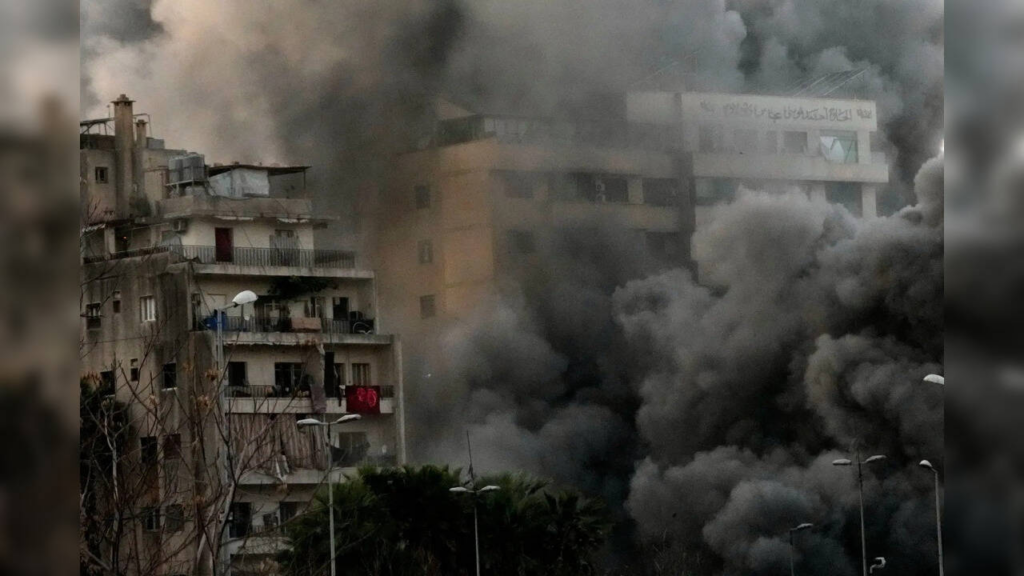
A fragile ceasefire between the United States and Iran had barely taken hold when a new wave of violence erupted—this time over Beirut. In one of the most intense aerial operations of the current conflict, Israel launched more than 100 strikes in just 10 minutes, targeting positions linked to Hezbollah across Lebanon.
The speed, scale, and timing of the attack raise urgent questions about the scope of the ceasefire and whether it ever applied beyond Iran.
What happened in Beirut during the strikes?
The operation unfolded with staggering intensity. Within minutes, explosions rippled across Beirut, southern Lebanon, and the Bekaa Valley.
A rapid and coordinated assault
According to reports, Israeli forces targeted the following:
- Missile launch sites
- Command and control centers
- Intelligence infrastructure
Strikes hit both densely populated urban areas and known Hezbollah strongholds. In central Beirut, at least one residential building was struck, sending plumes of black smoke into the skyline.
Emergency crews rushed to multiple locations simultaneously, navigating debris, fire, and damaged infrastructure.
The civilian toll remains unclear
As of initial reports:
- Casualty figures were not immediately confirmed
- Residential areas were impacted
- Emergency services were overwhelmed
The lack of warning before the strikes has drawn particular scrutiny, especially given the timing just hours after a ceasefire announcement.
Why did Israel strike despite the Iran ceasefire?
The key to understanding this escalation lies in a critical distinction: the ceasefire did not extend to Lebanon.
Israel’s position
Israeli Prime Minister Benjamin Netanyahu made it clear that operations against Hezbollah would continue.
Israeli officials argue the following:
- Hezbollah remains an active threat
- The group has continued rocket attacks
- Military action is necessary regardless of Iran-related agreements
In short, from Israel’s perspective, the battlefield in Lebanon is a separate theater of war.
Hezbollah’s stance
A Hezbollah official indicated the group had not committed to any ceasefire, though it was allowing time for mediation.
This creates a volatile gap:
- No mutual agreement to pause hostilities
- Ongoing readiness for escalation
- High risk of miscalculation
How does this reshape the broader conflict?
The strikes highlight a key reality: the Iran ceasefire has not ended the war—it has fragmented it.
The conflict is now multi-layered
Even as US-Iran tensions ease temporarily:
- Israel-Hezbollah conflict continues
- Regional actors remain engaged
- Proxy dynamics are intensifying
This creates overlapping conflicts with different rules, timelines, and objectives.
Risk of escalation remains high
Recent developments underscore the fragility of the situation:
- Missile alerts in Gulf states
- Attacks on energy infrastructure
- Continued military readiness across the region
The ceasefire may reduce one axis of conflict while leaving others fully active.
What is the humanitarian impact in Lebanon?
The Lebanon front has already seen significant human and economic costs—and this latest escalation adds to the strain.
Rising casualties and displacement
Current estimates indicate:
- Over 1,500 people killed
- More than 1 million displaced
- Hundreds of women and children among the victims
Entire communities have been uprooted, with many families living in temporary shelters.
Civilians caught in uncertainty
For civilians, the ceasefire brought a brief moment of hope—quickly reversed.
One displaced resident described the dilemma:
- Return home and risk airstrikes
- Stay displaced and endure harsh conditions
This uncertainty is becoming a defining feature of daily life.
“We can’t take it anymore—sleeping in tents, no showers, endless uncertainty,” said 35-year-old Fadi Zaydan. “But we’ll be targeted if we go home,” he added, explaining that his family has chosen to wait it out in Sidon for now, according to AP.
Why is Beirut a significant target?
Historically, central Beirut has rarely been struck at this scale in recent conflicts.
Strategic and symbolic importance
Targeting Beirut signals:
- A willingness to escalate military operations
- An attempt to disrupt Hezbollah’s urban networks
- A message of deterrence
Striking the capital carries both military and psychological weight.
Risks of urban warfare
Urban strikes introduce complex challenges:
- Higher risk of civilian casualties
- Difficulty distinguishing military from civilian infrastructure
- Greater international scrutiny
This raises questions about proportionality and long-term consequences.
What happens next?
The situation remains fluid, with multiple possible paths forward.
Possible scenarios
- Continued Israel-Hezbollah escalation
- Expansion into a broader regional conflict
- Diplomatic intervention to extend ceasefire terms
- Temporary stabilization followed by renewed fighting
Each scenario depends on decisions made not just in Washington and Tehran, but also in Tel Aviv and Beirut.
The role of diplomacy
While military operations dominate headlines, diplomacy remains the only path to sustained de-escalation.
TL;DR
Israel launched over 100 strikes in 10 minutes across Beirut and Lebanon, targeting Hezbollah despite a US-Iran ceasefire. The truce does not cover Lebanon, leaving a major front of the conflict active. Civilians face growing uncertainty as displacement rises and regional tensions continue to simmer.