


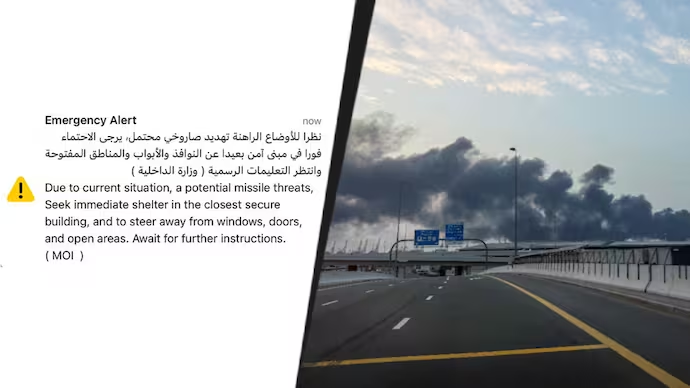
Residents across Dubai were gripped by anxiety after receiving multiple emergency alerts warning of a possible missile attack, as tensions in West Asia escalated following Iranian strikes on U.S. military installations in the Gulf.
Within minutes, four consecutive alerts appeared on mobile phones across the city, urging people to remain indoors and prepare for potential emergencies. The warnings came as the regional security situation deteriorated rapidly after a major escalation between Iran, the United States, and Israel.
For many residents in the Gulf’s financial hub, the alerts were a stark reminder that a conflict unfolding hundreds of miles away could have immediate consequences closer to home.
What Happened in Dubai?
Residents reported receiving four back-to-back emergency notifications on their phones warning of a potential missile threat.
The alerts advised people to:
- Avoid going outdoors unless necessary
- Stay alert and follow official instructions
- Prepare emergency essentials and important documents
One Dubai resident described how quickly people began preparing.
“We got four back-to-back alerts on the phone. We stocked up on essentials and kept a bag ready with important documents, including passports, in case of any emergency.”
Such warnings are rare in the United Arab Emirates, which is generally considered one of the most stable countries in the region. The sudden alerts, therefore, triggered widespread concern among residents.
Why the Alerts Were Issued
The emergency notifications followed a dramatic escalation in regional hostilities that began on February 28, when the United States and Israel launched coordinated airstrikes against targets inside Iran.
The strikes reportedly targeted elements of Iran’s nuclear program and killed Iran’s Supreme Leader Ayatollah Ali Khamenei.
Tehran quickly responded with retaliatory attacks across the Gulf.
Iranian retaliation
Iran launched waves of missiles and drones toward locations believed to host U.S. military assets across the region.
According to multiple reports, the targets included:
- The US Consulate Dubai
- Al Dhafra Air Base in Abu Dhabi
These developments dramatically raised the risk level for civilians living across the UAE, prompting authorities to issue alerts urging residents to stay vigilant.
Rising Tensions Across the Gulf
The situation highlights how quickly regional conflicts can ripple across the Gulf.
Several Gulf countries host U.S. military facilities, making them potential targets during periods of heightened tension with Iran.
Strategic installations across the region include:
- Naval facilities in Bahrain
- Air bases in Qatar
- Military infrastructure in the United Arab Emirates
Because of this network, retaliatory strikes can quickly affect the broader region—even if the initial conflict takes place elsewhere.
Aviation Chaos Across the Middle East
The escalating conflict has also caused major disruptions to global aviation, particularly in the Middle East.
Several countries temporarily restricted or closed airspace as a safety precaution, affecting commercial flights and cargo routes.
The impact has been particularly severe in Dubai, which is home to Dubai International Airport, one of the busiest international transit hubs in the world.
Effects on travel
Airlines were forced to:
- Cancel flights
- Reroute aircraft around restricted airspace
- Delay departures across multiple international routes
The disruption stranded thousands of travelers in Gulf countries, including many from India.
However, many passengers later praised UAE authorities for managing the situation efficiently and helping travelers secure alternate flights.
Indian Travelers Among Those Stranded
Because Dubai serves as a major transit point between Asia, Europe, and North America, the aviation disruptions had global ripple effects.
A significant number of Indian travellers were among those stranded at airports across the region.
Many were connecting through Dubai on international routes when airspace restrictions disrupted schedules.
Despite the chaos, airport authorities reportedly worked to:
- Rebook passengers
- Provide accommodation
- Manage airport congestion
This helped prevent a larger humanitarian situation at the airport.
Why Dubai Matters Strategically
The developments have drawn global attention partly because of Dubai’s importance as a global economic and transportation hub.
The city plays a crucial role in:
- International aviation
- Global trade logistics
- Energy transportation routes
- Financial markets across the Middle East
Any instability affecting Dubai could therefore have far-reaching economic consequences.
Even short-term disruptions can impact:
- Oil shipping routes
- International supply chains
- Global airline operations
Calls for Restraint as Crisis Deepens
As tensions continue to rise, several global leaders and international organisations have urged all parties to avoid further escalation.
Diplomatic efforts are underway to prevent the conflict from expanding into a wider regional war.
The stakes are high. A prolonged conflict involving Iran, the United States, Israel, and Gulf states could:
- Disrupt global energy markets
- Trigger humanitarian crises
- Draw additional countries into the conflict
For now, authorities across the Gulf remain on high alert.
TL;DR
- Residents in Dubai received four emergency alerts warning of a possible missile attack.
- The warnings followed Iranian retaliatory strikes on U.S. bases in Gulf countries.
- Reported targets included the US Consulate in Dubai and Al Dhafra Air Base in Abu Dhabi.
- The crisis has disrupted aviation across the Middle East, stranding many international travellers.
- Governments worldwide are urging restraint to prevent the conflict from escalating further.