
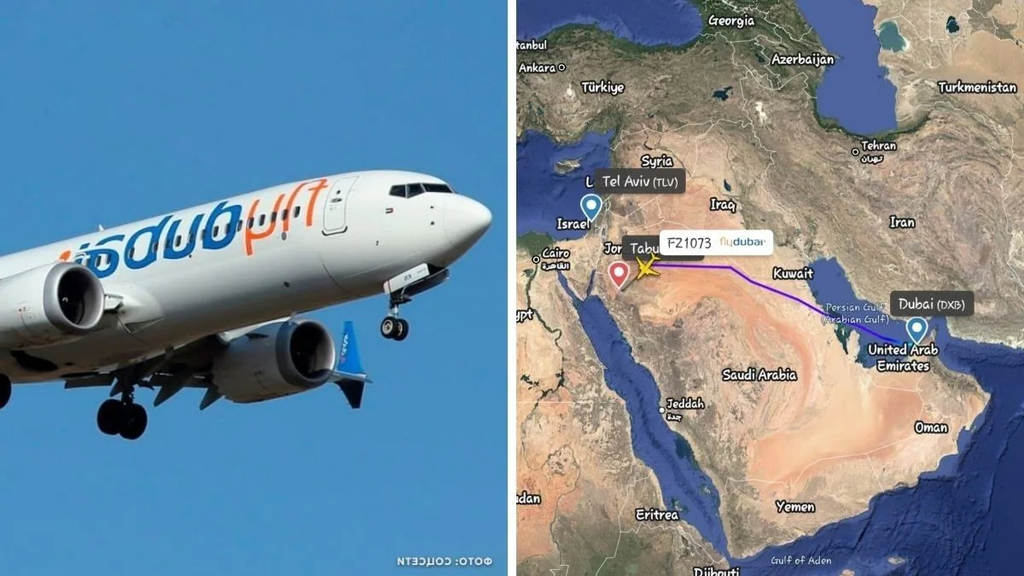
A routine Flydubai flight from Dubai to Tel Aviv turned into a major aviation security incident on Wednesday after a violent confrontation reportedly broke out inside the cockpit, forcing the Boeing 737 MAX to divert to Saudi Arabia.
Flight FZ1073 was flying toward Ben Gurion Airport when emergency signals were transmitted and the aircraft made a sudden descent before landing safely at Tabuk Airport in northwestern Saudi Arabia.
Initial fears centered on a possible hijacking.
Those fears intensified after the aircraft transmitted the international transponder code 7500, which is used to indicate unlawful interference. Israeli fighter jets were scrambled as authorities assessed the situation.
But officials later said the incident was not a hijacking.
Instead, Israeli officials and multiple reports said the emergency was linked to a physical altercation involving the two pilots in the cockpit. Flydubai confirmed that an “incident” occurred during the flight but did not publicly disclose the details of the confrontation. All passengers were reported safe.
What happened aboard Flydubai FZ1073?
The aircraft departed Dubai International Airport bound for Tel Aviv on September 30.
The flight was being operated by a Boeing 737 MAX 8, registration A6-FKF, according to flight-tracking data. It was cruising toward Israel when its flight path changed dramatically over the region.
Flight-tracking information showed the aircraft sending a general emergency signal before briefly transmitting 7500, the code associated with hijacking or unlawful interference, and later returning to the emergency code.
The plane also descended rapidly from cruising altitude.
That combination immediately triggered a major response because a commercial aircraft on an international route had apparently developed an emergency inside the cockpit.
The aircraft ultimately diverted to Tabuk, Saudi Arabia, where it landed safely.
Why did Israel scramble fighter jets?
The appearance of the 7500 transponder code was the critical trigger.
Code 7700 signals a general emergency. Code 7500 is used when an aircraft is experiencing unlawful interference and is commonly associated with a hijacking situation.
Because FZ1073 briefly transmitted the latter code while flying toward Israel, Israeli authorities treated the event as a potential security threat.
Israeli fighter aircraft were scrambled to respond to the emergency, according to Israeli officials cited by Reuters and the Associated Press.
The initial response was therefore based on what was known at the time, not on a confirmed finding that the aircraft had actually been hijacked.
Once authorities determined that the problem was internal to the aircraft, the hijacking concern was dropped.
The reported cockpit fight
The most startling part of the incident came after the emergency landing.
According to Israeli officials, the two pilots had become involved in a physical confrontation inside the cockpit.
Reuters reported that an Israeli official characterized the episode as a fight between the pilots rather than a hijacking.
Other reports described a more violent confrontation, with witnesses claiming they heard shouting from the cockpit and saw signs of a struggle.
Some accounts circulating online have gone further, alleging that a knife was involved and that one crew member attempted to take control of the aircraft.
Those details remain part of an ongoing investigation and should not be presented as established fact.
The airline itself has not released a detailed account of what happened in the cockpit.
Were the pilots Russian and Ukrainian?
This is one of the most disputed details surrounding the incident.
Early reports, including some Israeli media coverage, identified the two pilots as Russian and Ukrainian. That version quickly led to speculation about whether the war between Russia and Ukraine had somehow spilled into the cockpit.
But later reports challenged that account.
An Azerbaijani news report citing Israeli media said the pilot accused of putting passengers at risk was an Omani citizen, while the aircraft commander was from the United Arab Emirates. Other international reports continued to identify the crew as Russian and Ukrainian.
Because the nationalities have not been consistently confirmed by Flydubai or another primary source, the safest description is that reports about the pilots’ identities and nationalities remain conflicting.
There is therefore no established evidence that the incident was connected to the Russia-Ukraine conflict.
Was this actually an attempted hijacking?
At this stage, authorities say no.
An Israeli official told Reuters that the flight was not hijacked and that the episode was an internal personnel incident.
That distinction is important because the aircraft did transmit a code associated with unlawful interference.
A 7500 signal indicates the crew is reporting an external security problem or unlawful interference, but it does not independently establish what caused the emergency.
In this case, the code helped trigger the security response.
It did not prove that someone had seized the aircraft.
The final cause of the signal is part of the investigation into the cockpit confrontation.
What caused the aircraft’s dramatic descent?
Flight-tracking data showed an unusually steep descent while the aircraft was over the region.
The exact figures vary across reporting because the rate of descent recorded by public tracking systems can change depending on how data is transmitted and processed.
Reuters reported that the aircraft descended about 14,000 feet in a very short period before diverting to Tabuk.
Other tracking-based reports have cited an even more dramatic rate of descent.
What is clear is that the aircraft descended substantially from cruising altitude and changed course toward Saudi Arabia.
The descent appears to have been part of the crew’s response to the emergency rather than evidence by itself of an attempted crash.
Why did the aircraft land in Saudi Arabia?
Tabuk became the diversion airport as the aircraft moved away from its original destination.
In an emergency, the priority is to reach an airport where the aircraft can land safely, receive security assistance and allow authorities to address whatever is happening onboard.
Tabuk is located in northwestern Saudi Arabia, not far from the route between the Arabian Peninsula and Israel.
The decision had an unusual diplomatic dimension because Saudi Arabia and Israel do not have formal diplomatic relations.
That made the arrival of a plane carrying Israeli passengers in Saudi territory particularly sensitive.
Saudi authorities nonetheless permitted the emergency landing and handled the aircraft after it arrived.
Why were Israeli passengers on Saudi soil?
The passengers had been traveling from Dubai to Tel Aviv, one of the busiest links between the UAE and Israel following the normalization of relations between the two countries in 2020.
Saudi Arabia opened its airspace to Israeli-linked commercial aviation in 2022, allowing some flights to transit Saudi territory.
That does not mean Riyadh and Jerusalem have established formal diplomatic relations.
Saudi Arabia has continued to say that diplomatic normalization with Israel depends on the establishment of an independent Palestinian state.
The distinction between allowing aircraft to use airspace and establishing diplomatic relations is therefore significant.
In this case, the emergency landing created an unusual situation in which a large group of Israeli travelers found themselves at a Saudi airport despite the absence of formal bilateral diplomatic ties.
Netanyahu called an emergency security meeting
The incident triggered a response at the highest levels of the Israeli government.
Prime Minister Benjamin Netanyahu convened a security consultation after the emergency involving the Flydubai aircraft.
Israel’s defense establishment was also involved in assessing the situation, particularly after the aircraft transmitted the unlawful-interference signal and fighter jets were launched.
The prime minister’s office said the situation was under control and that authorities were working to ensure the Israeli passengers could return safely to Israel.
The government response illustrates how quickly an onboard incident can become a national-security issue when the aircraft is carrying Israeli passengers and flying toward Israel.
What happened to the passengers?
The most important outcome was that the aircraft landed safely and passengers remained safe.
Reuters reported that the aircraft was carrying approximately 150 Israeli passengers.
Flydubai said everyone onboard was safe and accounted for and confirmed that the airline was cooperating with authorities after the aircraft diverted to Tabuk.
There were no confirmed passenger fatalities.
Reports about injuries vary, particularly regarding unverified accounts of blood inside the cabin or injuries connected to the alleged confrontation.
Those claims should therefore be treated cautiously until authorities release a complete account.
What is Flydubai saying?
The airline has kept its public statement brief.
Flydubai said FZ1073 experienced an incident while en route from Dubai to Tel Aviv and landed in Tabuk.
The airline confirmed that all passengers were safe and accounted for but did not publicly describe the nature of the dispute between the pilots.
That limited statement leaves many questions unanswered.
In particular, it does not establish whether the emergency was caused directly by the reported physical altercation, whether one pilot deliberately changed the aircraft’s flight path, or how the emergency signals were transmitted.
Those details will likely emerge through the aviation and security investigations now underway.
Why the Russia-Ukraine angle became controversial
The Russia-Ukraine connection immediately became one of the most widely discussed parts of the story because of the early claim that the pilots came from those two countries.
That framing created an obvious and emotionally charged narrative.
But aviation investigations require something more reliable than an intriguing narrative.
There is currently conflicting reporting about the pilots’ nationalities, and there is no confirmed evidence that the confrontation was politically motivated.
Even if the Russian-Ukrainian nationalities were ultimately confirmed, that alone would not establish that the war between the two countries had anything to do with the cockpit incident.
A fight between two crew members can have many possible causes, and investigators would need evidence before connecting it to politics, nationality or ideology.
What investigators will need to establish
The investigation will likely focus on several basic questions.
What exactly happened inside the cockpit?
Which pilot initiated the confrontation?
Were any weapons involved?
Who was controlling the aircraft during the disturbance?
Why were the emergency and unlawful-interference codes transmitted?
Was the aircraft deliberately placed into a rapid descent?
How was the cockpit secured afterward?
And did either pilot attempt to gain unauthorized control of the airplane?
Investigators will have several sources of evidence available, including cockpit voice recordings, flight-data recordings, air-traffic control communications, airport security footage, passenger accounts and crew interviews.
The combination of those sources should help reconstruct the sequence far more reliably than early reports or social-media claims.
The flight was never lost
One of the most important facts to emerge from the episode is that the aircraft remained under sufficient control to divert and land safely.
The emergency was serious enough to trigger an international security response.
But it did not end with a crash, hijacking or mass-casualty event.
The aircraft reached Tabuk, passengers survived and authorities were able to secure the situation on the ground.
That outcome is particularly notable given how quickly the situation appeared to escalate from a cockpit disturbance to a potential hijacking alert.
An extraordinary aviation incident with more questions than answers
FZ1073 began as a normal Dubai-to-Tel Aviv flight.
Within minutes, the aircraft was sending emergency signals, changing altitude and diverting toward Saudi Arabia while Israeli fighter jets were being scrambled.
The initial fear was hijacking.
The emerging explanation was a physical fight inside the cockpit.
And even that explanation remains incomplete.
The nationalities of the pilots are disputed in current reporting. Claims about knives, attempted suicide or an effort to deliberately crash the plane remain unverified. Flydubai has confirmed an incident but has not publicly provided the full sequence of events.
For now, the most firmly established facts are straightforward.
The flight diverted safely to Tabuk.
The emergency triggered a major Israeli security response.
The passengers were safe.
And authorities say the episode was not a hijacking.
The rest of the story is still being assembled from cockpit data, witness accounts and official investigations.