
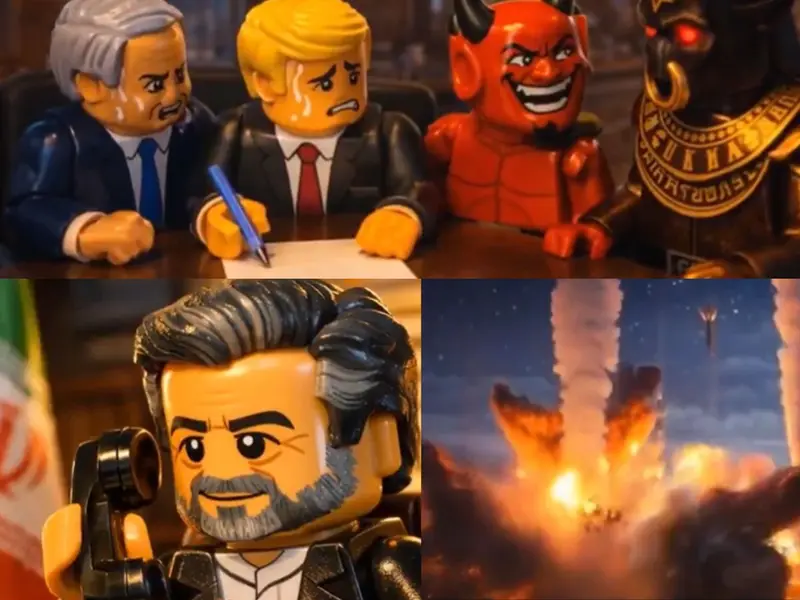
In modern conflict, the battlefield doesn’t end at borders. It spills into timelines, comment sections, and viral feeds. Since the outbreak of the Iran war on February 28, pro-Iran groups have leaned heavily on artificial intelligence to create a steady stream of memes, animated clips, and fabricated visuals designed to influence global opinion.
What stands out is not just the volume but the cultural fluency. Much of this content speaks directly to American audiences, often targeting figures like Donald Trump and Benjamin Netanyahu with a tone that feels less like foreign propaganda and more like domestic satire.
What is the “AI meme war” in the Iran conflict?
The “AI meme war” refers to the use of artificial intelligence tools to rapidly produce and distribute politically charged, highly shareable content during the Iran conflict.
This includes:
- AI-generated memes using U.S. political humor
- Short animated videos styled like popular franchises
- Fabricated satellite images or battlefield clips
- English-language posts tailored for Western audiences
Unlike traditional propaganda, which often feels formal or state-driven, this content blends into everyday internet culture. It doesn’t announce itself. It scrolls past you like any other post.
How are Trump and Netanyahu portrayed in these memes?
Framing Trump as isolated and ineffective
A recurring theme in these AI-generated memes is the portrayal of Donald Trump as disconnected from both global realities and his own domestic base.
Common narrative angles include:
- Highlighting U.S. political divisions
- Referencing past controversies
- Depicting him as outmaneuvered on the world stage
The strategy is subtle. Instead of direct attacks, the memes echo criticisms already circulating within American discourse, making them feel familiar and therefore more believable.
Casting Netanyahu as embattled
Benjamin Netanyahu is often depicted as politically cornered or strategically weakened.
These portrayals typically:
- Emphasize ongoing military challenges
- Suggest unmet war objectives
- Frame Israel’s actions as costly or ineffective
Together, these narratives aim to erode confidence in leadership without relying on overt disinformation alone.
Why are these memes so effective?
1. Cultural fluency gives them credibility
Experts note that the content shows a deep understanding of U.S. culture. References to pop culture, political humor, and social debates make the material feel native rather than foreign.
As propaganda scholar Nancy Snow has observed, this approach turns American pop culture into a tool against itself.
2. AI accelerates production and scale
Artificial intelligence allows creators to:
- Generate large volumes of content quickly
- Customize messaging for different audiences
- Experiment with formats that boost engagement
This creates a constant stream of material, increasing the chances of virality.
3. Memes lower skepticism
Memes are inherently informal. People engage with them casually, often without the scrutiny applied to news reports.
That makes them powerful vehicles for:
- Reinforcing narratives
- Nudging public opinion
- Blurring the line between humor and messaging
Is there evidence of coordination with Iran?
Researchers suggest that the sophistication of these campaigns points to at least some level of coordination.
Mahsa Alimardani of WITNESS has noted that producing and distributing such content at scale likely requires resources beyond independent actors.
Additional indicators include:
- Amplification by Iranian state media
- Consistent messaging across multiple accounts
- Organized dissemination patterns
Accounts like Akhbar Enfejari have openly described their goal as disrupting Western dominance of global narratives.
While direct attribution remains complex, the ecosystem appears anything but random.
What role does AI play in modern information warfare?
From propaganda to participatory influence
Traditional propaganda was centralized. Today’s AI-driven campaigns are decentralized, interactive, and designed for sharing.
Key shifts include:
- Speed: Content can be created and distributed in minutes
- Adaptability: Messaging evolves based on audience reaction
- Accessibility: Tools are widely available, lowering barriers to entry
The rise of synthetic visuals
Beyond memes, AI has enabled:
- Fabricated satellite imagery
- Deepfake-style videos
- Simulated battlefield footage
Some of these pieces have collectively generated hundreds of millions of views, complicating efforts to separate fact from fiction.
How have platforms responded?
Social media companies are beginning to react, though unevenly.
For instance, X announced in March that it would temporarily suspend creators from its revenue-sharing program if they fail to disclose AI-generated conflict-related content.
This move highlights a broader challenge:
- Platforms must balance free expression with misinformation control
- Enforcement remains inconsistent
- Detection tools are still evolving
Why haven’t the US and Israel responded similarly?
Analysts point out a notable asymmetry. While pro-Iran groups have embraced meme-driven narratives, the U.S. and Israel have not engaged at the same scale in comparable campaigns.
Possible reasons include the following:
- Different strategic priorities
- Concerns about credibility and ethics
- Institutional limitations in adopting informal communication styles
This creates a gap in the information space, where one side actively shapes narratives while the other relies more on traditional messaging.
Does this actually influence public opinion?
The measurable impact remains debated. Virality does not automatically translate into persuasion.
However, these campaigns can:
- Amplify existing divisions
- Reinforce biases
- Shape online discourse
Even if they don’t change minds outright, they can shift the tone of conversations, which in turn influences how events are perceived.
A new phase of digital conflict
The use of AI-generated memes marks a turning point in how conflicts are fought and understood.
This isn’t just about misinformation. It’s about narrative competition in an environment where:
- Attention is limited
- Emotion drives engagement
- Authenticity is increasingly hard to verify
The battlefield now includes algorithms, aesthetics, and timing.
TL;DR
- Pro-Iran groups are using AI to create memes and videos targeting Western audiences
- Content often mocks Donald Trump and Benjamin Netanyahu
- Memes leverage U.S. culture to appear authentic and gain traction
- Researchers suggest possible coordination with Iranian state-linked networks
- Platforms like X are beginning to enforce disclosure rules
- The trend signals a broader shift toward AI-driven information warfare