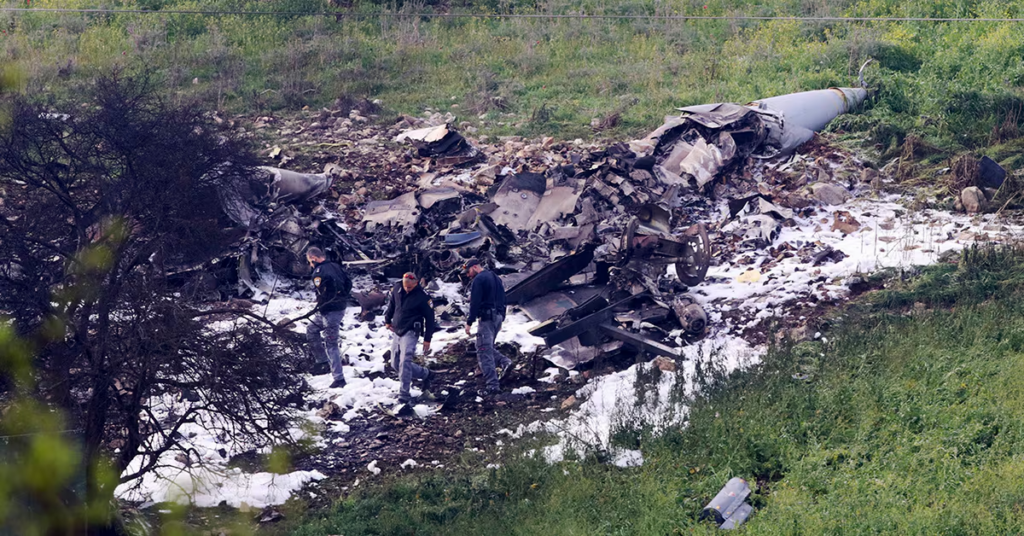
Iran says it has downed an Israeli fighter jet deep inside its airspace. Israel says its aircraft was targeted but survived. Between those two claims sits a familiar fog of war, where facts move more slowly than headlines. Here’s a clear, evidence-based breakdown of what’s been reported, what’s still unverified, and why this matters beyond a single F-16.
What exactly is Iran claiming?
Iran’s Islamic Revolutionary Guard Corps (IRGC), via state-linked media, says it struck a third Israeli F-16 Fighting Falcon over central Iran using advanced air defense systems.
Key details from the claim:
- The jet was hit around 3:45 a.m. local time
- The strike occurred in central Iranian airspace
- It was described as the “third” Israeli aircraft downed
However, Iran has not released:
- Wreckage images
- Radar data
- Independent verification
That absence is critical. In modern conflicts, confirmed shootdowns are usually accompanied by at least some visual or satellite evidence.
What does Israel say about the incident?
The Israel Defense Forces (IDF) has pushed back on the claim.
According to Israeli officials:
- A fighter jet was targeted by Iranian defenses
- The aircraft successfully evaded the strike
- The mission continued without confirmed loss
This version suggests engagement did occur, but not a successful shootdown.
Why is it hard to verify these claims?
The “information battlefield” is real
Modern warfare includes a parallel fight over narrative. Both sides use:
- Selective disclosures
- Delayed confirmations
- Strategic ambiguity
A downed jet is not just a military event. It’s a psychological and political signal.
What confirmation would look like
For analysts to treat this as confirmed, they typically look for:
- Satellite imagery of crash sites
- Pilot capture or recovery reports
- Independent intelligence leaks
- Visual debris with identifiable markings
So far, none of these have surfaced publicly.
What air defense systems might Iran be using?
Iran has spent years building a layered air defense network designed to counter advanced aircraft.
Key components likely involved
- Bavar-373: Iran’s domestically developed long-range system
- S-300: Russian-supplied system capable of targeting aircraft and missiles
- Short- and medium-range SAMs: For lower-altitude interception
Together, these systems form an integrated air defense network, allowing Iran to:
- Track incoming aircraft
- Engage at multiple ranges
- Increase the probability of a hit
Iran claims recent upgrades have significantly improved this network’s effectiveness.
Why the F-16 matters in this context
The F-16 Fighting Falcon is not a stealth aircraft, but it remains a highly capable multirole fighter used worldwide.
Strengths of the F-16
- High maneuverability
- Advanced avionics (in modern variants)
- Proven combat record
Its vulnerability
Unlike stealth jets such as the F-35 Lightning II, the F-16:
- Has a larger radar signature
- Is more detectable by advanced air defenses
That makes it more exposed in heavily defended airspace like central Iran.
What about Iran’s claim of hitting a US F-35?
Iran has also claimed it struck a US F-35 Lightning II, one of the most advanced jets in the world.
Here’s what we know:
- US officials have confirmed an F-35 made an emergency landing
- The pilot was safe
- The cause is under investigation
What remains unclear:
- Whether Iranian fire actually hit the aircraft
- The extent of any damage
If confirmed, even a partial hit on an F-35 would be a major development in air warfare.
What would a confirmed shootdown mean?
Military implications
If Iran successfully downed an F-16 inside its territory, it would suggest:
- Improved tracking and targeting capabilities
- Greater risk for Israeli and US air operations
- A stronger defensive posture than previously assumed
Strategic implications
It could also:
- Shift air campaign tactics (more stand-off weapons, fewer deep penetrations)
- Increase reliance on stealth aircraft
- Escalate the conflict further
Psychological impact
Even unverified claims can:
- Boost domestic morale
- Signal strength to adversaries
- Influence global perception
In conflict, perception often shapes reality as much as facts do.
How does this fit into the broader conflict?
The reported incident comes amid a widening confrontation involving Iran, the US, and Israel.
Recent developments include:
- Airstrikes on Iranian military targets
- Iranian retaliation against regional bases
- Increased drone and missile activity
The air domain is becoming one of the most contested aspects of this conflict.
What should we watch next?
Signals that will clarify the situation
- Satellite imagery releases
- Official Israeli confirmation or denial updates
- Independent reporting from defense analysts
- Evidence shared by Iran (if any emerges)
Broader indicators
- Changes in Israeli airstrike patterns
- Increased use of stealth aircraft
- New sanctions or diplomatic responses
TL;DR
- Iran claims it shot down an Israeli F-16 over central Iran
- Israel says the jet was targeted but survived
- No independent evidence has confirmed a shootdown
- Iran’s air defense systems are becoming more advanced
- A confirmed hit would have major military and strategic implications