

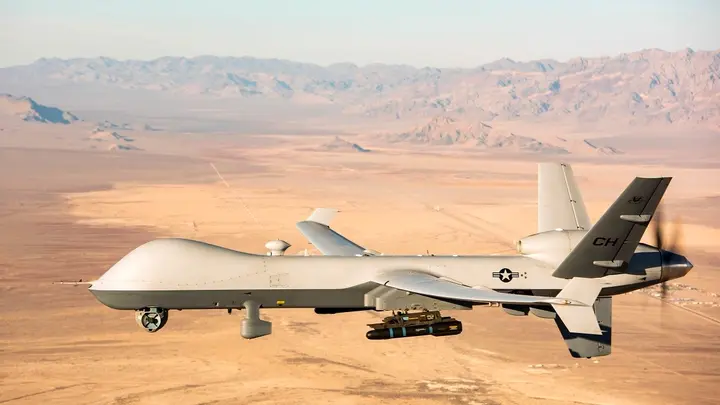
Tensions between Iran and the United States escalated again after Iran’s Islamic Revolutionary Guard Corps claimed it shot down a US MQ-9 Reaper drone and fired at an “intruding” F-35 fighter jet over the Gulf region.
The claim, if confirmed, would mark one of the most serious aerial confrontations between the two countries since the current regional ceasefire took hold earlier this year.
But there is a major caveat:
Iran’s statement did not specify when the alleged incidents occurred, and no independent confirmation has yet emerged from US officials or allied militaries operating in the region.
That uncertainty has not stopped the episode from intensifying geopolitical anxiety around an already fragile truce.
What exactly did Iran claim?
According to a statement attributed to the Islamic Revolutionary Guard Corps, Iranian forces:
- Shot down a US MQ-9 drone
- Fired upon an intruding F-35 fighter jet
- Responded to what Tehran described as an airspace violation
The IRGC also warned that it reserves the “legitimate and definite” right to retaliate against any violations of the regional truce by the United States.
The statement did not clarify:
- The exact location of the encounter
- Whether the aircraft entered Iranian airspace
- When the event allegedly happened
- Whether any wreckage was recovered
That ambiguity matters because military messaging in high-tension regions often serves multiple purposes:
- Domestic signaling
- Deterrence
- Strategic ambiguity
- Diplomatic pressure
Why the MQ-9 Reaper matters
The reported target, the MQ-9 Reaper, is not just another drone.
The General Atomics MQ-9 Reaper is one of the most important unmanned military aircraft in the US arsenal and has become central to American surveillance and precision strike operations worldwide.
Developed by General Atomics, the MQ-9 evolved from the earlier Predator drone program into a far more capable intelligence and strike platform.
The aircraft is designed for:
- Long-endurance surveillance
- Precision airstrikes
- Maritime monitoring
- Intelligence gathering
- Counterterrorism missions
Its role in modern warfare is so extensive that the Reaper has effectively become the flying symbol of America’s remote warfare doctrine.
What makes the MQ-9 Reaper so significant?
The MQ-9 is built for persistence.
Powered by a Honeywell turboprop engine, the drone can:
- Stay airborne for more than 27 hours
- Fly at altitudes up to 50,000 feet
- Reach speeds around 240 knots
- Carry up to 3,000 pounds of external payload
That combination allows it to patrol massive geographic areas continuously while carrying both surveillance equipment and weapons.
The Reaper’s modular system supports multiple payloads, including:
- Electro-optical sensors
- Infrared targeting systems
- Maritime surveillance radar
- Signals intelligence systems
- AGM-114 Hellfire missiles
- Laser-guided bombs
In practice, the aircraft functions like a flying intelligence hub with teeth.
Iran and the US have a long history of drone confrontations
Drone incidents between Iran and the United States are not new.
One of the most significant confrontations occurred in 2019, when Iran shot down a US RQ-4 Global Hawk surveillance drone near the Strait of Hormuz.
That incident nearly triggered direct military escalation before the Trump administration ultimately refrained from retaliatory strikes.
Since then, unmanned aircraft have become increasingly central to the shadow conflict between:
- Iran
- The US
- Israel
- Gulf states
Drones operate constantly across the region for:
- Surveillance
- Intelligence gathering
- Maritime monitoring
- Proxy warfare coordination
Because they are unmanned, they also create a dangerous gray zone:
states may be more willing to target drones than piloted aircraft, potentially lowering the threshold for escalation.
The mention of an F-35 raises bigger questions
Iran’s claim that it also fired upon an “intruding” F-35 fighter jet is especially notable.
The Lockheed Martin F-35 Lightning II is among the world’s most advanced stealth fighter aircraft and is operated by both the US and Israel.
However, Iran’s statement did not claim the aircraft was shot down, only that it was fired upon.
That distinction is important.
There is currently:
- No public evidence of an F-35 loss
- No confirmation from Washington
- No known emergency landing reports
- No visible operational disruption
Still, merely referencing the aircraft serves a symbolic purpose.
The F-35 represents technological superiority and strategic reach. Mentioning it in official messaging allows Iran to project defiance against advanced Western military systems.
Why this matters during peace talks
The timing of the claim is especially sensitive because it comes amid ongoing attempts to preserve a fragile regional ceasefire.
Relations between Iran and the US remain highly unstable following months of:
- Airstrikes
- Proxy attacks
- Maritime incidents
- Nuclear tensions
- Cyber operations
Even unverified military incidents can complicate diplomacy because they:
- Increase political pressure
- Trigger retaliatory rhetoric
- Raise military alert levels
- Strengthen hardline factions on both sides
In volatile regions, perception alone can become destabilizing.
Why Gulf airspace remains one of the world’s most dangerous zones
The Gulf region is crowded with:
- Commercial air traffic
- Military patrol aircraft
- Surveillance drones
- Naval aviation assets
- Missile defense systems
That concentration creates constant risks of:
- Miscalculation
- Identification errors
- Escalatory incidents
US forces maintain a significant presence across the Gulf, including operations tied to:
- Maritime security
- Energy shipping protection
- Intelligence collection
- Regional deterrence
Iran, meanwhile, closely monitors those activities and frequently accuses foreign aircraft and naval vessels of violating its operational boundaries.
The result is a permanent state of strategic friction where even routine flights can suddenly become international incidents.
Could this escalate further?
That depends largely on whether the incident is independently confirmed and how Washington responds.
Several scenarios are possible:
- The US denies the incident entirely
- The episode remains limited to rhetorical signaling
- New sanctions or military warnings emerge
- Regional military posturing increases
- Diplomatic talks slow down or collapse
At the moment, there is no indication of immediate large-scale escalation.
But incidents involving drones often function like sparks near dry brush. Even small confrontations can rapidly reshape regional calculations if political leaders choose escalation over restraint.
The bigger picture: drones are reshaping modern conflict
The episode also reflects a broader transformation in warfare.
Unmanned systems now sit at the center of modern military competition because they offer:
- Lower operational risk
- Long-duration surveillance
- Precision strike capability
- Psychological pressure
- Strategic ambiguity
Countries increasingly compete not just through traditional military force, but through invisible aerial networks of sensors, drones, cyber systems, and intelligence platforms.
The MQ-9 Reaper embodies that shift.
And every time one appears in a geopolitical flashpoint, it becomes more than an aircraft. It becomes a floating symbol of surveillance, deterrence, and technological power.