
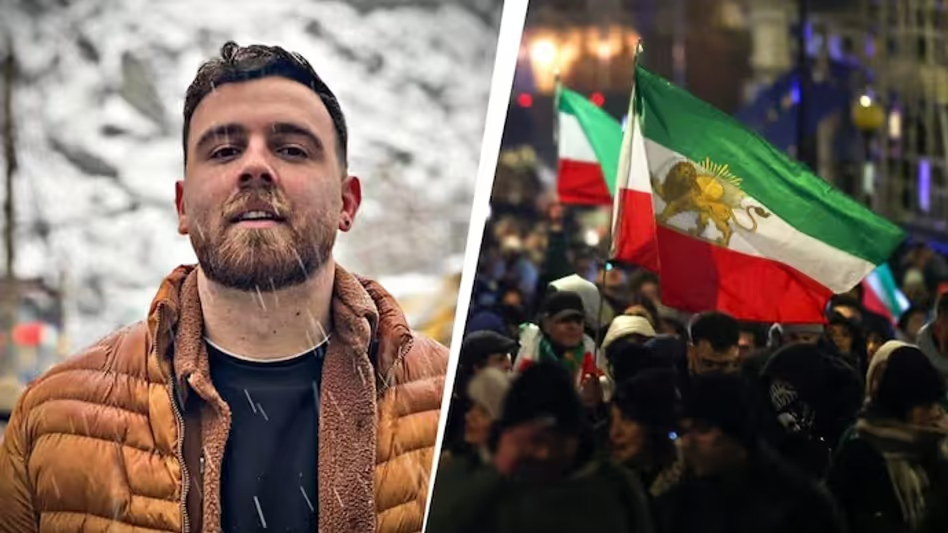
Iran is preparing to execute a 26-year-old man in what rights groups say would be the first confirmed execution linked directly to the latest wave of anti-government protests targeting Supreme Leader Ayatollah Ali Khamenei. The case has intensified international alarm over Tehran’s response to dissent, as activists warn of mass killings, thousands of arrests, and a justice system being used as a tool of intimidation rather than law.
According to multiple human rights organizations, Erfan Soltani was arrested during demonstrations near Tehran and has been sentenced to death following a process that appears to have bypassed basic legal safeguards. Iranian authorities have not independently confirmed the execution, but campaigners say the timing and secrecy fit a familiar pattern.
Who is Erfan Soltani, and what is he accused of?
Erfan Soltani, 26, was detained last week during protests in Karaj, a city west of Tehran, as demonstrations spread across Iran in opposition to the country’s clerical leadership.
Charges carrying the death penalty
Rights groups say Soltani has been charged with “waging war against God,” a broadly defined offense under Iran’s Islamic Penal Code that is punishable by death. The charge, known in Persian as moharebeh, has frequently been used against political dissidents, protesters, and activists.
According to the National Union for Democracy in Iran (NUFD):
- Soltani was arrested during street protests.
- He was denied access to a lawyer.
- His family was informed that he had already been sentenced to death.
Iran Human Rights (IHR), a Norway-based NGO, reported that Soltani’s family was told the execution is scheduled for January 14.
Claims of a rushed and opaque process
Human rights advocates argue that Soltani did not receive a fair trial, if any meaningful trial at all. The lack of public court documents, legal representation, or official confirmation from Iranian authorities has raised concerns that the sentence was issued swiftly to send a message rather than deliver justice.
With Iran under an internet blackout in many regions, independent verification of court proceedings has become extremely difficult.
Why this execution matters now
If carried out, Soltani’s hanging would mark a significant escalation in the government’s crackdown on dissent.
A warning to protesters
Executions linked to protests are widely seen as a tactic to deter further unrest. Rights groups say the timing of Soltani’s sentence suggests authorities are aiming to instill fear as demonstrations continue despite heavy security measures.
IHR Director Mahmood Amiry-Moghaddam said the killing of protesters in recent days echoes the mass executions and political repression of the 1980s, events that have since been recognized by some international bodies as crimes against humanity.
Numbers that point to a wider crisis
According to Iran Human Rights:
- At least 648 people have been confirmed killed during the protests.
- Among the dead are nine minors.
- The real death toll may be far higher, with some estimates exceeding 6,000.
The organization also estimates that around 10,000 people have been arrested nationwide. These figures cannot be independently verified due to communications restrictions, but they align with patterns seen during previous waves of unrest.
How Iranian authorities are responding to the protests
While rights groups describe a brutal crackdown, Iranian leaders insist they have regained control.
State-backed rallies and official messaging
On Monday, Iranian state media broadcast images of mass pro-government rallies across the country. Supreme Leader Ayatollah Ali Khamenei, who has ruled since 1989 and is now 86, hailed the turnout as proof that the protest movement had failed.
“These massive rallies, full of determination, have thwarted the plan of foreign enemies,” Khamenei said, according to state television. He framed the protests as a foreign-backed plot rather than a domestic uprising.
In Tehran, state TV showed crowds waving Iranian flags and holding prayers for victims of what officials have labeled “riots.”
Rhetoric of war and external enemies
At Enghelab (Revolution) Square, parliament speaker Mohammad Bagher Ghalibaf told supporters that Iran was facing a “four-front war,” citing:
- Economic pressure
- Psychological warfare
- Military threats from the United States and Israel
- What he called a war against “terrorists,” referring to protesters
Standing beneath banners reading “Death to America” and “Death to Israel,” Ghalibaf warned that Iran would respond forcefully to any external attack.
This rhetoric underscores how the Iranian leadership is framing internal dissent as part of a broader geopolitical confrontation.
What role is the international community playing?
Rights groups argue that outside pressure may be the only factor capable of stopping Soltani’s execution.
Calls for urgent intervention
Both IHR and NUFD have urged governments and international organizations to act immediately. NUFD described Soltani as a “young freedom seeker” whose only crime was “shouting for freedom for Iran.”
“The international community has a duty to protect civilian protesters against mass killing by the Islamic Republic,” Amiry-Moghaddam said.
U.S. reaction and rising tensions
Former President Donald Trump, who returned to the White House in 2025, has taken a hard line on Tehran. He said Iran was seeking negotiations with Washington even as his administration weighs potential responses to the crackdown.
According to people familiar with internal discussions, options under consideration include:
- Cyberattacks
- Direct military strikes by the U.S. or Israel
- Expanded sanctions
These deliberations highlight the risk that domestic repression in Iran could further inflame already tense relations with the West.
Why executions tied to protests raise global concern
Executions following protests are particularly alarming to human rights advocates because they blur the line between criminal justice and political repression.
Due process under strain
International law requires fair trials, access to legal counsel, and the right to appeal, especially in capital cases. Rights groups say Iran routinely violates these standards, using vague charges and closed proceedings to silence dissent.
The chilling effect on society
Beyond the immediate loss of life, executions send a broader signal. Families of protesters, activists, and journalists may retreat from public life out of fear, shrinking the space for civil society.
For many Iranians, the threat is not just imprisonment but death.
What happens next for Erfan Soltani?
As of now, Soltani’s fate remains uncertain. Rights groups say the execution is imminent but acknowledge that the lack of independent verification makes confirmation difficult.
Past cases suggest that international attention can sometimes delay or halt executions, though outcomes vary. Advocates are urging governments, diplomats, and global institutions to raise Soltani’s case publicly in the hours ahead.
TL;DR
- Iran is reportedly preparing to execute Erfan Soltani, 26, over his alleged role in anti-Khamenei protests.
- Rights groups say he was denied a fair trial and access to a lawyer.
- At least 648 people have been confirmed killed during the protests, with estimates far higher.
- Iranian leaders claim the unrest has been defeated and blame foreign enemies.
- Activists are calling for urgent international intervention to stop the execution.