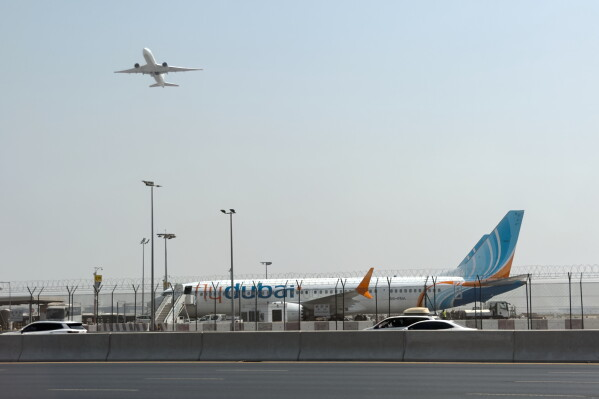
Israel was prepared for the possibility of shooting down a Flydubai passenger aircraft after an alleged cockpit attack left the plane plunging toward the region last week, according to two Israeli sources with direct knowledge of the response.
The flight, FZ1073, was travelling from Dubai to Tel Aviv with more than 150 Israelis among the passengers when Omani co-pilot Hamam al-Hammami allegedly attacked Indian captain Smit Machchhar inside the cockpit.
The Boeing 737 MAX then lost roughly 14,000 feet in a matter of seconds. Israeli fighter jets were scrambled after attempts to establish contact with the cockpit went unanswered, while Israeli airspace was temporarily closed as officials assessed whether the aircraft had been hijacked.
The plane ultimately turned toward Saudi Arabia. The Israeli jets were recalled, Saudi Arabia scrambled its own aircraft, and the crisis ended when Machchhar managed to open the cockpit door, allowing passengers and other crew members to overpower the co-pilot.
The episode has now revealed how close the incident could have come to a far more devastating outcome.
Was Israel really prepared to shoot down the Flydubai plane?
According to CBS News, two Israeli sources familiar with the response said Israel activated its established procedure for a passenger aircraft believed to pose a potential threat.
That procedure exists for an extreme scenario in which an aircraft appears to have been seized and could potentially be used as a weapon against a target inside Israel.
The sources said Israeli authorities were prepared to make the difficult decision if the aircraft continued toward Israel, remained unresponsive and was assessed as a genuine threat.
No Israeli fighter actually fired on Flight FZ1073.
The aircraft changed course toward Saudi Arabia before the situation reached that point, and the fighters were recalled.
Why did Israel scramble fighter jets?
The situation initially looked particularly dangerous because the aircraft had undergone a dramatic loss of altitude and the cockpit was not responding to attempts at communication.
When a passenger aircraft traveling toward Israel suddenly behaves erratically and communication with the flight crew cannot be established, authorities have to consider multiple possibilities, including a technical emergency, medical crisis, unlawful interference or hijacking.
The reported cockpit attack made the situation even more serious.
Israel therefore treated the aircraft as a potential security threat while trying to determine what was happening inside the flight deck.
What would have happened if the plane continued toward Israel?
The Israeli sources told CBS that a pre-established command structure would have assessed the aircraft’s behaviour and information gathered by fighter pilots.
The military aircraft would attempt to determine whether the civilian plane was under control, whether communication could be restored, and whether there were signs that it posed an imminent danger.
If officials concluded that the aircraft had been hijacked and continued toward Israel without responding, the matter could have reached Israel’s highest political leadership.
According to the sources, the Israeli prime minister is the authority who would make the final decision on whether a civilian aircraft should be shot down.
That does not mean such a decision would have been automatic. The circumstances would have had to indicate that allowing the aircraft to continue posed a greater danger to people on the ground.
Why would Israel consider destroying a passenger plane?
The policy is rooted in the fear that a hijacked aircraft could be deliberately crashed into a densely populated area or another high-value target.
The logic is extraordinarily grim: officials would have to weigh the lives aboard the aircraft against the possibility of a much larger loss of life if the plane were used as a weapon.
The security doctrine became particularly significant in Israel after the September 11, 2001 attacks, when passenger aircraft were deliberately used as weapons in the United States.
Israeli authorities have long maintained contingency plans for similar scenarios.
The Flydubai incident demonstrated why those plans still exist decades later.
How close did FZ1073 come to such a decision?
The precise point at which Israeli authorities would have been legally or operationally required to make a shoot-down decision has not been publicly disclosed.
What is known is that the aircraft was approaching the region, had suffered a dramatic descent, and was initially not responding to attempts to make contact.
The situation changed before the most extreme step became necessary.
Once the plane turned away from Israel and toward Saudi Arabia, the immediate risk to Israeli territory diminished, and Israeli fighter aircraft were recalled.
That decision ultimately prevented the crisis from becoming an entirely different kind of catastrophe.
What happened inside the cockpit?
The crisis began when al-Hammami allegedly attacked Machchhar with the aircraft’s crash axe.
The UAE has since described the incident as an attempted terrorist attack.
Machchhar suffered serious injuries but managed to open the cockpit door after fighting with his co-pilot.
Passengers then entered the flight deck and restrained al-Hammami.
Two off-duty Flydubai pilots who were travelling as passengers helped the crew regain control of the aircraft and complete the emergency landing in Tabuk, Saudi Arabia.
The captain’s actions have since been widely praised because opening the cockpit door created the opportunity for others to intervene.
How did the aircraft avoid disaster?
The aircraft underwent an extreme loss of altitude during the confrontation.
Flight-data analysis cited by Reuters showed the aircraft descending more than 16,000 feet in around 30 seconds before the passengers and crew managed to disrupt the attack and regain control.
The plane then made its emergency landing at Tabuk.
The incident left Captain Machchhar injured, but the other people aboard survived.
The sequence illustrates how quickly a cockpit attack can become an aviation emergency, particularly when one of the people involved has legitimate access to the aircraft’s controls.
What role did the passengers play?
The passengers became an unexpected final line of defence.
Once Machchhar managed to open the cockpit door, people nearby rushed inside and helped overpower the alleged attacker.
Several passengers have since described hearing screams, feeling the aircraft plunge, and seeing blood inside the flight deck.
Their intervention bought time for the aircraft to be stabilised and for qualified pilots aboard the plane to take over flying duties.
The passengers’ actions have been praised by Israeli officials and Indian authorities.
Who is Hamam al-Hammami?
The suspected attacker has been identified in multiple reports as Hamam al-Hammami, an Omani national.
Investigators are examining his background, including reports that he had previously been removed from flying duties in Oman over concerns about alleged extremist views.
Israeli Prime Minister Benjamin Netanyahu has also said investigators believe the co-pilot underwent Islamist radicalization.
Those allegations remain part of the investigation and should not be treated as a final finding until authorities publish supporting evidence.
Al-Hammami is currently in the United Arab Emirates, where he is being questioned as investigators examine his motive and possible connections.
Was the attack planned before he joined Flydubai?
This is among the most serious claims to emerge from the investigation.
Reuters reported on October 5 that an Israeli official said al-Hammami told UAE interrogators that he had planned the attack before joining Flydubai.
According to the official, his alleged objective was to crash the aircraft into Israel’s Ben Gurion Airport.
The report also said investigators were examining whether he had previously considered a similar attack.
These claims have not yet been established in a court or through a completed investigation.
If verified, however, they would significantly change the understanding of the incident from a spontaneous cockpit assault to an alleged premeditated plot.
Why has Israeli security come under criticism?
The case has raised questions about how al-Hammami was cleared to operate a flight into Israel in the first place.
Reports have suggested that authorities in Oman had previously raised concerns about him. Other reports have disputed whether his nationality itself prevented him from operating flights into Israel.
The issue is therefore broader than simply asking why an Omani citizen was in the cockpit.
Investigators will need to determine what information was available about al-Hammami, which authorities had access to it and whether relevant information was shared between employers, regulators and security agencies.
Israeli Prime Minister Netanyahu has already ordered a review of security arrangements surrounding foreign airlines operating flights into Israel.
Does an Omani nationality automatically prevent a pilot from flying to Israel?
Not necessarily.
This point has produced conflicting reporting.
Some Israeli sources have said that rules governing certain flights to Israel restricted pilots from countries that do not recognize Israel. Other reports, including coverage by The Jerusalem Post, have said the Israel-UAE aviation agreement does not itself impose such a nationality requirement.
That means the question cannot be answered simply by looking at al-Hammami’s Omani passport.
Investigators must establish which bilateral agreements, airline operating rules and Israeli security procedures applied to the flight and whether any additional requirements existed outside the treaty itself.
What happens to the passengers after the emergency?
After the aircraft landed in Tabuk, passengers continued their journey to Israel on another Flydubai aircraft.
Saudi authorities initially detained the alleged attacker after the emergency landing.
He was later transferred to the United Arab Emirates, where he is undergoing further questioning.
Israeli representatives have also been involved in the investigation, while authorities in several countries are examining different aspects of the case.
Could the incident have become another 9/11-style attack?
That possibility was explicitly raised by Israeli officials.
Netanyahu described the scenario as potentially resembling a 9/11-style event because a passenger aircraft could have been used as a weapon if the alleged attacker had succeeded in maintaining control.
However, the comparison should not obscure an important difference.
The Flydubai aircraft never reached Israel, and the passengers and crew successfully intervened before it could be used against a target.
The reported shoot-down contingency was therefore a response to a potential threat rather than an action that Israel ultimately carried out.
What does the incident reveal about aviation security?
The case highlights one of the most difficult problems in modern aviation security: the insider threat.
Passenger screening and reinforced cockpit doors are designed largely to stop unauthorized people from gaining access to the flight deck.
But a pilot already has legitimate access.
That means preventing a cockpit attack also depends on crew vetting, security intelligence, information sharing, psychological assessment and procedures for dealing with a potentially dangerous crew member.
The Flydubai incident has brought those issues into sharp focus.
What remains unknown?
Several major questions remain unanswered.
Investigators still need to determine the full motive behind the attack, whether al-Hammami acted alone and whether anyone else knew about or assisted in the alleged plan.
They must also establish the exact chain of events inside the cockpit, how long the aircraft was outside normal control and what information was available to security officials before the flight.
The reported claims about premeditation and a planned attack on Ben Gurion Airport will also need to be independently verified.
Perhaps the biggest unanswered question is whether any earlier warning signs were missed.
What happens next?
The UAE-led investigation is expected to examine the alleged attack, al-Hammami’s background and the circumstances surrounding his employment and clearance.
Israel has separately ordered a review of security procedures for international flights entering the country.
The FZ1073 incident has already produced major questions about pilot vetting and the handling of internal threats. The revelation that Israel had a potential shoot-down contingency adds another layer to the story.
For the passengers aboard the aircraft, however, the outcome came down to a much simpler fact.
The captain survived long enough to open the cockpit door. Passengers entered. Other pilots helped regain control. The aircraft turned away from Israel and landed safely in Saudi Arabia.
The most extreme option in Israel’s contingency plan was never used.
But the fact that authorities were preparing for it shows just how seriously the incident was being treated.