
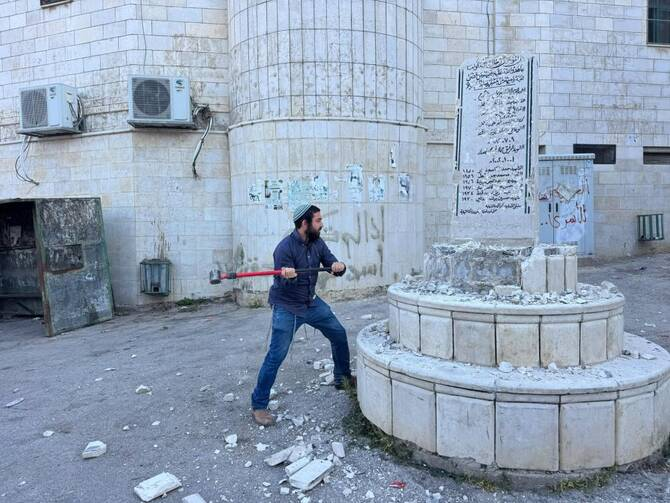
An Israeli far-right lawmaker has sparked outrage after using a sledgehammer to damage a Palestinian memorial in the occupied West Bank, saying the monument glorified terrorism.
Zvi Sukkot, a member of Israel’s Religious Zionist Party, visited the Palestinian village of Madama, south of Nablus, on August 25 and filmed himself damaging the memorial.
The Israeli military later said the destruction was unauthorized and accused Sukkot and his associates of misleading soldiers who had been assigned to provide security for their visit.
The incident has intensified concerns among Palestinian residents and added another flashpoint to an already tense situation in the West Bank.
What happened in Madama?
Sukkot traveled to Madama on Tuesday as part of a visit presented as a tour of West Bank villages.
During the visit, he went to a Palestinian memorial and used a sledgehammer to damage it.
Video posted by Sukkot showed him carrying out the destruction himself.
He said the memorial celebrated Palestinians who had been killed during previous conflicts and argued that it promoted violence against Israelis.
“Every child who sees every day a giant monument that glorifies murderers of Jews will dream of being a terrorist,” Sukkot wrote on X.
The footage quickly spread online, prompting criticism from Palestinian residents as well as Israeli politicians.
Why did Sukkot say the memorial should be removed?
Sukkot argued that the monument glorified people he described as terrorists and that leaving it in place could influence children in the village.
His stated justification was therefore based on what he viewed as the memorial’s political and ideological symbolism.
However, Palestinian officials rejected that characterization.
Rami Nassar, head of the Madama village council, questioned Sukkot’s argument about children and said there had been no evidence that the memorial was causing the kind of confrontation he described.
The competing descriptions reflect the wider political dispute over Palestinian memorials and how Israelis and Palestinians interpret monuments linked to past conflicts.
What did the Israeli military say?
The Israel Defense Forces said the lawmakers and their aides had been given military protection for a planned “memorial tour.”
According to the IDF, the group did not follow the arrangement that had been coordinated with security forces.
The military said the participants acted “deceitfully and manipulatively,” without authorization and in violation of the approved plan.
According to the IDF account, soldiers contacted their commanders after the destruction began and were instructed to intervene and remove the group from the area.
The military described the incident as a serious misuse of the protection provided to the lawmakers and their associates.
Why were Israeli soldiers there?
Israeli forces had been assigned to protect Sukkot and his aides during their visit.
Providing security for Israeli officials traveling in the West Bank is not unusual because of the security risks associated with the region.
The controversy arose because the military said the agreed purpose of the visit was different from what actually happened.
The fact that soldiers were present also raised questions over why the destruction was not immediately stopped.
The footage circulating online did not appear to show soldiers intervening as Sukkot damaged the memorial.
What did Palestinians say about the incident?
The village council head warned that the episode could encourage further attacks by Israeli settlers and increase pressure on Palestinian residents.
Rami Nassar said the actions of an Israeli politician could send a message to more radical settlers that similar behavior was acceptable.
He warned that the incident could be followed by additional raids, harassment or property damage.
Nassar also rejected the idea that the memorial was influencing children in the way Sukkot claimed.
His comments reflected wider Palestinian concerns about escalating settler activity and the role of Israeli political figures in the West Bank.
Why is the West Bank particularly sensitive?
The West Bank has experienced persistent Israeli-Palestinian tension, including clashes, settler attacks, military operations and disputes over land and property.
Incidents involving Israeli politicians can carry additional significance because they are not viewed simply as isolated acts by private individuals.
When an elected official becomes involved, Palestinians may interpret the action as reflecting or legitimizing broader political attitudes.
The Madama incident therefore risks having consequences beyond the damage to one memorial.
What did Israeli politicians say?
The response inside Israel was also divided.
Foreign Minister Gideon Sa’ar criticized Sukkot and argued that he does not have sovereign authority over the territories commonly referred to by Israeli officials as Judea and Samaria.
Sa’ar said decisions in the area should be made by the state and in coordination with security authorities.
Opposition politician Yair Golan called for Sukkot’s arrest in a social-media post that was later deleted after Sukkot threatened legal action.
Democratic Party lawmaker Gilad Kariv also questioned the military’s involvement.
He raised concerns about why soldiers were available to escort Sukkot while other requests for military protection had reportedly been denied.
Who is Zvi Sukkot?
Zvi Sukkot is an Israeli lawmaker associated with the Religious Zionist Party, a far-right political party in Israel.
He has been outspoken on issues involving Israeli control of the West Bank and Palestinian political activity.
His involvement in the Madama incident has drawn attention because it combines the actions of a sitting lawmaker with an already sensitive dispute involving Palestinians and Israeli security forces.
The incident has also highlighted disagreements within Israel over how politicians should conduct themselves in areas under military administration.
Could Sukkot face legal consequences?
That remains unclear based on the information available in the supplied report.
The IDF has said the act was unauthorized and described the conduct as a misuse of military protection.
However, the report does not establish that Sukkot has been arrested or formally charged over the destruction of the memorial.
Any criminal or administrative proceedings would need to be confirmed by Israeli authorities before being reported as an established development.
What does the memorial represent?
The supplied report describes the structure as a memorial honoring Palestinians killed in past conflicts.
It does not provide a detailed account of the individuals commemorated or the circumstances of their deaths.
Those details should therefore not be inferred.
The political disagreement centers on how the memorial is interpreted: Sukkot characterized it as glorifying terrorism, while Palestinian representatives rejected that interpretation.
Understanding precisely whom the memorial commemorates would require additional verification.
Why did the incident go viral?
Sukkot himself recorded and shared footage of the destruction.
That made the incident highly visual and easy to circulate across social-media platforms.
Video of a sitting Israeli lawmaker using a sledgehammer against a Palestinian memorial is likely to attract attention because it combines political symbolism, a physical act of destruction and the longstanding Israeli-Palestinian conflict.
The footage also became central to questions about the role played by soldiers who were present.
Could the incident trigger more violence?
Palestinian officials have warned that it could.
Nassar said the incident could embolden radical settlers and contribute to additional attacks against Palestinians.
The concern is particularly significant because acts involving property destruction can become flashpoints in communities already experiencing high tensions.
That does not mean further violence is inevitable.
But in the context of the West Bank, actions involving religious, national or political symbols can quickly become catalysts for wider confrontation.
Why is the military’s role being questioned?
The IDF’s response has produced its own controversy.
The military says soldiers were misled about the purpose and conduct of the visit.
At the same time, critics are asking why troops did not immediately intervene when the memorial began being damaged.
That creates two separate questions.
One concerns whether the lawmakers violated the terms under which they received military protection.
The other concerns how security forces should respond when an Israeli politician allegedly takes unauthorized action while under that protection.
The supplied report does not provide a complete answer to either question.
What happens next?
The immediate consequences are likely to focus on the military’s review of the incident and the political fallout.
The IDF has already described the conduct as a misuse of military protection.
Israeli politicians from both government and opposition circles have criticized aspects of Sukkot’s actions.
For Palestinians in Madama, the larger concern is whether the incident contributes to further settler violence or intimidation.
The situation will depend on whether Israeli authorities pursue any disciplinary, legal or political action against those involved.
The bigger picture
The destruction of the Madama memorial is significant because it sits at the intersection of several highly sensitive issues: Israeli political authority in the West Bank, Palestinian memorials, settler activity and the role of the military.
Sukkot says the memorial glorified terrorism and should not have remained standing.
The IDF says the destruction was unauthorized and that the group violated the agreed framework for the visit.
Palestinian representatives fear the incident could encourage further attacks.
Israeli politicians have also criticized Sukkot, arguing that elected officials cannot simply take matters into their own hands in the West Bank.
The episode is therefore about more than a damaged monument.
It raises questions about who has authority to act in the West Bank, how political figures interact with military forces and how symbolic acts can affect an already volatile environment.
For now, the video of an Israeli lawmaker wielding a sledgehammer has become another stark image of the tensions surrounding the region.