
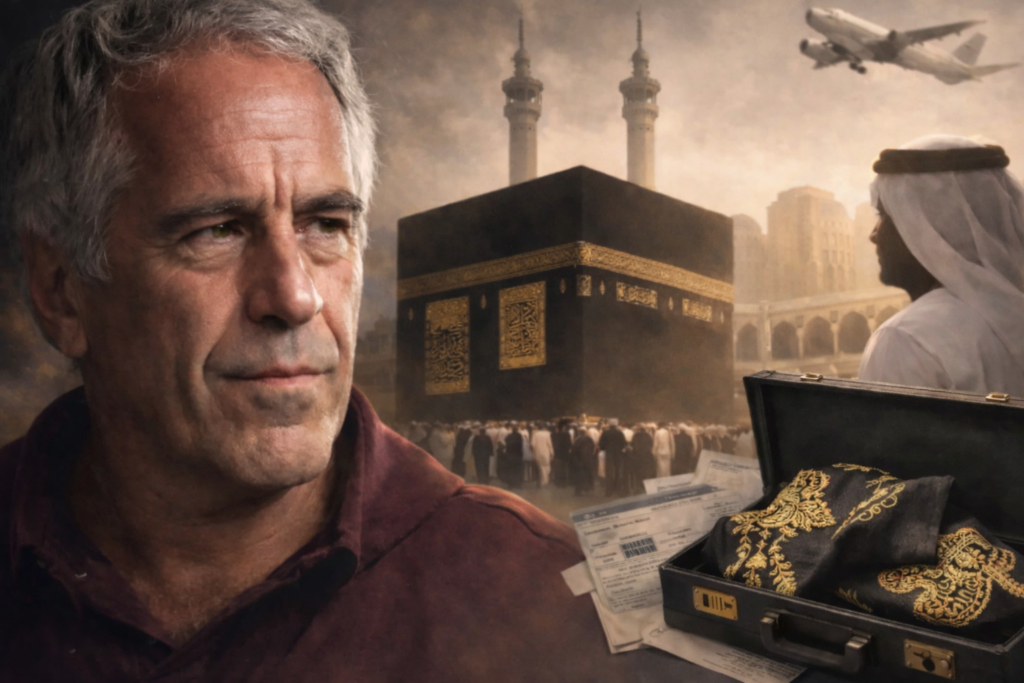
In early 2017—nearly a decade after he was first convicted and registered as a sex offender—Jeffrey Epstein quietly arranged the shipment of three pieces of the Kiswa, the sacred black cloth that covers the Kaaba in Mecca, from Saudi Arabia to his home in the United States.
The details emerge from newly released emails in the latest tranche of the Jeffrey Epstein files, offering an unsettling glimpse into how religious artifacts of immense spiritual significance moved through private networks tied to a man at the center of one of the most notorious criminal cases in modern history.
What the emails reveal is not just a logistics story. They raise deeper questions about access, privilege, and how global power networks can blur ethical, cultural, and legal lines.
What is the Kiswa and why does it matter?
The Kiswa is not an ordinary textile. It is the black, gold-embroidered cloth that drapes the Kaaba, Islam’s holiest site, located in Mecca.
Why the Kiswa is sacred to Muslims
- It is replaced annually during the Hajj pilgrimage.
- Millions of pilgrims touch it while circling the Kaaba, praying and leaving symbolic traces of devotion.
- Fragments of old Kiswas are typically handled by Saudi authorities and distributed in highly controlled ways, often to museums or dignitaries.
For many Muslims, the Kiswa carries profound spiritual meaning. Its handling is governed by religious protocol, state oversight, and deep cultural reverence.
That context makes its appearance in the Jeffrey Epstein files particularly jarring.
What do the Jeffrey Epstein files say about the shipment?
Emails dated February and March 2017 outline a carefully coordinated effort to move three Kiswa-related items from Saudi Arabia to the U.S., using air freight and detailed customs paperwork.
What was shipped?
According to the correspondence:
- One fragment was described as coming from inside the Kaaba.
- Another was from a previously used outer covering.
- A third piece, made from the same material but unused, was classified as “artworks” to ease customs clearance.
The shipment reportedly traveled by British Airways cargo from Saudi Arabia to Florida, arriving at Epstein’s residence in March 2017.
This occurred well after Epstein had:
- Served jail time.
- Been publicly identified as a convicted sex offender.
- Become a known figure of controversy and scrutiny.
Who helped facilitate the shipment?
The emails reference a small but influential network of intermediaries operating across borders.
Key figures mentioned in the emails
- Aziza al-Ahmadi, an Emirati businesswoman, appears central to the coordination.
- Abdullah al-Maari, identified as a Saudi intermediary, assisted with logistics.
- Epstein’s assistants handled much of the direct communication on his behalf.
In one email addressed directly to Epstein, Ahmadi underscored the religious weight of the cloth:
“The black piece was touched by at least 10 million Muslims of various denominations, including Sunni and Shia.”
She went on to describe pilgrims’ prayers, tears, and hopes being placed upon the fabric—language that underscores how far removed this artifact is from a typical collector’s item.
Why would Epstein want the Kiswa?
The emails do not state Epstein’s purpose for acquiring the Kiswa fragments. That silence is notable—and troubling.
Possible interpretations (without speculation)
- Epstein was known to collect rare, symbolic, and status-laden objects.
- The Kiswa’s spiritual and cultural gravity may have amplified its perceived value as a possession.
- The classification of one piece as “artworks” suggests an attempt to fit the shipment into secular, collectible frameworks.
What’s missing is any indication of institutional approval, donation intent, or public display—factors that typically accompany legitimate transfers of sacred artifacts.
What do the emails reveal about Epstein’s wider relationships?
The correspondence extends beyond the shipment itself, offering glimpses into Epstein’s personal network after his initial conviction.
Post-hurricane exchanges
Following Hurricane Irma in September 2017, which devastated parts of the Caribbean, Ahmadi repeatedly contacted Epstein’s office to check on his safety at Little Saint James, his private island.
Epstein’s secretary replied with a blunt damage assessment:
- Structures destroyed.
- Roads impassable.
- Docks and trees gone.
- Interior spaces largely intact.
Ahmadi responded lightly: “Promise to send new tent ;)”
There is no indication in the emails that Ahmadi visited the island or knew the full scope of what occurred there. Still, the casual tone contrasts sharply with what is now known about Little Saint James as a hub for Epstein’s sex-trafficking operations.
Why does Little Saint James matter in this context?
Little Saint James is central to the Epstein story.
What the island represents
- It functioned as a private, tightly controlled space.
- Survivors have identified it as a site of abuse and exploitation.
- Its isolation enabled secrecy, power imbalance, and impunity.
That sacred artifacts linked to Mecca were shipped to a man who controlled such a place underscores the ethical dissonance at the heart of these revelations.
What about the DNA testing kit mentioned in the emails?
In one exchange, Epstein’s longtime assistant Lesley Groff sent Ahmadi a DNA testing kit. The purpose is not explained.
What we know—and don’t know
- No context is given for why the kit was sent.
- There is no follow-up clarifying its use.
- The absence of explanation leaves the detail unresolved but notable.
Given Epstein’s history, even seemingly minor anomalies draw scrutiny. However, without corroborating evidence, the significance of this exchange remains unclear.
How do intelligence ties factor into the Jeffrey Epstein files?
Separate from the email cache, an FBI memo released Friday evening adds another layer of complexity.
Key claim from the memo
- Epstein reportedly had connections with U.S. and Israeli intelligence.
- The memo states he was close to former Israeli Prime Minister Ehud Barak and “trained as a spy under him.”
These claims have circulated in various forms for years, but their inclusion in an official memo elevates the need for careful verification.
Why does this matter beyond Epstein?
The Kiswa shipment is not just another bizarre footnote in Epstein’s life. It touches on broader issues:
Bigger questions raised
- How sacred religious artifacts move across borders.
- Who gets access—and why.
- How wealth and connections can override cultural and ethical norms.
- The failure of safeguards when power operates privately.
For Muslim communities worldwide, the idea that fragments of the Kaaba’s covering ended up in Epstein’s possession is deeply unsettling.
TL;DR
- Newly released Jeffrey Epstein files show he arranged the shipment of three Kiswa fragments from Saudi Arabia to the U.S. in 2017.
- The Kiswa is the sacred cloth covering the Kaaba, Islam’s holiest site.
- Emails detail coordination involving Emirati and Saudi intermediaries and customs workarounds.
- The shipment arrived after Epstein’s conviction and registration as a sex offender.
- The revelations raise serious ethical, cultural, and accountability questions that extend beyond Epstein himself.