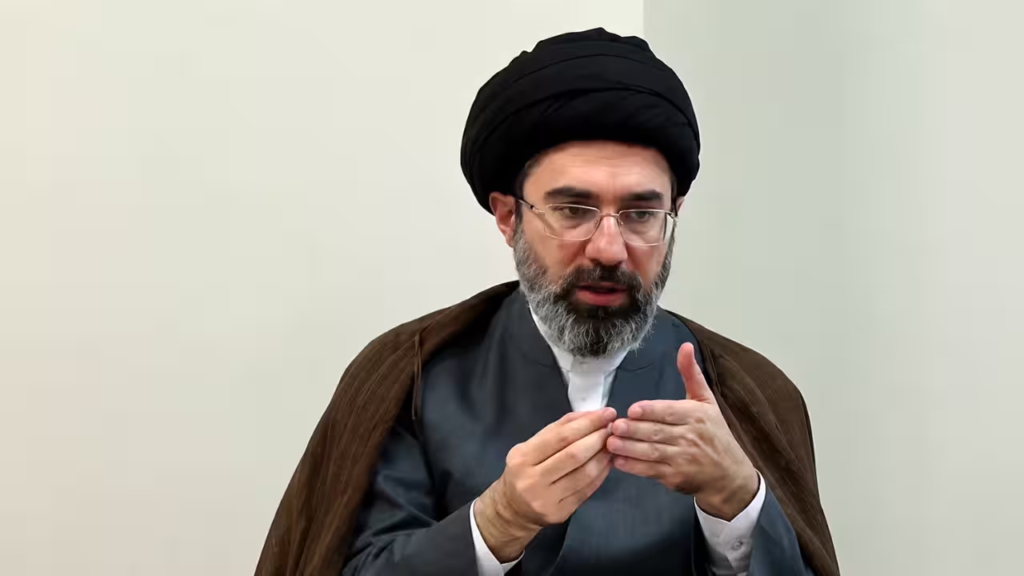
Iran has released rare footage in which Supreme Leader Mojtaba Khamenei can be seen speaking during a religious academic discussion, offering the clearest public audio of him yet amid persistent speculation about his health and whereabouts.
The video, released by Iranian media and reported on August 25, shows Mojtaba Khamenei listening to a student present a thesis before commenting on the work. He reportedly gives the research a score of 19.5 out of 20 and describes it as flawless.
But there is an important catch: the footage is undated. There is no independently verified evidence establishing when or where it was recorded, meaning the video cannot by itself prove Mojtaba Khamenei’s current physical condition.
That uncertainty is central to the story. The footage confirms that Khamenei is alive at the time the recording was made and that he is able to speak, but it does not establish how recently it was filmed.
What does the new Mojtaba Khamenei video show?
The footage reportedly shows Mojtaba Khamenei presiding over a religious academic session in his earlier role as an Islamic jurisprudence scholar.
A student presents research concerning the “Islamic Security Model” of the Iranian regime, after which Khamenei discusses the work and evaluates it. Reports say he awards the student 19.5 out of 20.
The most notable element is the audio.
Earlier footage released since Khamenei became supreme leader has either been extremely brief or has not clearly provided his voice. The new recording is being described by multiple outlets as the first known public footage in which his voice can clearly be heard since the beginning of the conflict.
The release therefore serves two purposes: it gives audiences a rare glimpse of the Iranian leader and provides Tehran with an opportunity to counter speculation surrounding his health.
Does the video prove Mojtaba Khamenei is currently healthy?
No.
That is the most important caveat surrounding the footage.
The video is undated, and Iranian authorities have not provided enough independently verifiable information to establish when it was recorded. Reports have even suggested that the footage may have been recorded before Khamenei assumed the position of supreme leader.
The distinction is crucial.
A recently released video is not necessarily a recently recorded video. Unless the recording date can be independently established, it cannot be used as definitive evidence of Khamenei’s present physical condition.
The footage does, however, undermine the broadest versions of rumors claiming that he is dead or incapable of speaking.
Why have there been so many rumors about Mojtaba Khamenei’s health?
Khamenei has maintained an unusually low public profile since succeeding his father, Ayatollah Ali Khamenei.
His absence has fueled repeated reports and speculation about his health, particularly after the February 28 US-Israeli strikes that killed his father and preceded his selection as Iran’s new supreme leader.
Iranian media have responded with occasional footage intended to demonstrate that Mojtaba remains active.
On August 9, the semi-official Mehr News Agency released another short, undated video showing him interacting with people around him. That footage also did not identify when or where it had been recorded.
The latest release is therefore part of a broader pattern rather than an isolated appearance.
Why is hearing his voice significant?
For an important political leader who has remained largely absent from public view, audio can provide a stronger sign of presence than a static image.
The new video allows viewers to hear Khamenei directly responding during an academic discussion rather than simply seeing him seated or appearing alongside advisers.
That makes the footage more difficult to dismiss as a still photograph or recycled image.
Even so, audio does not solve the key problem of timing. Without a confirmed recording date, the material cannot independently establish his current health.
When did Mojtaba Khamenei become Iran’s supreme leader?
Mojtaba Khamenei was selected as Iran’s supreme leader in early March 2026 after his father, Ayatollah Ali Khamenei, was killed in the February 28 strikes, according to reporting on the succession.
His rise was significant because he moved from being a relatively low-profile religious and political figure to the most powerful position in Iran.
The succession also attracted intense scrutiny because of his limited public appearances.
Unlike his father, who had spent decades as a highly visible symbol of the Islamic Republic, Mojtaba entered the position while maintaining a much more restricted public presence.
Why has Tehran released undated footage of him?
The timing of the releases appears closely connected to the uncertainty surrounding his whereabouts and health.
Iran has an obvious political incentive to demonstrate continuity at the top of the government. Showing the supreme leader alive, speaking and engaging with others can help counter reports that he has been incapacitated.
But the decision to release undated footage creates its own problem.
Without a date or location, viewers cannot determine whether the video was recorded recently or selected from an earlier period.
That is why independent verification remains essential.
What does the latest video reveal about Mojtaba Khamenei’s activities?
The scene offers a glimpse into Khamenei’s background in religious scholarship.
He is shown listening to and evaluating a student’s academic work, rather than delivering a political speech or addressing the nation.
That is significant because it appears to place the recording in a scholarly setting associated with his religious studies.
The video therefore provides a different window into Khamenei from the highly controlled images usually associated with senior Iranian political leadership.
Has Mojtaba Khamenei appeared publicly since becoming supreme leader?
His public visibility has remained limited.
Iranian media released a short video in August showing him interacting with people, but that recording was also undated. An earlier report by Anadolu noted that he had not been publicly seen since his selection as supreme leader.
The latest academic-session video adds audio but does not resolve the question of when it was filmed.
That has left analysts and journalists facing the same basic issue: Tehran is providing evidence that Khamenei exists and has been functioning in some capacity, but not enough independently verifiable information to establish his present condition.
What have Iranian officials said about his condition?
Iranian officials have pushed back against reports that Khamenei is seriously ill.
Iranian President Masoud Pezeshkian has publicly said that Khamenei is in good health, according to reports carried after the earlier video release.
Those statements are relevant but should be treated as official claims rather than independent medical confirmation.
No public medical report has been provided that would allow outside observers to verify the details of his condition.
Why does Khamenei’s health matter politically?
The supreme leader sits at the center of Iran’s political and security establishment.
Any uncertainty about his ability to govern can therefore raise questions about decision-making, succession, military policy and relations with the United States and Israel.
That makes even apparently routine footage of Khamenei politically significant.
A short video showing him speaking can become a signal of continuity. Conversely, prolonged absence can fuel speculation about instability or internal divisions.
The information vacuum itself becomes part of the geopolitical story.
Could the video have been recorded before he became supreme leader?
That possibility cannot be ruled out.
Several reports emphasize that the footage is undated, while some reporting has suggested it may be archival material from before Khamenei assumed the top position.
That possibility explains why the phrase “alive” should be used cautiously.
The footage demonstrates that Khamenei recorded the discussion at some point, but it does not establish that he was in the same condition on August 25, 2026.
For that, a dated public appearance or independently verified recent communication would be much stronger evidence.
What does this mean for the “alive” buzz?
The video is significant because it pushes back against claims that Mojtaba Khamenei has died or is unable to speak.
But it does not settle the wider health debate.
The most accurate conclusion is narrower: Iranian media have released footage that appears to show Khamenei speaking during a religious academic session, and multiple outlets describe it as the first known recording in which his voice can be clearly heard publicly.
Because the footage is undated and has not been independently authenticated, it should not be presented as proof of his current health.
That distinction could become increasingly important if Tehran releases additional material in response to continuing speculation.
What happens next?
The next significant development will likely be whether Iran releases a clearly dated and verifiable recent appearance by Khamenei.
A live broadcast, a recent official meeting or a public event with identifiable participants would provide considerably stronger evidence about his current condition than archival footage.
Until then, the latest video offers an intriguing but incomplete piece of evidence.
For Tehran, it is a chance to project continuity. For observers, it is another reminder that in a conflict shaped heavily by information warfare, even a few seconds of someone’s voice can become a geopolitical signal.
Key takeaways
- Iranian media have released rare footage showing Mojtaba Khamenei speaking during a religious academic session.
- He reportedly evaluated a student’s thesis and awarded it 19.5 out of 20.
- Multiple outlets describe it as the first known public recording in which his voice can clearly be heard since the conflict began.
- The footage is undated, so it does not independently establish his current health or when the recording was made.
- Iran had already released another undated video of Khamenei earlier in August.
- Reports have continued to circulate about his health and whereabouts since he became supreme leader.
- Iranian officials have rejected reports that he is seriously ill, but independent medical confirmation is unavailable.