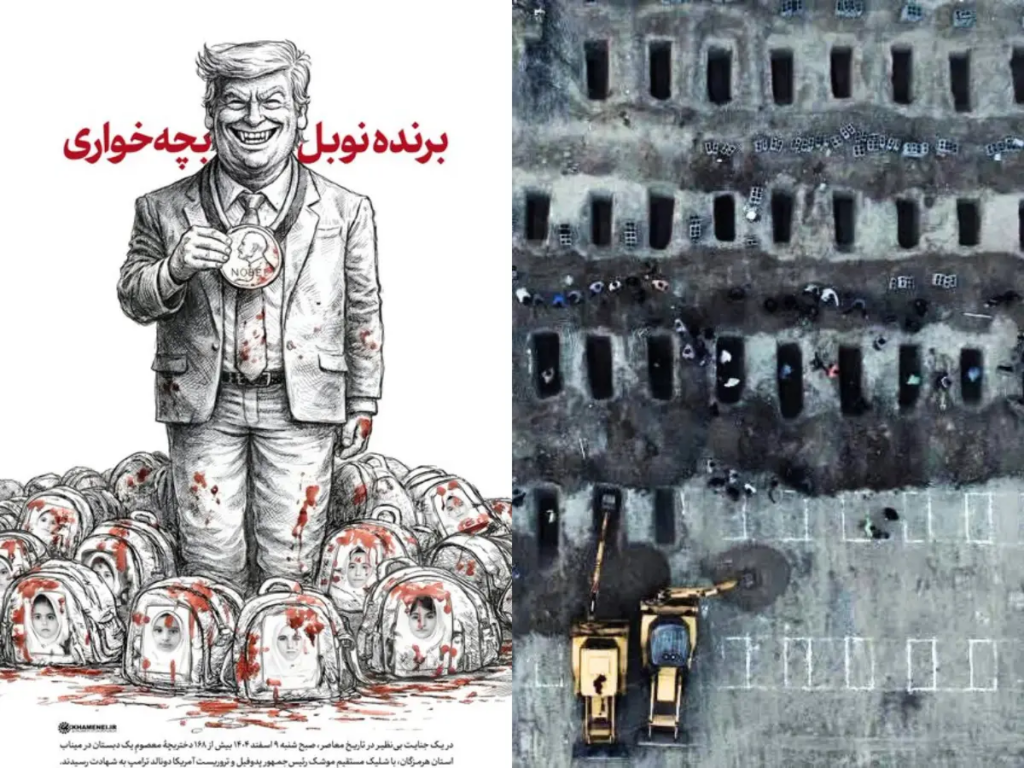
Iran’s official messaging took a stark turn this week after a graphic cartoon of U.S. President Donald Trump appeared on the X account associated with Iran’s late Supreme Leader Ayatollah Ali Khamenei. The illustration, captioned “Nobel Cannibal,” surfaced as tensions intensified over a deadly missile strike that destroyed a girls’ elementary school in the Iranian city of Minab. The attack has become one of the most controversial and emotionally charged incidents of the ongoing Iran-U.S.-Israel conflict.
Iranian officials and state-aligned media have blamed the United States for the strike. Washington, however, has rejected responsibility and suggested alternative explanations. The social media post appears to be part of Tehran’s effort to shape the narrative around the incident.
What Does the “Nobel Cannibal” Cartoon Show?
The image shared online portrays President Trump as a monstrous figure with exaggerated teeth, smiling while holding a Nobel Peace Prize medal.
The background shows debris from the Shajareh Tayyebeh girls’ elementary school in Minab, along with school bags scattered across rubble. The cartoon uses stark black-and-white imagery with red blood splatters to highlight the alleged civilian toll.
A caption accompanying the illustration accuses Trump of responsibility for the attack and claims that dozens of schoolchildren were killed when a missile struck the school.
The message labels the incident an “unprecedented crime in contemporary history,” emphasizing the deaths of children.
Iranian officials and media outlets have framed the strike as evidence of deliberate targeting of civilians.
What Happened in the Minab School Strike?
The Shajareh Tayyebeh girls’ elementary school in Minab, located in Iran’s Hormozgan Province, was reportedly hit by a missile on February 28.
The attack occurred during the early phase of the current Iran-U.S.-Israel conflict.
According to Iranian sources:
• The strike hit a primary school building
• A large number of children were present at the time
• Casualty estimates exceed 170 deaths
Many of the victims were reportedly between the ages of 7 and 12.
If confirmed, it would mark one of the deadliest civilian incidents in the conflict so far.
However, key details—including the missile’s origin and responsibility for the strike—remain contested.
What Did Trump Say About the Missile Strike?
A day before the cartoon appeared, President Trump publicly rejected accusations that the United States carried out the attack.
Speaking to reporters at his Doral resort in Florida, Trump said investigations were ongoing and suggested the missile involved might not have been launched by the U.S.
He raised the possibility that another country—including Iran itself—could possess the type of missile suspected in the attack.
Trump referenced the Tomahawk cruise missile while discussing the incident.
Key points from his remarks included
• The origin of the missile is still under investigation
• Tomahawk missiles exist in multiple global arsenals
• Other nations may possess similar weapons systems
The comments were widely reported across international media and sparked strong reactions from Iranian officials.
Why Iran Is Using Propaganda Imagery
Political cartoons and graphic imagery have long been used during conflicts to influence public opinion and shape international narratives.
In this case, the cartoon appears designed to achieve several goals.
Domestic messaging
The illustration reinforces the Iranian government’s portrayal of the United States as responsible for civilian casualties.
Such imagery can help consolidate domestic support during wartime.
International pressure
By highlighting the deaths of schoolchildren, Tehran may be attempting to increase diplomatic pressure on Washington.
Images involving civilian casualties often gain significant traction on social media and in international media coverage.
Information warfare
Modern conflicts increasingly include an online dimension in which narratives compete across social platforms.
Governments frequently use viral imagery, video clips, and symbolic messaging to influence global perceptions.
Why the Minab Strike Is So Controversial
Civilian casualties, especially involving children, often become flashpoints in international conflicts.
The Minab school strike has become a focal point because of three factors.
The scale of casualties
Reports suggest that more than 170 people may have died in the attack, many of them young students.
Disputed responsibility
Iran claims the United States launched the missile, while U.S. officials deny involvement.
Without independent verification, competing narratives continue to circulate.
Symbolic impact
Schools are widely viewed as protected civilian infrastructure under international humanitarian law.
Attacks involving schools often trigger intense international scrutiny.
The Role of Social Media in Wartime Narratives
The viral spread of the “Nobel Cannibal” cartoon highlights how social platforms have become central battlegrounds in modern geopolitical conflicts.
Posts from government officials and state-aligned accounts can reach millions of users within minutes.
These messages can:
• Frame responsibility for events
• Mobilize domestic audiences
• Influence global public opinion
• Pressure international institutions
However, analysts caution that wartime information flows often include propaganda, misinformation, and unverified claims.
TL;DR
• Iran-linked X accounts posted a graphic cartoon depicting Donald Trump as “Nobel Cannibal.”
• The image references a deadly missile strike on a girls’ school in Minab, Iran.
• Iranian officials blame the United States for the attack.
• President Trump has denied responsibility and suggested the missile’s origin remains under investigation.
• The cartoon reflects the growing role of propaganda and social media messaging in modern conflicts.