


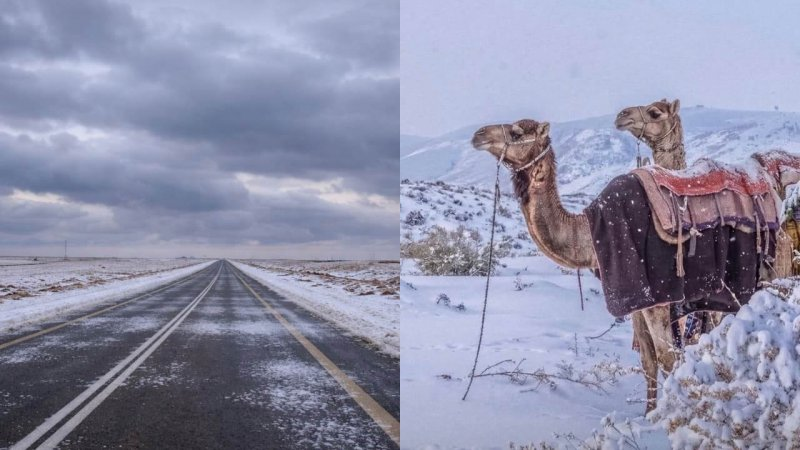
Snowfall and Saudi Arabia rarely appear in the same sentence. Yet this week, images of snow-capped dunes from the kingdom’s northern regions have taken over social media feeds, leaving many stunned and searching for answers.
Parts of the Middle East, best known for scorching summers and endless deserts, are witnessing rare snowfall—an event many residents are seeing for the first time in their lives. The phenomenon is unusual, but it isn’t random. Scientists say it reflects deeper shifts in weather patterns across the Middle East.
Below is a clear, grounded explanation of what’s happening, where the snow fell, and why events like this may no longer be as rare as they once were.
Where did snowfall occur in Saudi Arabia?
The snowfall was reported primarily in the northern regions of the Kingdom, especially:
These areas sit at higher elevations compared to much of Saudi Arabia’s low-lying desert terrain. Temperatures there can drop sharply during winter, creating conditions where snow—while rare—is meteorologically possible.
Why these regions matter
- Higher altitude: Cooler air temperatures make snowfall feasible.
- Proximity to weather systems: Northern Saudi Arabia is more exposed to cold air masses moving in from the Mediterranean and Europe.
- Desert topography: Mountainous deserts can experience extreme temperature swings, including snowfall.
Has it ever snowed in Saudi Arabia before?
Yes—though infrequently.
Historical records show that there was measurable snowfall in January 1973, with reports suggesting nearly 20 centimeters accumulated in parts of the city. Since then, only isolated and light snow events have been documented, mostly in northern or elevated areas.
For many Saudis today, however, this is the first snowfall they have ever witnessed inside the country, making the moment feel historic even if it’s not unprecedented.
Why is it snowing in Saudi Arabia now?
The “warming paradox” explained
According to climate scientists and bodies such as the Middle East, it is warming faster than many other regions globally. This creates what experts call a warming paradox.
Here’s how it works:
- Warmer air holds more moisture
- More moisture fuels extreme weather
- Cold air intrusions interacting with moist air can trigger snow
In simple terms, global warming doesn’t just mean “hotter everywhere all the time.” It also increases the intensity and unpredictability of weather events—heatwaves, floods, and, occasionally, snowfall in unlikely places.
Key contributing factors
- Rapid warming across the Middle East
- Increased atmospheric moisture
- Sudden drops in temperature due to shifting air masses
Is snowfall in desert regions really that unusual?
Not entirely.
Snowfall has been recorded in several desert regions worldwide, including:
- , India
- The United States
Deserts are defined by low precipitation, not by heat. Some deserts experience freezing winter temperatures, especially at night or at high elevations. Saudi Arabia’s recent snowfall fits within this broader global pattern.
How are people in Saudi Arabia reacting?
Social media tells the story better than words alone.
Videos and photos show:
- Children throwing snowballs for the first time
- Families attempting makeshift skiing
- Locals shaping snow figurines atop dunes
For many residents, it’s not just weather; it’s a once-in-a-generation memory. The contrast between snow and sand has made the visuals especially striking, helping them go viral far beyond the region.
Are there safety concerns?
Yes. While the snowfall looks picturesque, authorities have urged caution.
Saudi Arabia’s National Centre of Meteorology issued advisories warning of:
- Slippery roads
- Reduced visibility
- Sudden temperature drops
Infrastructure in desert regions is not designed for icy conditions, making even light snowfall potentially disruptive.
Does this signal a bigger climate trend?
Scientists caution against tying a single weather event directly to climate change. Still, patterns matter, and the trend is clear.
Across the Middle East, researchers are observing:
- More intense rainfall events
- Longer heatwaves
- Greater variability in winter weather
Snowfall in Saudi Arabia doesn’t contradict global warming. It illustrates how warming reshapes weather systems in complex, sometimes counterintuitive ways.
Why this snowfall captured global attention
Snow in Saudi Arabia resonates because it challenges assumptions. It disrupts the mental image of the Middle East as uniformly hot and dry, reminding audiences that climate and geography are more nuanced than stereotypes allow.
It also raises a larger question:
If extreme weather is becoming more common in unexpected places, how prepared are regions—deserts included—to handle it?
TL;DR
- Snowfall was reported in northern Saudi regions like Tabuk and Al-Jawf
- The areas are high-elevation zones where winter snow is possible
- Climate-driven atmospheric changes increase extreme weather events
- Desert snowfall is rare but not unprecedented globally
- Authorities have warned residents to exercise caution