Within hours, a single word—“Draft”—turned a routine diplomatic message into a global talking point. A now-edited post by Pakistan’s Prime Minister Shehbaz Sharif has triggered scrutiny over how the country communicates during high-stakes international crises, particularly amid rising tensions involving Iran and the United States.
The controversy centers not just on what was said, but how it appeared to be said, and who may have written it.
What happened with Shehbaz Sharif’s X post?
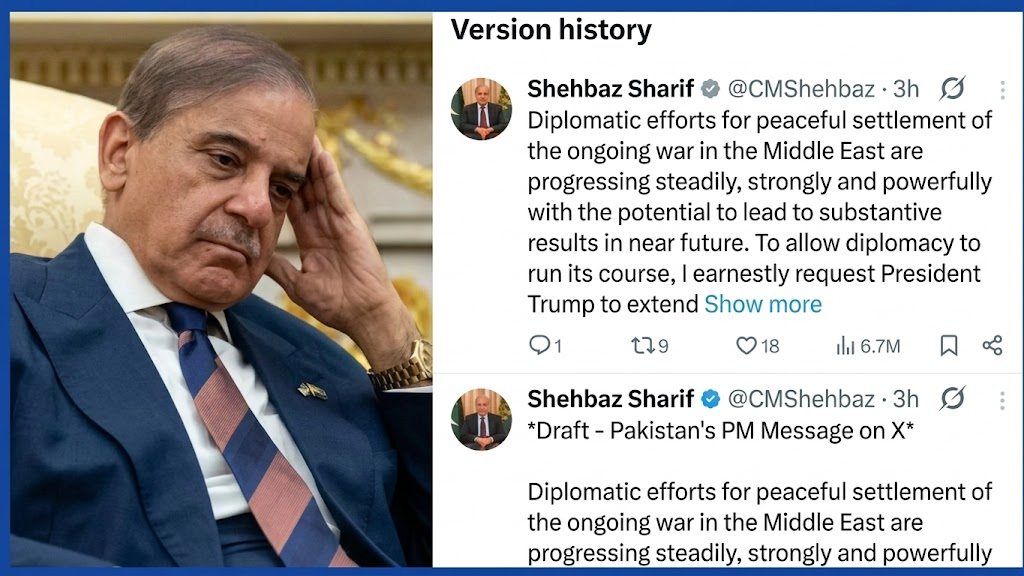
The controversy began when Sharif posted a message on X (formerly Twitter) urging Donald Trump to extend a deadline related to escalating tensions with Iran. He framed the appeal as a push for diplomacy, asking for a two-week pause in hostilities and calling on Iran to reopen the Strait of Hormuz as a goodwill gesture.
But soon after the post went live, screenshots began circulating online showing an earlier version labeled: “Draft – Pakistan’s PM Message on X.”
That small detail ignited a much larger debate.
Why did the “draft” label raise red flags?
Language and formatting concerns
Observers quickly pointed out that the phrasing “Pakistan’s PM” is unusual for a message written directly by a sitting prime minister or their close team. It reads more like a briefing note or an internal document.
This led to speculation that:
- The message may have been copied from a prepared draft
- It could have originated outside Pakistan’s internal communication channels
- A staff-level error may have resulted in posting an unedited version
Journalist commentary, including remarks attributed to Ryan Grim, suggested the wording didn’t resemble Sharif’s typical communication style.
Timing amplified the impact
The issue wasn’t just the wording—it was when it happened. The post came at a sensitive moment, as diplomatic backchannels were reportedly active between Washington and Tehran.
In crisis communication, even minor errors can:
- Undermine credibility
- Create confusion about intent
- Trigger geopolitical speculation
Here, the “draft” label did all three.
How does this connect to the Iran crisis?
A delicate diplomatic balancing act
Pakistan has positioned itself as a mediator in the ongoing tensions between Iran and other countries. Sharif’s message aligned with broader efforts to:
- Encourage a temporary ceasefire
- Allow negotiations to progress
- Prevent escalation in the Middle East
The post also referenced a potential two-week pause in military action—something Trump later echoed publicly.
Trump stated that, following conversations with Sharif, he would suspend planned military actions against Iran for two weeks. This gave the original message more weight—and made the controversy harder to ignore.
The Strait of Hormuz factor
Sharif’s appeal also included a call for Iran to reopen the Strait of Hormuz, a critical global oil route.
This is significant because
- Roughly 20% of the global oil supply passes through it
- Any disruption can spike global energy prices
- Reopening it signals de-escalation
Including such a specific request further suggests the message was carefully structured—raising more questions about its origin.
Was there external influence?
What the speculation says
Online reactions ranged from cautious analysis to outright claims that the message was influenced—or even drafted—by external actors.
Some widely shared claims suggested the following:
- The post resembled a “White House-style” briefing note
- It may have been pre-written and shared for posting
- The inclusion of U.S. officials like J. D. Vance and Marco Rubio added to suspicions
However, it’s important to note:
- None of these claims has been independently verified
- There has been no official response from Islamabad or Washington
- No concrete evidence confirms external authorship
The more likely explanation
Many analysts believe a simpler explanation is more plausible: a procedural or editorial error.
Possible scenarios include:
- A staff member accidentally posted a draft version
- Copy-paste oversight from an internal document
- Lack of final review before publishing
In high-pressure environments, such mistakes are not uncommon—but they rarely occur under such global scrutiny.
Why this matters beyond one post
Diplomacy is as much about perception as policy
In international relations, messaging is strategic. Every word, phrase, and even formatting choice can carry meaning.
This incident highlights how
- Digital communication is now central to diplomacy
- Informal platforms like X are used for official messaging
- Errors can instantly become geopolitical talking points
Trust and credibility are at stake
For a country positioning itself as a mediator, clarity and independence are crucial.
This controversy raises key questions:
- Who drafts official diplomatic messages?
- What review processes are in place?
- How can governments prevent similar missteps?
Even if the issue was a simple mistake, the optics matter.
Lessons for political communication in the digital age
1. Drafts are not harmless
What was once an internal label can now become public instantly. Teams must treat every version as potentially visible.
2. Platforms like X are not casual spaces anymore
Leaders use them for real-time diplomacy, which means:
- Messages must meet the same standards as official statements
- Speed should not compromise accuracy
3. Transparency matters
In the absence of official clarification, speculation fills the gap. Quick responses can prevent narratives from spiraling.
What happens next?
As of now:
- No official explanation has been issued
- The edited post remains online without the “draft” label
- The broader diplomatic efforts around Iran continue
But the incident leaves a lingering question: was this a simple mistake—or a glimpse into how modern diplomacy is scripted behind the scenes?
Either way, it’s a reminder that in global politics, even a single overlooked word can shift the conversation.
TL;DR
- A post by Pakistan PM Shehbaz Sharif included a visible “Draft” label before being edited
- The message urged Donald Trump to pause actions against Iran for two weeks
- The wording sparked speculation about external influence and authorship
- No official confirmation supports these claims
- The episode highlights risks in digital diplomacy and real-time political communication