
Quick Summary
NASA satellites spotted a mysterious turquoise glow off Australia’s coast, which turned out to be a massive bloom of phytoplankton. The glowing waters, visible from space, highlight the ecological importance of these microscopic organisms and demonstrate how advanced satellite technology is helping scientists track ocean health and climate change.
What did NASA see off Australia’s coast?
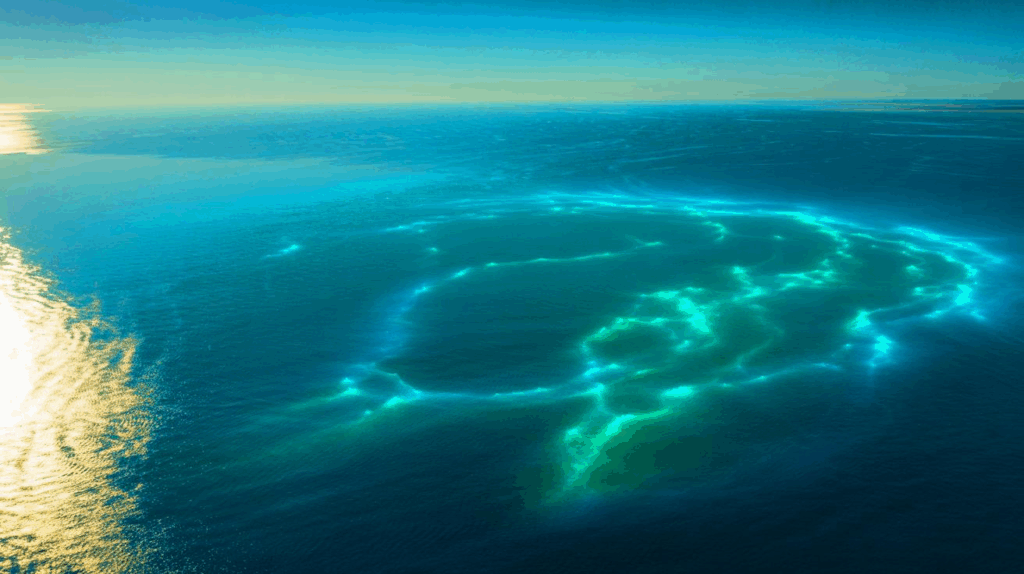
NASA satellites recently spotted a mysterious turquoise glow in the ocean off Australia’s southern coast, between mainland Australia and Tasmania. At first glance, the sight puzzled observers. The luminous waters, however, were not caused by anything supernatural or artificial—they were the result of a vast bloom of phytoplankton, tiny marine organisms that play a crucial role in the ocean’s ecosystem.
The glow was captured by NASA’s Plankton, Aerosol, Cloud, ocean Ecosystem (PACE) spacecraft using its advanced Ocean Color Instrument. The bloom was so dense and widespread that it was visible from space, covering areas in the Great Australian Bight and the Tasman Sea.
Why does phytoplankton glow?
Phytoplankton are microscopic plants that float near the ocean surface and contain chlorophyll a, the green pigment that enables photosynthesis. When present in high concentrations, they reflect light in shades of blue and green, producing a glowing effect that satellites can detect.
Factors behind the bloom
- Nutrients like nitrogen and phosphorus, released as marine life decays, fuel phytoplankton growth.
- Sunlight penetrates deep into the photic zone, helping them thrive.
- The bloom spotted by NASA reportedly reached a depth of nearly 500 feet, making it particularly visible from space.
Oceanographer Jochen Kaempf from Flinders University explained that the turquoise glow likely also included contributions from disturbed sediments in shallower waters and the presence of multiple phytoplankton species.
Has this happened before?
This isn’t the first time satellites have caught the ocean glowing.
- In 2023, the Suomi NPP satellite picked up similar bioluminescence.
- In 2024, NASA’s Aqua satellite also detected phytoplankton blooms in the same region.
The repeated observations reveal seasonal patterns in how and where the blooms appear. With advances in satellite technology, scientists are now able to map, track, and analyze these events with far greater precision than ever before.
Why are phytoplankton important?
Phytoplankton may be microscopic, but their ecological role is enormous.
- Foundation of the marine food chain: They are the primary producers, feeding everything from tiny zooplankton to giant whales.
- Carbon cycle regulators: Through photosynthesis, they absorb large amounts of carbon dioxide and release oxygen. In fact, phytoplankton are responsible for producing about half of Earth’s oxygen supply.
- Indicators of ocean health: Large blooms can signal changes in nutrient levels, ocean currents, and even climate shifts.
Why does this matter?
The turquoise glow spotted off Australia highlights the power of modern satellite imagery to uncover and monitor natural processes in real time. Beyond being a stunning spectacle, these blooms provide valuable insights into oceanographic dynamics, climate change, and global carbon cycles.
The region where this bloom occurred is also a busy maritime route leading to Port Phillip Bay, meaning better monitoring of such phenomena can support both environmental research and navigation safety.