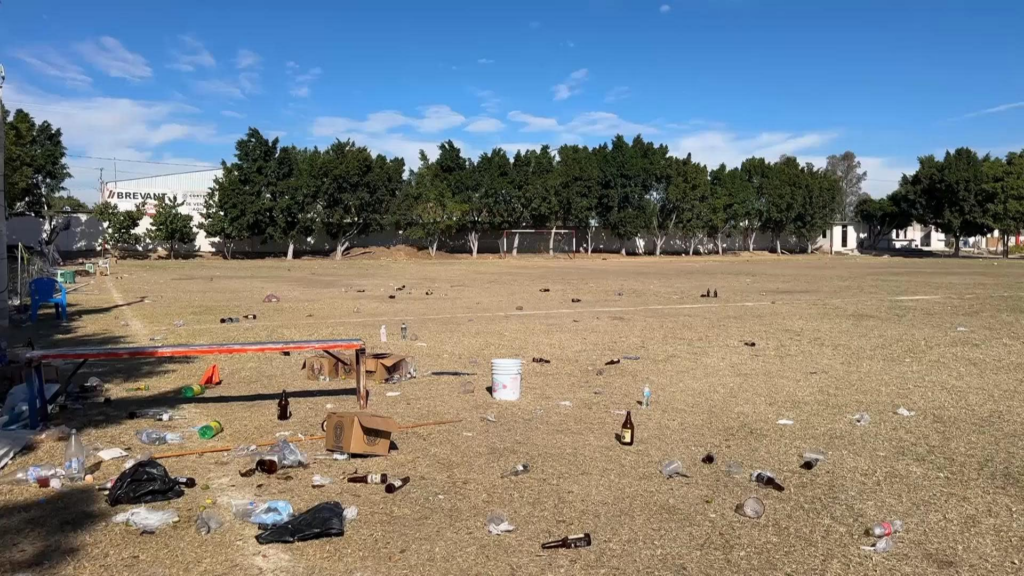
Gunmen opening fire on families gathered at a local football pitch in Salamanca, central Mexico, killing at least 11 people, is not just another violent headline in a country long accustomed to cartel bloodshed. The attack stands out because of where it happened, who was targeted, and what it says about how organized crime is increasingly reshaping daily life in parts of Mexico. Public spaces, once considered neutral, are now becoming battlegrounds.
On Sunday evening, armed men arrived in several vehicles at the Cabañas football pitch in Salamanca, in the state of Guanajuato, and fired indiscriminately at those present. Witnesses reported hearing around 100 gunshots. Among the dead were at least one woman and one child. Several more were injured. The motive remains under investigation, but the context surrounding the attack points to deeper structural violence rather than a random act.
TL;DR
- At least 11 people were killed when gunmen opened fire at a football pitch in Salamanca, Guanajuato
- Families and children were present after a local match
- Guanajuato is Mexico’s deadliest state due to cartel rivalry and fuel theft
- Salamanca’s Pemex refinery has made it a strategic target for criminal groups
- The attack highlights how cartel violence is increasingly spilling into everyday public spaces
What happened at the Salamanca football pitch
The shooting took place in the Loma de Flores neighborhood of Salamanca, a working-class area where football pitches double as social gathering points. According to witnesses, families remained at the grounds after a local match to talk and socialize when several vehicles arrived. Armed men exited and began shooting without warning.
Neighbors described a prolonged burst of gunfire, suggesting the attackers were heavily armed and acting with coordination. Emergency services arrived at scenes of chaos, with victims scattered across the pitch. Local and federal security forces launched an investigation, but no immediate arrests were announced.
The massacre followed a violent weekend in Salamanca. Just a day earlier, five men were killed in separate incidents, and another person was abducted. The clustering of attacks underscores how the city is experiencing sustained pressure from organized crime rather than isolated episodes.
Why Guanajuato has become Mexico’s most violent state
Guanajuato registered the highest number of murders in Mexico last year, surpassing traditionally violent regions such as Michoacán and Guerrero. The reasons are rooted less in geography and more in economics and infrastructure.
Here’s a breakdown of the key drivers behind Guanajuato’s violence:
| Factor | Why it matters |
|---|---|
| Strategic pipelines | Major fuel pipelines cross the state |
| Pemex infrastructure | Refineries and storage facilities attract criminal interest |
| Rival cartels | Competing groups fight for control |
| Urban density | Violence increasingly affects civilians |
The state’s wealth, industrial footprint, and energy infrastructure have turned it into a prize for criminal groups seeking control over fuel theft and distribution routes.
Salamanca’s role in cartel economics
Salamanca is home to one of the country’s most important oil refineries, operated by Pemex, Mexico’s state-run energy firm. The refinery and surrounding pipelines have made the city a focal point for fuel theft, known locally as huachicol.
Criminal groups tap pipelines, hijack tanker trucks, and sell stolen fuel on the black market. This activity generates millions of dollars and requires territorial control, enforced through violence and intimidation.
Salamanca’s location also places it near key transport routes linking central Mexico to other regions, further increasing its strategic value. As a result, residents live under the constant threat of clashes between armed groups seeking dominance.
The cartel rivalry behind the bloodshed
Analysts attribute much of the violence in Guanajuato to the rivalry between the Jalisco New Generation Cartel and the Cartel de Santa Rosa de Lima.
- Jalisco New Generation Cartel, commonly known as CJNG, is one of Mexico’s most powerful criminal groups, with operations spanning drug trafficking, extortion, and fuel theft.
- Cartel de Santa Rosa de Lima emerged locally and has fought to retain control over fuel theft operations in the region.
As these groups battle for territory, civilians often become collateral damage or deliberate targets. Mass attacks serve multiple purposes, spreading fear, punishing communities suspected of cooperating with rivals, and demonstrating dominance.
Why public spaces are increasingly targeted
Football pitches, markets, bars, and town squares have become frequent scenes of cartel violence. These locations are symbolic. They represent normalcy, community, and shared life. Attacking them sends a message that no space is truly safe.
In Salamanca, the presence of families and children amplified the shock of the attack. Violence is no longer confined to night-time confrontations between armed men. It increasingly intrudes into everyday moments, eroding trust and altering how communities function.
For many residents, this means restricting movement, avoiding gatherings, and living with constant anxiety. Over time, this social fragmentation weakens communities and makes criminal control easier to enforce.
The broader US–Mexico security dimension
The violence in Guanajuato also intersects with growing tensions between Mexico and the United States over how to confront organised crime.
The US has designated the CJNG as a foreign terrorist organisation and imposed sanctions on the Cartel de Santa Rosa de Lima. President Donald Trump has repeatedly argued that Mexican cartels pose a direct threat to US security, particularly through the trafficking of fentanyl, heroin, methamphetamines, and cocaine.
The US has already carried out dozens of maritime strikes against vessels suspected of transporting drugs, actions that have raised legal and diplomatic questions. Critics argue such operations risk escalating violence without addressing the underlying causes.
Mexican President Claudia Sheinbaum recently authorized the extradition of 37 high-profile suspects to the United States, a move widely seen as an attempt to demonstrate cooperation and reduce the risk of unilateral US action on Mexican soil.
What this attack means for ordinary Mexicans
For residents of Salamanca and similar cities, attacks like this reinforce a grim reality. Violence is unpredictable, often indiscriminate, and increasingly public. Parents face impossible choices about letting children play outside or attend community events. Businesses close earlier. Social life contracts.
Psychologically, the impact is profound. Survivors and witnesses carry trauma, while entire neighborhoods internalize fear. Over time, this normalization of violence erodes confidence in institutions and deepens feelings of abandonment.
What comes next for Salamanca and Guanajuato
Security forces have pledged investigations and increased patrols, but experience offers limited reassurance. Arrests and troop deployments have rarely produced lasting reductions in violence. Cartel structures are resilient, adaptable, and deeply embedded in local economies.
Without addressing fuel theft networks, corruption, and the economic incentives that sustain criminal groups, cities like Salamanca are likely to remain flashpoints. The challenge for authorities is not only tactical but also structural.
How this violence continues and what must change
The Salamanca football pitch massacre illustrates a shift in Mexico’s security crisis. Violence is no longer hidden in remote areas or confined to criminal targets. It is visible, communal, and deeply destabilizing.
Long-term solutions require more than force. They involve rebuilding trust, protecting communities, dismantling illicit economies, and addressing the social conditions that allow cartels to thrive. Until then, attacks like this will continue to punctuate daily life, reminding communities that even the most ordinary moments can be shattered in seconds.