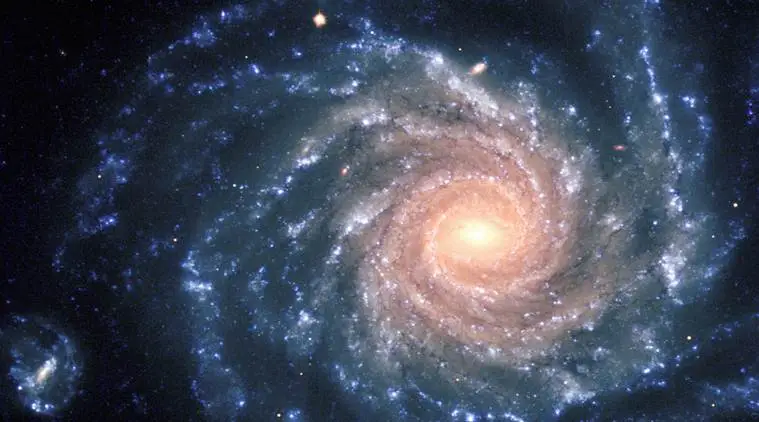
Astronomers have uncovered new evidence suggesting that the Milky Way underwent a dramatic transformation around 10 billion years ago, when a violent collision with a dwarf galaxy caused the entire galactic disc to tilt by more than 90 degrees.
The study, presented at the Royal Astronomical Society’s National Astronomy Meeting in Birmingham by researchers from Durham University, offers fresh insight into one of the most significant events in the Milky Way’s history. The findings suggest that the collision with a dwarf galaxy known as Gaia Sausage reshaped our galaxy long before the Sun and Earth existed.
What caused the Milky Way to flip?
According to the research team, the Milky Way collided head-on with a smaller dwarf galaxy called Gaia Sausage roughly 10 billion years ago.
Rather than simply absorbing the smaller galaxy, the impact dramatically altered the orientation of the Milky Way’s stellar disc.
Researchers estimate that the galaxy’s disc rotated by more than 90 degrees, a phenomenon they describe as a “disc flip.”
Lead researcher Kirill Batrakov said the transformation did not happen instantly. Instead, it unfolded over hundreds of millions of years as the two galaxies merged.
What is Gaia Sausage?
Gaia Sausage, sometimes referred to as Gaia-Enceladus or the Gaia Sausage-Enceladus merger, is an ancient dwarf galaxy that merged with the Milky Way billions of years ago.
Astronomers believe the collision contributed:
- Millions of stars to the Milky Way.
- Large amounts of dark matter.
- Changes to the galaxy’s structure.
- The formation of parts of the Milky Way’s stellar halo.
Today, the original galaxy no longer exists as a separate object because it was completely absorbed into the Milky Way.
How did scientists discover the galactic flip?
The discovery emerged while researchers investigated the unusual motion of stars in the Milky Way’s stellar halo.
The halo is a vast, roughly spherical region surrounding the galaxy that contains:
- Ancient stars.
- Globular clusters.
- Dark matter.
- Remnants of smaller galaxies consumed over billions of years.
Previous observations from the European Space Agency’s Gaia spacecraft showed that halo stars rotate much more slowly than stars in the Milky Way’s disc.
Scientists wanted to understand why.
What did computer simulations reveal?
Researchers used advanced computer simulations to recreate the evolution of galaxies similar to the Milky Way.
The models showed that when a large dwarf galaxy collides nearly head-on with a spiral galaxy, the gravitational forces can gradually rotate the host galaxy’s disc.
The simulations consistently produced a disc flip similar to the one inferred from observations of the Milky Way.
These results provide a possible explanation for the slow rotation observed in halo stars today.
Why does this discovery matter?
Understanding ancient galactic collisions helps astronomers reconstruct the Milky Way’s history.
The findings also improve scientists’ understanding of:
- How galaxies grow through mergers.
- The formation of stellar halos.
- The distribution of dark matter.
- The evolution of spiral galaxies across the universe.
Because galaxy mergers are common throughout the cosmos, studying the Milky Way offers valuable clues about how other galaxies evolved over billions of years.
Did the collision affect Earth?
No.
The collision occurred around 10 billion years ago, approximately 5.5 billion years before the Sun formed and about 5.4 billion years before Earth existed.
While the merger reshaped the Milky Way itself, there was no Earth or solar system at the time.
Instead, the event became part of the long evolutionary history that eventually produced the galaxy we see today.
What’s next for researchers?
Astronomers plan to continue studying data from the European Space Agency’s Gaia mission alongside increasingly sophisticated galaxy simulations.
Future observations could reveal:
- Additional evidence of ancient galactic mergers.
- More details about the Milky Way’s early structure.
- How often disk flips occur in spiral galaxies.
- The role of dark matter during major galaxy collisions.
As astronomical surveys continue to improve, researchers hope to build a more complete timeline of the Milky Way’s formation over the past 13 billion years.
TL;DR
- Researchers say the Milky Way flipped by more than 90 degrees after colliding with the dwarf galaxy Gaia Sausage around 10 billion years ago.
- The collision occurred billions of years before the Sun and Earth formed.
- Scientists discovered clues while studying the slow rotation of stars in the Milky Way’s stellar halo.
- Computer simulations showed that head-on galaxy mergers can produce a gradual “disc flip”.
- The findings help explain the Milky Way’s evolution and improve understanding of how spiral galaxies form.