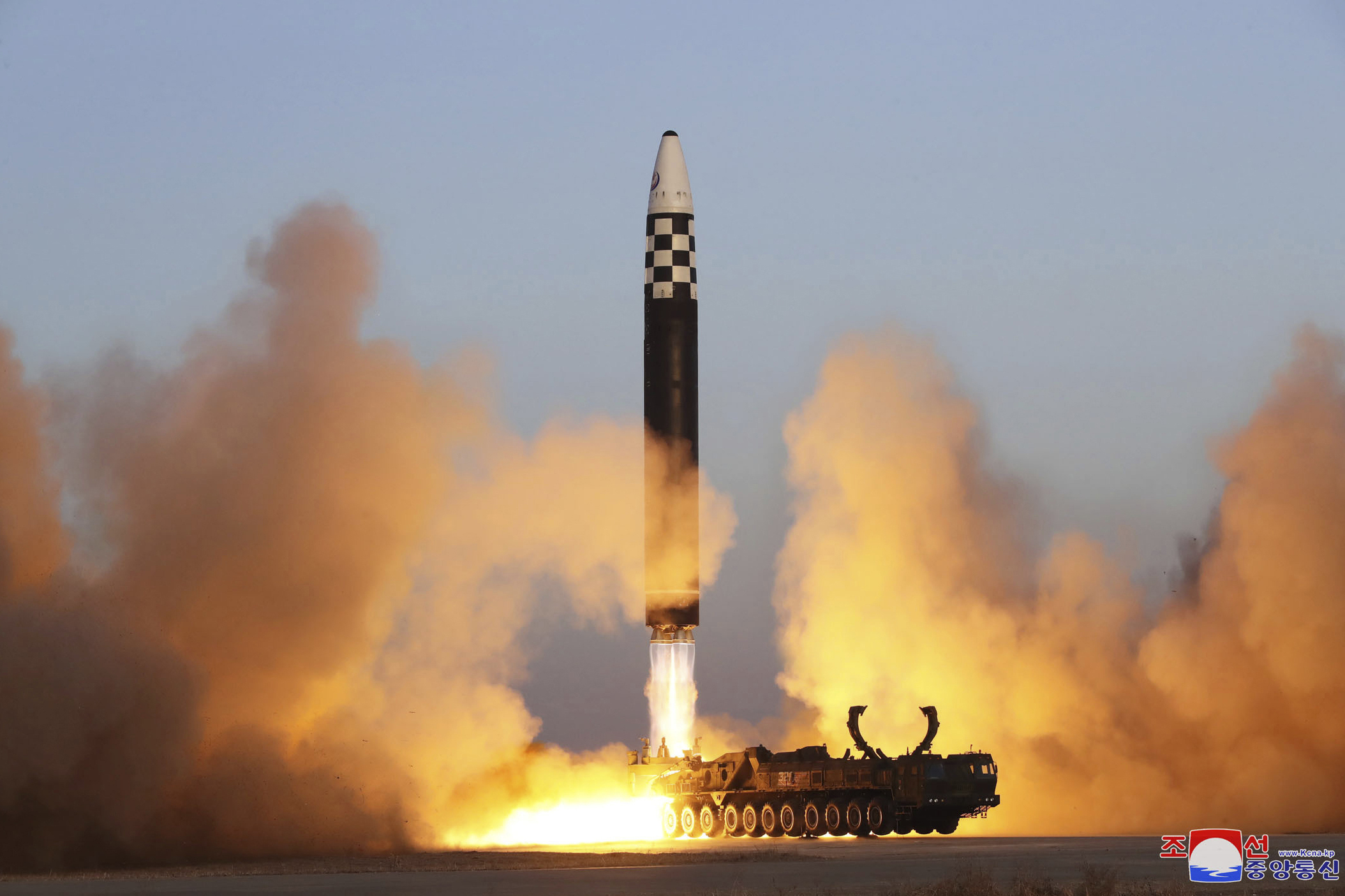
According to South Korea and Japan, North Korea has conducted another suspected solid-fuel intercontinental ballistic missile (ICBM) test after a five-month hiatus.
It was Pyongyang’s second missile launch in as many hours on Monday, following a warning from Kim Jong-un’s regime against a “open declaration of nuclear confrontation” with North Korea.
The latest launches appear to be in response to a meeting of South Korean and US defense officials in Washington on Friday to discuss how they would respond to a hypothetical nuclear attack by North Korea.
This is North Korea’s fifth intercontinental ballistic missile test this year
The South Korean and Japanese militaries said an ICBM missile test fired at a lofted trajectory was detected on Monday at 8.24 a.m. local time (11.24 p.m. Sunday GMT).
According to Japanese officials, the missile reached a maximum altitude of more than 6,000 kilometers and flew for 73 minutes before crashing into the sea west of Hokkaido, outside Japan’s exclusive economic zone.
According to Seoul’s Joint Chiefs of Staff, the ICBM missile was launched from Pyongyang and flew about 1,000 kilometers to the sea off the North’s east coast.
According to these measurements, the weapon has a potential range of 15,000 km, which would allow it to reach the US mainland.
If confirmed, it would be North Korea’s fifth intercontinental ballistic missile test this year, the most ever for a single year.
According to the South Korean, Japanese, and US governments, the test came just hours after North Korea launched a short-range ballistic missile into the sea off its east coast.
The short-range missile flew about 570 kilometers (354 miles) before landing in the waters between the Korean Peninsula and Japan, according to South Korea’s military. It had enough range to reach key defense sites in South Korea, including US military installations.
The United States, South Korea, and Japan have all condemned the latest back-to-back launches by Kim Jong-un’s regime, which come at a time when tensions on the Korean peninsula have been high since Pyongyang successfully launched its spy satellite into orbit in November.
South Korea called the launches a “grave provocation” that jeopardized international peace and violated UN Security Council resolutions prohibiting the country from launching ballistic missiles.
On December 15, the US and South Korea held the second meeting of the Nuclear Consultative Group (NCG)
Fumio Kishida, Japan’s prime minister, called a meeting of his National Security Council and told reporters that he had received no reports of injuries or damage as a result of the missile launch.
According to the White House, the US reaffirmed its support for regional allies, and National Security Adviser Jake Sullivan spoke with South Korea’s National Security Office director Cho Taeyong and Japan’s General Akiba Takeo.
He condemned the test, “which is a flagrant violation of multiple UN Security Council resolutions,” according to the statement.
On December 15, the US and South Korea held the second meeting of the Nuclear Consultative Group (NCG) since July, vowing that a nuclear attack against the US and its allies would be the “end of the Kim regime.”
“Any nuclear attack by North Korea against the United States or its allies is unacceptable and will result in the end of the Kim regime, and the US side reiterated that any nuclear attack by the DPRK against the ROK will be met with a swift, overwhelming, and decisive response,” the White House said.
North Korea on Sunday lashed out at the US and South Korea for the meeting it called a “preview of a nuclear war” against Pyongyang.
“This is an open declaration on nuclear confrontation to make the use of nuclear weapons against the DPRK a fait accompli in case of emergency and examine the operational procedures for its implementation in an atmosphere of real war,” the North Korean defense ministry said, according to KCNA.
It objected to the United States sending its nuclear-powered submarine Missouri to the South Korean port city of Busan on Sunday, as well as a US Air Force B-1B strategic bomber in January.
US nuclear submarine visits were once uncommon, but they have become more common as a result of improved agreements between Seoul and Washington, which have resulted in increased arrivals of US military assets.
Last month, the USS Carl Vinson, a US aircraft carrier, arrived in Busan as part of an effort to boost deterrence against North Korea’s nuclear and missile programs.